Short-tailed Pygmy Tyrant: The World's Smallest Passerine
In the dense canopies of the Amazon Basin lives a bird so diminutive that it is frequently mistaken for a large insect. The short-tailed pygmy tyrant (Myiornis ecaudatus) holds the distinction of being the smallest passerine—perching bird—on Earth. A member of the Tyrannidae family, these tiny flycatchers are masters of the humid forest, blending into the greenery with their olive plumage and elusive behavior.
Key Facts
- Smallest Passerine: Measures only 6 to 7 cm in length and weighs approximately 4.2 g.
- Range: Found across most of mainland South America (excluding Argentina, Chile, Paraguay, and Uruguay) and Trinidad.
- Appearance: Characterized by a bright olive-green back, a very short tail, and a "spectacled" look created by a white eye-ring and spot.
- Diet: Primarily insectivorous, foraging in the forest canopy.
- Conservation Status: Classified as Least Concern by the IUCN.
Taxonomy and Systematics
The short-tailed pygmy tyrant was first described in 1837 under the name Todirostrum ecaudatum. Over the following century, its classification shifted; it was placed in the genus Perissotriccus before being moved to its current genus, Myiornis. Some ornithologists have suggested that Myiornis should be merged into the genus Hemitriccus.
There are two recognized subspecies: the nominate M. e. ecaudatus and M. e. miserabilis. Historically, the black-capped pygmy tyrant (M. atricapillus) was considered a third subspecies, though it is now recognized as a separate species. Together, the short-tailed and black-capped pygmy tyrants are believed to form a superspecies.
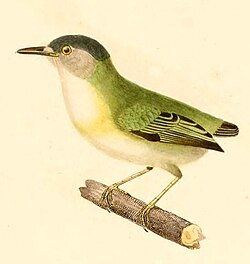
Physical Description
Measuring between 6 and 7 cm (2.4 to 2.8 in) and weighing roughly 4.2 g (0.15 oz), this bird is remarkably small. Both males and females share the same plumage. The nominate subspecies features a dark gray head with blackish lores (the area between the eye and the bill), a white eye-ring, and a prominent white spot above the lores, giving the bird a spectacled appearance.
Their upperparts—including the back, rump, and uppertail coverts—are a bright olive green. The wings are dusky with olive edges, forming two faint wing bars. A defining characteristic is the extremely short, mostly black tail. Their underparts are white with a pale yellow tinge on the crissum (the area between the cloaca and the tail). They possess a black bill that is unusually long for their size, pinkish legs, and a brown to dark iris.
The subspecies M. e. miserabilis differs slightly, exhibiting a duller green back, a darker gray crown and nape, and darker legs. While it resembles the larger slate-headed tody-flycatcher (Poecilotriccus sylvia), observers note that in flight, it is more likely to be mistaken for a large beetle or insect than another bird.
Distribution and Habitat
While primarily associated with the Amazon Basin, the short-tailed pygmy tyrant is widespread. The nominate subspecies inhabits Trinidad, northern Brazil, the Guianas, southern Venezuela, and southeastern Colombia. The subspecies M. e. miserabilis is found in eastern Peru, eastern Ecuador, northern and eastern Bolivia, and Brazil south of the Amazon.
These birds prefer the interior, edges, and gaps of humid forests, as well as secondary and transitional forests in lowlands and Andean foothills. Their elevation range varies by country:
- Colombia: Below 500 m (1,600 ft)
- Ecuador: Below 400 m (1,300 ft)
- Peru: Below 1,000 m (3,300 ft)
- Brazil: Below 950 m (3,100 ft)
- Venezuela: Below 500 m north of the Orinoco River and below 900 m south of it.
Behavior and Ecology
Movement and Feeding
The short-tailed pygmy tyrant is a year-round resident in its range. It feeds exclusively on insects, typically foraging alone or in pairs. While it occasionally joins mixed-species feeding flocks, it mostly stays in the forest canopy, moving lower only at the edges or in gaps. It captures prey using short upward sallies from a perch or by briefly hovering to glean insects from leaves.
Breeding and Nesting
Breeding seasons vary by region: February to May in Colombia, June to September in Brazil, and August to October in Peru. The nest is a sophisticated domed bag with a side entrance and a small "awning," constructed from moss, grass, dry leaves, and rootlets, then lined with down or soft plant fibers. These nests often feature a "beard" of loose material hanging from the bottom and are typically suspended from branches 1 to 8 m above the ground.
The clutch consists of two white eggs with brownish or cinnamon spots. While the female is believed to be the sole incubator, both parents share the responsibility of provisioning the nestlings.
Vocalization
The calls of the short-tailed pygmy tyrant are often compared to the sounds of frogs or insects. Common vocalizations include a soft, purr-like trill that can accelerate into a series of squeaky "creek" notes. Other described sounds include high, rising "treet" or "peet" notes.
Conservation Status
The IUCN classifies the short-tailed pygmy tyrant as Least Concern. Although its population size is unknown and believed to be decreasing, it maintains an extremely large range and occurs in numerous national parks and protected areas. It is considered fairly common in Colombia and Venezuela, though it is often overlooked due to its size.
| Feature | Details |
|---|---|
| Scientific Name | Myiornis ecaudatus |
| Length | 6–7 cm (2.4–2.8 in) |
| Weight | ~4.2 g (0.15 oz) |
| Primary Habitat | Humid forest canopy and edges |
| Diet | Insects |
| Conservation Status | Least Concern (IUCN 3.1) |
Frequently Asked Questions
What makes the short-tailed pygmy tyrant unique?
It is the smallest passerine (perching bird) on Earth, often mistaken for a large insect or beetle when flying.
Where can the short-tailed pygmy tyrant be found?
It is found in Trinidad and most mainland South American countries, except for Argentina, Chile, Paraguay, and Uruguay, primarily within the Amazon Basin.
What does the nest of a short-tailed pygmy tyrant look like?
The nest is a domed bag made of moss, grass, and leaves with a side entrance and a small awning, often featuring a "beard" of loose material hanging from the underside.
How does the bird hunt for food?
It feeds on insects by performing short upward sallies from a perch to grab prey from leaves or by briefly hovering while gleaning.
Is the short-tailed pygmy tyrant endangered?
No, it is listed as Least Concern by the IUCN due to its extremely large range, although its population is believed to be decreasing.