Cerebrum: Structure, Function, and Evolutionary Development
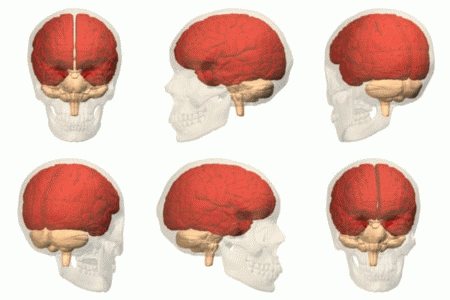
The cerebrum, also known as the telencephalon or endbrain, is the largest and most highly developed part of the human brain. Positioned as the uppermost region of the central nervous system, it serves as the primary hub for complex cognitive processes, sensory integration, and the execution of voluntary movements. From the regulation of emotions and personality to the intricate processing of vision and hearing, the cerebrum is fundamental to the human experience.
In humans, the cerebrum is divided into two approximately symmetric halves called cerebral hemispheres, separated by a deep groove known as the longitudinal fissure. While these hemispheres share a similar structure, they often exhibit lateralization, meaning certain functions are more dominant in one side than the other.
Key Facts
- Largest Brain Division: The cerebrum is the most substantial part of the brain in humans and other mammals.
- Contralateral Control: The right hemisphere predominantly processes signals from the left side of the body, and vice versa.
- Cortical Folding: In larger mammals, the surface folds into gyri (ridges) and sulci (furrows) to increase surface area.
- Prenatal Origin: It develops from the prosencephalon (forebrain) during embryonic growth.
- Core Components: Includes the cerebral cortex, hippocampus, basal ganglia, and olfactory bulb.
Anatomical Structure
The cerebrum consists of an outer layer of grey matter called the cerebral cortex and underlying regions of white matter. Beneath the cortex lie critical subcortical structures, including the basal ganglia, the hippocampus, and the olfactory bulb.
The Cerebral Cortex and Lobes
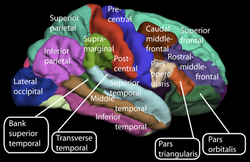
The cerebral cortex is unique to mammals. To maximize the number of neurons within the limited space of the skull, the cortex in humans is heavily folded. This surface is divided into four primary lobes based on the overlying skull bones:
- Frontal Lobe: Associated with motor function, personality, and higher-level decision making.
- Parietal Lobe: Responsible for processing somatosensory information like touch and spatial awareness.
- Occipital Lobe: The primary center for visual processing.
- Temporal Lobe: Essential for hearing, language comprehension, and memory.
Additionally, the insular lobe is located deep within the lateral sulcus, tucked away from the surface of the other four lobes.
Cerebral Hemispheres
The division of the cerebrum into left and right hemispheres allows for a specialized organization. This contralateral arrangement—where the opposite side of the brain controls the opposite side of the body—is believed to result from an axial twist occurring during early embryonic development.
Functional Capabilities
The cerebrum acts as the central processor for the body's most complex activities. Working in tandem with the cerebellum, it manages all voluntary actions and serves as the seat of judgment, thought, and memory.
Motor and Sensory Processing
Voluntary movement is initiated by upper motor neurons in the primary motor cortex (frontal lobe), which send signals through the brainstem and spinal cord to the muscles. When these neurons are damaged, it can lead to spasticity, muscle weakness, and hyperreflexia.
Sensory information is integrated across specific regions to create a cohesive perception of the environment:
- Visual: The occipital lobe's V1 area detects basic edges and colors, while V2–V5 areas recognize faces and objects.
- Auditory: The upper temporal lobe processes pitch and loudness, evolving into the comprehension of speech and music.
- Somatosensory: The parietal lobe maps touch, temperature, and pain, providing a spatial map of the body.
- Gustatory: Taste is processed in the insula and frontal areas before being combined into flavors in the orbitofrontal cortex.
Olfaction, Language, and Memory
The olfactory bulb handles the sense of smell. Unlike other senses, olfactory neurons send axons directly to the olfactory cortex without first passing through the thalamus. This sense is processed ipsilaterally (on the same side of the brain), though interhemispheric connections allow for bilateral integration.
Language is managed by two key regions: Broca's area (frontal lobe) for speech production and Wernicke's area (temporal-parietal junction) for comprehension. These are linked by a white matter tract called the arcuate fasciculus.
Memory is categorized by duration and type:
- Working Memory: Short-term information used for problem-solving, managed by the prefrontal cortex and hippocampus.
- Intermediate Memory: Lasts from minutes to weeks, involving chemical and physical changes at the synapse.
- Long-term Memory: Involves structural changes, such as increased synaptic vesicles and altered postsynaptic spines.
- Procedural Memory: Implicit memories of motor behaviors, which involve the basal ganglia.
Evolutionary Development
The cerebrum evolves from the prosencephalon (forebrain) in vertebrate embryos. This further divides into the diencephalon (which becomes the thalamus and hypothalamus) and the telencephalon.
| Group | Cerebral Characteristics | Key Features |
|---|---|---|
| Reptiles | Three-layered cortex | Paleopallium is larger than in amphibians. |
| Birds/Fish | Unlayered dorsal telencephalon | Lacks a true layered cytoarchitecture (cortex). |
| Mammals | Layered cerebral cortex | Cortex covers most of the hemispheres; presence of gyri/sulci in higher species. |
| Placental Mammals | Advanced connectivity | Development of the corpus callosum to connect hemispheres. |
In mammals, the dorsal telencephalon (pallium) becomes the cerebral cortex, while the ventral telencephalon (subpallium) becomes the basal ganglia. In highly evolved mammals like dolphins and humans, the cerebrum represents a significant portion of total body weight.
Frequently Asked Questions
What is the difference between the cerebrum and the cerebellum?
The cerebrum is the largest part of the brain and handles high-level functions like thought, emotion, and voluntary movement. The cerebellum is a separate structure that assists the cerebrum in coordinating those movements and maintaining balance.
What happens if Broca's area is damaged?
Damage to Broca's area results in expressive aphasia, also known as non-fluent aphasia, where a person struggles to produce speech even if they understand what is being said.
How does the brain distinguish between short-term and long-term memory?
Short-term memory relies on continuous neural activity in reverberating circuits. Long-term memory requires physical structural changes, such as an increase in the number of synaptic terminals and changes in the shape of postsynaptic spines.
Why is the cerebrum divided into two hemispheres?
The division is a result of embryonic development. This structure allows for contralateral organization, where the right hemisphere processes the left side of the body and the left hemisphere processes the right side.
What are gyri and sulci?
Gyri are the ridges or bumps on the surface of the cerebral cortex, and sulci are the furrows or grooves between them. These folds increase the surface area of the grey matter, allowing for more neurons to fit within the skull.