Cenozoic Era: The Rise of Mammals and Modern Earth
The Cenozoic Era, spanning from 66 million years ago to the present day, represents the most recent chapter of Earth's history. Often referred to as the "Age of Mammals," this era witnessed the transformation of the planet from a world recovering from a mass extinction into the diverse, biologically complex environment we inhabit today. Because the rock deposits from this era are relatively young and well-preserved, it is the most detailed period in the geologic record.
The term "Cenozoic" is derived from the Ancient Greek words kainós ('new') and zōḗ ('life'). It was first proposed in 1840 by British geologist John Phillips. This era is defined by the rapid diversification of mammals, the evolution of flowering plants, and dramatic shifts in global climate and tectonics.
Key Facts
- Time Span: 66.0 million years ago to 0 Ma (present).
- Nickname: The Age of Mammals.
- Major Divisions: Three periods (Paleogene, Neogene, Quaternary) and seven epochs.
- Defining Event: Began after the extinction of non-avian dinosaurs.
- Climate Trend: A general transition from a hot, humid "greenhouse" world to a cooler "icehouse" world.
- Human History: All recorded human history occurs within the Holocene epoch.
The Paleogene Period (66 – 23.03 Ma)
The Paleogene marks the dawn of the Cenozoic, beginning with the extinction of non-avian dinosaurs. This period is divided into the Paleocene, Eocene, and Oligocene epochs.
The Paleocene and Eocene
During the Early Eocene (56 to 33.9 Ma), Earth was exceptionally warm, with temperatures around 30 degrees Celsius and minimal difference between the poles and the equator. Carbon dioxide levels reached approximately 1,400 ppm. Dense forests dominated the landscape, hosting early primates, whales, and horses. At the top of the food chain were massive birds like Paracrax.
By the Mid-Eocene, the formation of the Antarctic Circumpolar Current between Australia and Antarctica disrupted global ocean currents, triggering a cooling effect that shrank the jungles. This environmental shift allowed mammals to reach massive sizes; whales became almost fully aquatic, and predators like Andrewsarchus dominated. The Late Eocene saw the return of seasons and the evolution of grasses, leading to the expansion of savannas.
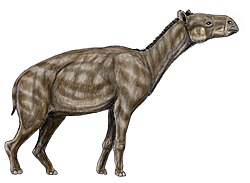
The Oligocene
Spanning from 33.9 to 23.03 million years ago, the Oligocene was characterized by further cooling and seasonal rains. The expansion of grasslands drove the evolution of many modern animal families, including the first cats, dogs, elephants, and marsupials.
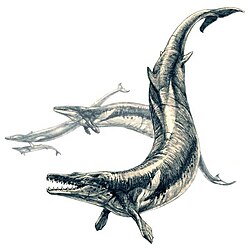
The Neogene Period (23.03 – 2.58 Ma)
The Neogene consists of the Miocene and Pliocene epochs, a time of increasing aridity and the refinement of modern ecosystems.
The Miocene Epoch
From 23.03 to 5.333 million years ago, grasses continued to spread, replacing many forests. In the oceans, the evolution of kelp forests supported new species such as sea otters. This era saw a boom in Perissodactyla (odd-toed ungulates) and the evolution of 30 different ape species. Geologically, the Tethys Sea closed as the Arabian Peninsula formed, leaving behind the Mediterranean, Red, Black, and Caspian Seas.
The Pliocene Epoch
The Pliocene (5.333 to 2.58 Ma) was a time of dramatic climatic change. In Africa, Australopithecus evolved, marking the beginning of the human lineage. A pivotal event was the formation of the Isthmus of Panama, which connected North and South America, triggering the "Great American Interchange" as animals migrated between continents.
During this time, the Mediterranean Sea dried up for several million years due to ice-age sea level drops and high evaporation. The foundations of modern geography were laid, including the development of the Sahara Desert and Indian monsoons.
The Quaternary Period (2.58 Ma – Present)
The Quaternary is the most recent period, defined by cyclical glaciations and the rise of humanity.
The Pleistocene Epoch
Lasting from 2.58 million to 11,700 years ago, the Pleistocene was the era of the great ice ages. Ice caps advanced as far south as 40° N in mountainous regions. This period saw the evolution of megafauna—large animals such as mammoths, giant ground sloths, sabre-toothed cats, and dire wolves—as well as Homo sapiens.
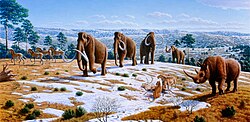
Toward the end of the Pleistocene, a major extinction event wiped out much of the world's megafauna and several hominid species, including Neanderthals.
The Holocene Epoch
The Holocene began 11,700 years ago and continues today. It encompasses all of recorded human history. However, human activity has triggered a mass extinction event beginning roughly 10,000 years ago, often called the "Sixth Extinction." Since the Industrial Revolution, over 322 species have been recorded as extinct, with some estimates suggesting up to 500 vertebrate species have vanished.
Tectonics and Climate Evolution
The Cenozoic climate transitioned from a hot, humid state to a cold one. Early in the Paleocene, the world remained warm, peaking during the Paleocene–Eocene Thermal Maximum (55.5 Ma). Long-term cooling began around 50 million years ago, largely driven by the collision of India with Eurasia. This created the Himalayas; the resulting erosion of upraised rocks reacted with atmospheric CO2, reducing the greenhouse effect.
Permanent ice formed on Antarctica around 35 million years ago. Later, the closure of the Isthmus of Panama around 2.8 million years ago strengthened the Gulf Stream and Humboldt currents, cooling the Arctic and leading to the Quaternary glaciations.
| Period | Epoch | Time Span (Ma) | Key Characteristics |
|---|---|---|---|
| Paleogene | Paleocene | 66.0 – 56.0 | Recovery from K-Pg extinction; early mammals. |
| Eocene | 56.0 – 33.9 | Global warmth; early whales and primates. | |
| Oligocene | 33.9 – 23.03 | Grassland expansion; first cats and dogs. | |
| Neogene | Miocene | 23.03 – 5.333 | Ape diversification; Tethys Sea closes. |
| Pliocene | 5.333 – 2.58 | Human lineage begins; Isthmus of Panama forms. | |
| Quaternary | Pleistocene | 2.58 – 0.0117 | Ice ages; megafauna; evolution of Homo sapiens. |
| Holocene | 0.0117 – Present | Recorded human history; Sixth Extinction. |
Frequently Asked Questions
Why is the Cenozoic called the Age of Mammals?
It is called the Age of Mammals because, following the extinction of non-avian dinosaurs, mammals underwent rapid diversification and evolution, filling vacant ecological niches and eventually becoming the dominant land animals.
What caused the global cooling trend in the Cenozoic?
The cooling was driven by several factors, including the collision of India and Eurasia (which created the Himalayas and reduced atmospheric CO2) and the formation of the Antarctic Circumpolar Current, which isolated Antarctica and led to permanent ice sheets.
What was the "Great American Interchange"?
This was a massive migration event that occurred when the Isthmus of Panama formed, creating a land bridge between North and South America. This allowed animals from both continents to migrate, significantly altering local ecologies.
What is the "Sixth Extinction"?
The Sixth Extinction refers to the current mass extinction event caused by human activity. It is characterized by a high rate of species loss, particularly since the Industrial Revolution, affecting hundreds of vertebrate species.
How does the Holocene differ from the Pleistocene?
The Pleistocene was marked by repeated glacial cycles (ice ages) and the presence of megafauna. The Holocene is the current, warmer interglacial period that has allowed for the development of human civilization.