degree Celsiustemperature scaleAnders CelsiuscentigradeKelvin conversion

Celsius Temperature Scale: History, Conversions, and Scientific Standards

Celsius Temperature Scale: History, Conversions, and Scientific Standards The degree Celsius (°C) is a fundamental unit of temperature used globally in science, engineering, and daily lif...

Celsius Temperature Scale: History, Conversions, and Scientific Standards

The degree Celsius (°C) is a fundamental unit of temperature used globally in science, engineering, and daily life. As one of the two temperature scales used in the International System of Units (SI), it provides a standardized way to measure thermal energy. While most of the world relies on this scale for weather reports and cooking, it remains closely linked to the Kelvin scale, the SI base unit for thermodynamic temperature.

Whether you are calculating the boiling point of water or converting temperatures for a scientific experiment, understanding the nuances of the Celsius scale—from its historical origins to its modern definition—is essential.
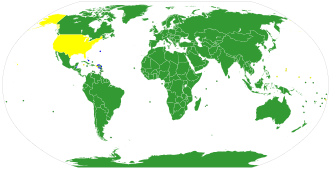
Countries by usage Celsius (°C) Celsius (°C) and Fahrenheit (°F) Fahrenheit (°F)

Key Facts

  • Symbol: °C
  • Named after: Swedish astronomer Anders Celsius.
  • System: Part of the International System of Units (SI).
  • Relationship to Kelvin: A change of 1 °C is equal to a change of 1 K.
  • Absolute Zero: Defined as exactly −273.15 °C.
  • Global Usage: Used by most countries, except the United States, Liberia, and some island territories.

The Evolution of the Celsius Scale

The history of the Celsius scale is a fascinating journey of scientific refinement. In 1742, Anders Celsius proposed a temperature scale that was actually the reverse of what we use today: he set 0 as the boiling point of water and 100 as the freezing point.

Anders Celsius's original thermometer used a reversed scale, with 100 as the freezing point and 0 as the boiling point of water.

Following his death in 1744, several scientists contributed to the inversion of the scale to its modern orientation. The French physicist Jean-Pierre Christin is often credited with inverting the scale so that 0 represented the freezing point and 100 represented the boiling point. Later, the Swedish botanist Carl Linnaeus also adopted this reversed version for his greenhouse thermometers.

From Centigrade to Celsius

For many years, the scale was commonly referred to as centigrade, derived from the Latin words for "one hundred steps." However, in 1948, the International Committee for Weights and Measures renamed it to honor Anders Celsius and to avoid confusion with the term for one hundredth of a gradian used in certain languages.

Scientific Definitions and Precision

The way we define the Celsius scale has changed as measurement technology has advanced. Historically, the scale was anchored to the freezing and boiling points of water at 1 atmosphere of pressure. However, modern metrology has moved toward more stable physical constants.

Between 1954 and 2019, the scale was defined using the triple point of water (the unique temperature and pressure where water exists as a solid, liquid, and gas simultaneously). Since 2019, the definition has been completely decoupled from the properties of water, instead relying on the Boltzmann constant to define the Kelvin, which in turn defines the Celsius scale.
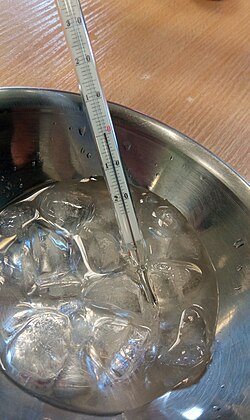
Measurement of an ice-water mixture in equilibrium at 370 m above sea level. Thermometer shows 0.05 °C. The slight deviation from 0 °C is due to instrument uncertainty and trace water impurities.

Because of these high-precision definitions, the actual melting point of ice is slightly below 0 °C, and the boiling point of water can vary based on atmospheric pressure. For example, at an altitude of approximately 370 meters above sea level, the boiling point may be measured at roughly 99.7 °C due to lower atmospheric pressure.
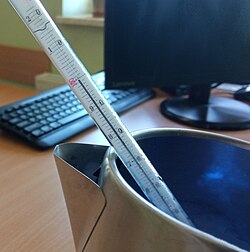
Boiling point of water measured at an altitude of ~370 m a.s.l. The 99.7 °C result reflects lower atmospheric pressure (~970 hPa), combined with minor instrument uncertainty and trace water impurities.

Temperature Conversions

In scientific and technical contexts, it is often necessary to convert Celsius to other scales such as Kelvin (K) or Fahrenheit (°F). Because the magnitude of one degree Celsius is identical to one Kelvin, the conversion between them is a simple matter of shifting the zero point.

Common Temperature Conversions and Equivalents
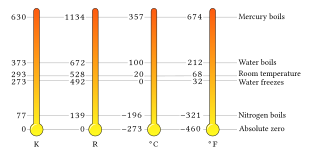
Condition Celsius (°C) Kelvin (K) Fahrenheit (°F) Rankine (°R)
Absolute Zero −273.15 0 −459.67 0
Melting Point of Ice 0 273.15 32 491.67
Common Room Temperature 20 293 68 528
Average Human Body Temp 37 310.15 98.6 558.27
Boiling Point of Water ~100 ~373.15 212 671.64
Equivalent temperatures in kelvin (K), Rankine (R), Celsius (°C), and Fahrenheit (°F)

Frequently Asked Questions

How do I convert Celsius to Fahrenheit?

To convert Celsius to Fahrenheit, use the formula: °F = (°C × 9/5) + 32.

What is the difference between Celsius and Centigrade?

They refer to the same temperature scale. "Centigrade" was the older name, but it was officially changed to "Celsius" in 1948 to honor the scale's namesake.

Is the Celsius scale used in the United States?

No, the United States primarily uses the Fahrenheit scale for daily temperature measurements, though Celsius is used in scientific and technical fields.

Why does the boiling point of water change?

The boiling point of water is dependent on atmospheric pressure. At higher altitudes where pressure is lower, water boils at a temperature below 100 °C.

Can Celsius be used to measure temperature intervals?

Yes, the degree Celsius can express both a specific temperature and a temperature interval (the difference between two temperatures). However, in scientific literature, context must be clear to distinguish between a point and an interval.

References

  1. Exact value, by SI definition of the kelvin
  2. NIST common reference temperature, provided as round numbers
  3. According to The Oxford English Dictionary (OED), the term "Celsius thermometer" had been used at least as early as 1797. Further, the term "The Celsius or Centigrade thermometer" was again used in reference to a particular type of thermometer at least as early as 1850. The OED also cites this 1928 reporting of a temperature: "My altitude was about 5,800 metres, the temperature was 28° Celsius." However, dictionaries seek to find the earliest use of a word or term and are not a useful resource as regards the terminology used throughout the history of science. According to several writings of Terry Quinn, Director of the BIPM (1988–2004), including "Temperature Scales from the early days of thermometry to the 21st century" (PDF). Archived from the original (PDF) on 26 December 2010. Retrieved 31 May 2016. (146 KiB) as well as Temperature (2nd Edition/1990/Academic Press/0125696817), the term Celsius in connection with the centigrade scale was not used whatsoever by the scientific or thermometry communities until after the CIPM and CGPM adopted the term in 1948. The BIPM was not even aware that "degree Celsius" was in sporadic, non-scientific use before that time. It is also noteworthy that the twelve-volume, 1933 edition of OED didn't even have a listing for the word Celsius (but did have listings for both centigrade and centesimal in the context of temperature measurement). The 1948 adoption of Celsius accomplished three objectives: All common temperature scales would have their units named after someone closely associated with them; namely, Kelvin, Celsius, Fahrenheit, Réaumur and Rankine.
  4. For Vienna Standard Mean Ocean Water at one standard atmosphere (101.325 kPa) when calibrated solely per the two-point definition of thermodynamic temperature. Older definitions of the Celsius temperature scale once defined the boiling point of water under one standard atmosphere as being precisely 100 °C. However, the current definition results in a boiling point that is actually 16.1 mK less. For more about the actual boiling point of water, see VSMOW in temperature measurement. A different approximation uses ITS-90, which approximates the temperature to 99.974 °C
  5. In 1948, Resolution 7 of the 9th CGPM stated, "To indicate a temperature interval or difference, rather than a temperature, the word 'degree' in full, or the abbreviation 'deg' must be used." This resolution was abrogated in 1967/1968 by Resolution 3 of the 13th CGPM, which stated that ["The names "degree Kelvin" and "degree", the symbols "°K" and "deg" and the rules for their use given in Resolution 7 of the 9th CGPM (1948),] ...and the designation of the unit to express an interval or a difference of temperatures are abrogated, but the usages which derive from these decisions remain permissible for the time being." Consequently, there is now wide freedom in usage regarding how to indicate a temperature interval. The most important thing is that one's intention must be clear and the basic rule of the SI must be followed; namely that the unit name or its symbol must not be relied upon to indicate the nature of the quantity. Thus, if a temperature interval is, say, 10 K or 10 °C (which may be written 10 kelvins or 10 degrees Celsius), it must be unambiguous through obvious context or explicit statement that the quantity is an interval. Rules governing the expressing of temperatures and intervals are covered in the BIPM's "SI Brochure, 8th edition" (PDF). (1.39 MiB).