Cazenovia College: A History of Education and Evolution
From its humble beginnings in the early 19th century to its final days as a modern institution of higher learning, Cazenovia College played a significant role in the educational landscape of New York. Founded on principles of accessibility and faith, the institution evolved through various identities, serving as a seminary, a preparatory school, and eventually a degree-granting college.
The Early Years: Genesee Seminary
Established in 1824, the institution began as the Genesee Seminary. It held the distinction of being the second Methodist seminary founded in the United States. While sponsored by the Methodist Church, it operated as a non-sectarian institution, meaning it was open to students regardless of their specific religious affiliation. Initially, the seminary operated out of the old Madison County Courthouse.
The seminary was the result of the efforts of George Peck and several other influential local clergymen. From its inception, the school was co-educational, welcoming both men and women. In 1839, the institution expanded its offerings by introducing a three-year course specifically designed for the education of women.
The seminary also emphasized global outreach through its missionary course. A notable milestone occurred in 1843 when Sophronia Farrington, a member of the class of 1828, became the first female missionary to Africa. This mission was conducted under the Young Men's Missionary Society of Boston and marked the earliest foreign mission established by the Methodist Episcopal Church.
Evolution of Identity and Governance
Over the decades, the institution underwent several name changes reflecting its shifting focus and regional associations. It was known variously as the Oneida and Genesee Conference Seminary, the Oneida Conference Seminary, and the Central New York Conference Seminary. Although the name Cazenovia Seminary was used informally from the start, it was not officially adopted until 1894.
Between 1904 and 1931, the institution served as a secondary school for local youth, a role that concluded following the construction of Cazenovia Central High School.
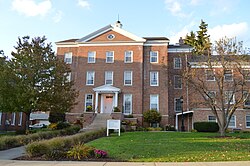
Transition to a College
A major shift occurred in 1942 when church sponsorship was withdrawn. The institution reorganized as Cazenovia Junior College, combining a preparatory school with a junior college program. By 1961, it transitioned into the Cazenovia College for Women. However, the school returned to its co-educational roots in 1982, adopting the final name of Cazenovia College.
The institution continued to grow its academic credentials, gaining recognition as a bachelor's degree-granting institution in 1988. Its final academic expansion took place in 2019 with the launch of its first graduate program: a Master of Science in Clinical Mental Health Counseling.
Key Facts
- Founded: 1824 as Genesee Seminary.
- First Female Missionary: Sophronia Farrington (1843) to Africa.
- Co-educational Status: Co-educational from foundation, briefly a women's college (1961–1982).
- Degree Status: Bachelor's degree-granting since 1988.
- Final President: David Bergh.
- Closure Date: June 30, 2023.
The Final Chapter and Legacy
The college's tenure came to an end due to severe financial instability. In September 2022, the college defaulted on a $25 million bond payment to the Madison County Capital Resource Corporation after failing to refinance its debt. On December 7, 2022, the administration announced the permanent closure of the school.
The final commencement ceremony was held on May 13, 2023, followed by a final term of online summer classes that concluded on June 25, 2023. The college officially closed its doors on June 30, 2023. Following the closure, A&G Real Estate Partners put the campus up for sale in April 2023.
Today, the college's academic records are maintained by Le Moyne College. The physical campus has found a temporary new purpose; in the fall of 2023, the New York State Police began utilizing the site as a state police training academy, a temporary arrangement scheduled to last until August 2025.
| Year/Period | Institutional Name/Status | Key Milestone |
|---|---|---|
| 1824 | Genesee Seminary | Founded as the 2nd Methodist seminary in the US |
| 1843 | Genesee Seminary | First female missionary (Sophronia Farrington) sent to Africa |
| 1904–1931 | Secondary School | Served as a local preparatory school |
| 1942 | Cazenovia Junior College | Church sponsorship withdrawn; junior college added |
| 1961 | Cazenovia College for Women | Transitioned to a women's institution |
| 1982 | Cazenovia College | Returned to co-educational status |
| 1988 | Cazenovia College | Authorized to grant bachelor's degrees |
| 2019 | Cazenovia College | Launched first graduate program (MS in Counseling) |
| 2023 | Closed | Final closure on June 30 following financial default |
Frequently Asked Questions
Why did Cazenovia College close?
The college closed primarily due to poor finances, specifically after defaulting on a $25 million bond payment to the Madison County Capital Resource Corporation in September 2022.
Who maintains the academic records of former students?
The records of Cazenovia College are currently maintained by nearby Le Moyne College.
Was Cazenovia College always co-educational?
It was co-educational from its foundation in 1824, but it operated as the Cazenovia College for Women between 1961 and 1982 before returning to a co-educational model.
What is the current use of the Cazenovia College campus?
As of fall 2023, the New York State Police have been using the former campus as a temporary state police training academy, which is scheduled to close in August 2025.
What was the first graduate degree offered by the college?
In 2019, the college introduced its first graduate program, a Master of Science in Clinical Mental Health Counseling.