Carl Alexander Clerck and the Foundations of Arachnology
The scientific classification of animals relies on a precise system of naming, but few individuals contributed as fundamentally to the early days of this practice as Carl Alexander Clerck (1709–1765). A Swedish entomologist and arachnologist, Clerck provided the groundwork for how we identify and categorize spiders today, bridging the gap between amateur observation and formal zoological science.
Early Life and Academic Journey
Born into the petty nobility, Clerck entered the University of Uppsala in 1726. While he was a contemporary of the legendary Carl Linnaeus, there is no evidence that the two interacted during their university years. Due to limited financial resources, Clerck was forced to leave his studies prematurely to enter government service, eventually securing a position within the administration of the City of Stockholm.
Clerck's passion for natural history ignited later in life. The turning point occurred in 1739 when he attended a lecture by Linnaeus in Stockholm. This encounter sparked a lifelong dedication to the study of insects and arachnids, leading him to spend years collecting and categorizing specimens with meticulous detail.
The Legacy of Svenska Spindlar
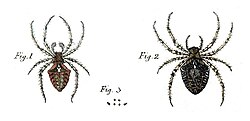
In 1757, Clerck published his seminal work, Svenska Spindlar (Swedish Spiders), also known by its Latin subtitle, Aranei Suecici. This publication was more than a simple list; it contained comprehensive observations on the morphology (the study of the form and structure of organisms) and behavior of various spider species.

Beyond his work with spiders, Clerck began publishing Icones insectorum rariorum, a series of highly detailed plates illustrating rare butterfly species. These plates were left uncommented, and the project remained unfinished after the third fascicle in 1766, following Clerck's death.
The Priority of Binomial Nomenclature
The significance of Svenska Spindlar extends far beyond its descriptions. In the world of zoology, the binomial system—the practice of naming a species using two parts (genus and species)—is the gold standard. While Carl Linnaeus is often credited with this system, the International Code of Zoological Nomenclature officially recognizes the names proposed by Clerck in 1757 as available and valid.
Because Clerck's work predates Linnaeus's 1758 Systema Naturae, his spellings take priority in cases of doubt. For example, the genus name Araneus is used instead of Aranea. Consequently, the spiders in Clerck's 1757 work were the first animals in modern zoology to receive available scientific names under the Linnean system, with Araneus angulatus being the first species to achieve this status.
Professional Recognition and Honors
Over time, Clerck developed a close friendship and correspondence with Carl Linnaeus. Linnaeus held Clerck's meticulous work in high regard and used his influence to sponsor Clerck's entry into the scientific elite. As a result, Clerck was elected a member of the Royal Society of Sciences in Uppsala in 1756 and the Royal Swedish Academy of Sciences in 1764.
Today, Clerck's original collections are preserved and housed in the Swedish Museum of Natural History, serving as a permanent record of his contributions to science.
Key Facts
- Primary Work: Published Svenska Spindlar (1757), the first work to provide available binomial names for spiders.
- First Named Species: Araneus angulatus is recognized as the first species to obtain an available name in the binomial system.
- Nomenclature Priority: Under the International Code of Zoological Nomenclature, Clerck's 1757 names take priority over Linnaeus's 1758 names.
- Academic Honors: Member of the Royal Society of Sciences in Uppsala (1756) and the Royal Swedish Academy of Sciences (1764).
- Other Works: Authored Icones insectorum rariorum, a series of detailed butterfly illustrations.
| Category | Details |
|---|---|
| Lifespan | 1709 – July 22, 1765 |
| Major Publication | Svenska Spindlar (1757) |
| Scientific Focus | Arachnology and Entomology |
| Key Achievement | Established the first available binomial names for animals |
| Current Collection | Swedish Museum of Natural History |
Frequently Asked Questions
Why is Carl Alexander Clerck important to modern zoology?
Clerck is vital because his 1757 work, Svenska Spindlar, is recognized by the International Code of Zoological Nomenclature as the starting point for available binomial names for spiders, predating the general system established by Linnaeus in 1758.
What is the difference between Araneus and Aranea?
This is an example of nomenclature priority. Because Clerck used the spelling Araneus in 1757, it takes precedence over the spelling Aranea proposed by Linnaeus in 1758.
Did Clerck study under Carl Linnaeus?
While they were contemporaries at the University of Uppsala in the 1720s, it is unknown if they had any contact during that time. Clerck's primary influence from Linnaeus came later, following a lecture he attended in Stockholm in 1739.
What happened to the Icones insectorum rariorum?
This series of detailed plates illustrating butterflies remained unfinished. Only three fascicles were published before Clerck's death in 1765.
Which species was the first to be named in the binomial system?
The species Araneus angulatus is recognized as the first animal to obtain an available scientific name within the modern binomial system.