Caramel: The Science, History, and Art of Caramelization
Caramel is more than just a sweet treat; it is a versatile range of food ingredients created through the application of high heat to sugars. From the deep, bitter notes of a commercial colorant to the buttery richness of a chewy candy, caramel serves as a cornerstone of global confectionery. It is widely used as a flavoring for puddings, a decadent filling for bonbons, a topping for ice cream, and a distinct colorant in various beverages.
Key Facts
- Core Process: Caramelization occurs when sugars are heated slowly to approximately 170 °C (340 °F).
- Main Ingredient: Sugar is the primary component, often supplemented with cream, butter, or glucose.
- Salted Caramel: Popularized in Brittany, France, and later globally by high-end chefs and mass-market brands.
- Chemical Change: The process involves the removal of water, isomerization, and polymerization of sugars.
- Versatility: Used in everything from crème brûlée and flan to cola and vodka.
The Science of Caramelization
At its heart, caramelization is a chemical reaction. When sugar is heated, water is removed, leading to isomerization (the rearrangement of the molecule's structure) and polymerization (the bonding of molecules into larger chains). These reactions create high-molecular-weight compounds that produce the characteristic dark-brown color.
Simultaneously, fragmentation reactions create low-molecular-weight volatile compounds, which are responsible for the distinct aroma and flavor of caramel. To prevent the sugar from crystallizing—which would result in a grainy texture—modern commercial recipes often add glucose or invert sugar, typically making up 10% to 50% of the sugar mass.
Types of Caramel Preparations
Caramel Sauce
Caramel sauce is created by blending caramelized sugar with cream. Depending on the desired flavor profile, chefs may add butter, vanilla, liquors, or fruit purees. A specific variation known as clear caramel, consisting only of caramelized sugar and water, is used specifically for desserts like flan or crème caramel.
Caramel Candy
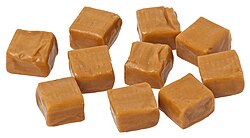
Often referred to as "caramels" or sometimes "toffee," this soft, chewy confection is made by boiling a mixture of sugar, glucose, butter, cream, and vanilla. The process typically involves heating sugar and glucose to 130 °C (270 °F) before adding cream and butter to cool the mixture, then reheating it to 120 °C (250 °F). Salt and vanilla are added at the very end to prevent the flavors from burning or causing the sugars to invert prematurely.
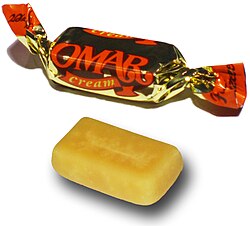
Alternatively, "milk caramel" or "cream caramel" is made by cooking all ingredients together, ensuring the temperature does not exceed 120 °C (250 °F). This allows the milk to caramelize, though the sugar itself does not reach the temperature required for full caramelization.
Caramel Colouring
In the commercial food industry, caramel coloring is a dark, bitter liquid produced through near-total caramelization. This highly concentrated product is used primarily as a coloring agent in beverages, most notably in cola.
The Evolution of Salted Caramel
The pairing of salt and caramelized sugar dates back to the 19th century in regional French cuisines, such as the kouign-amann from Brittany. By 1946, salted caramel sweets containing milk or butter were sold in Brittany, though their perishability limited their reach.
A turning point occurred in 1977 when pastry chef Henri Le Roux developed a stable salted butter caramel with crushed nuts (caramel au beurre salé) using Breton demi-sel butter. This creation was named the "Best confectionery in France" in 1980. The trend eventually moved from French school children's goûter (a 4 pm snack) to high-end Parisian patisseries via Pierre Hermé in the late 1990s, and finally into the mass market through brands like Starbucks and Häagen-Dazs in 2008.
Interestingly, a 2017 University of Florida study suggests that salted caramel's popularity may be linked to hedonic escalation. The complex flavor profile may trigger the brain to produce more endogenous opioids than other foods, encouraging continued consumption.
Caramel Summary Table
| Type | Primary Ingredients | Key Characteristic | Common Use |
|---|---|---|---|
| Caramel Sauce | Sugar, Cream, Butter | Liquid/Pourable | Ice cream topping |
| Caramel Candy | Sugar, Glucose, Milk/Cream | Soft and Chewy | Bonbons, Candy bars |
| Milk Caramel | Milk, Sugar (cooked together) | Milk-based caramelization | Traditional sweets |
| Caramel Colouring | Highly caramelized sugar | Dark, Bitter liquid | Cola, Beverages |
Frequently Asked Questions
What is the difference between caramel, toffee, and butterscotch?
While they share similar ingredients, the primary difference lies in the sugar used and the cooking temperature. Caramel uses white sugar, whereas toffee and butterscotch typically use brown sugar or molasses.
At what temperature does sugar caramelize?
The process of caramelization generally occurs when sugars are heated slowly to approximately 170 °C (340 °F).
Why is glucose added to commercial caramel?
Glucose (often from corn or wheat syrup) or invert sugar is added to prevent crystallization, ensuring the caramel remains smooth rather than grainy.
Why is salt added to caramel at the end of the cooking process?
Adding salt too early in the cooking process can cause the sugars to invert, which alters the final texture and consistency of the confection.
What is the etymology of the word "caramel"?
The word comes from the French caramel, borrowed from the Spanish caramelo. It likely originates from the Late Latin calamellus (sugar cane), derived from the Greek kálamos (reed/cane).