Cándido López: The Naïve Artist of the Paraguayan War
Cándido López was a remarkable Argentine soldier and painter whose life and work were defined by resilience and a unique artistic vision. Working in the Naïve style—a form of art characterized by a childlike simplicity and a lack of traditional academic training—López is most celebrated for his detailed documentation of the Paraguayan War, a conflict that shaped both his physical existence and his creative legacy.
Key Facts
- Born: August 29, 1840, in Buenos Aires, Argentina.
- Died: December 31, 1902, in Baradero, Argentina.
- Artistic Style: Naïve painting.
- Military Rank: Second Lieutenant in the San Nicolás Infantry.
- Defining Event: Lost his right arm during the Battle of Curupayty.
- Primary Subject: Historical scenes and military encampments of the Paraguayan War.
Early Life and Artistic Beginnings
López began his creative journey in 1858 as a daguerreotypist (an early photographer using silver-plated copper sheets). He studied under Carlos Descalzi, a local photographer and portrait painter. Because the daguerreotype process required meticulous planning, López began creating sketches to organize his compositions, which naturally led him to explore painting.
Between 1859 and 1863, he traveled extensively through the villages of Buenos Aires Province and southern Santa Fe Province, capturing the landscape through his lens. By 1860, he established a permanent studio in Mercedes, and by 1862, his reputation had grown enough to earn him a commission to paint a portrait of the newly elected President Bartolomé Mitre.
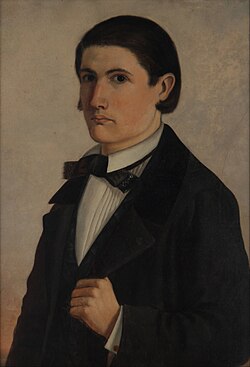
Seeking to refine his craft, López befriended the Italian muralist Ignacio Manzoni, who encouraged him to improve his use of perspective and color. Manzoni introduced him to Baldassare Verazzi, another Italian painter in Argentina, from whom López took formal lessons. However, his plans to study in Europe were interrupted by the outbreak of the Paraguayan War.
The Paraguayan War and Personal Tragedy
López enlisted in the army and was appointed Second Lieutenant due to his literacy. He served in the Division of General Wenceslao Paunero within the San Nicolás Infantry. During the intervals between battles, he spent his free time painting the landscapes and military camps he encountered, sending these works back to Buenos Aires where they became highly popular among a public eager for news from the front.
His military service was marked by participation in the battles of Boquerón and Estero Bellaco. However, tragedy struck at the Battle of Curupayty, where a grenade explosion shattered his right wrist. To prevent the spread of gangrene, his arm was amputated above the elbow. Retired as an invalid, López returned to San Nicolás after a period of convalescence in Corrientes.
Overcoming Adversity
Undeterred by his injury, López began the grueling process of learning to paint with his left hand. By 1869, he felt proficient enough to resume his career, dedicating himself entirely to depicting the military scenes he had witnessed. He spent his later years in San Antonio de Areco, Merlo, and Carmen de Areco, where he spent the years between 1888 and 1902 transforming his wartime sketches into finished masterpieces.
Artistic Style and Philosophy
López’s primary goal was to document the war, but he avoided the chauvinism and dramatic eloquence common in military art of the era. He sought a sense of neutrality, attempting to represent the conflict from a balanced perspective regarding the Triple Alliance (Argentina, Brazil, and Uruguay).
His work is noted for a curious lack of overt suffering or raw emotion. Instead, his paintings often resemble detailed "postcards." He frequently juxtaposed the tragedy of war with serene, neutral natural landscapes, allowing the viewer's eye to find rest amidst the chaos. Soldiers are often depicted as small, variegated shadows moving across the terrain.
Technical Characteristics
- Horizontal Format: He utilized an unusual 1:3 aspect ratio (e.g., 40 x 120 cm), allowing him to capture multiple simultaneous actions in great detail.
- Perspective: He evolved from a low, triangular perspective to a highly elevated point of view, which pushed the horizon further away and blurred the intensity of the war.
- Color Palette: He often used soft sunset colors to create a distance between the viewer and the drama of the scene.
| Category | Details |
|---|---|
| Primary Mediums | Daguerreotype, Sketching, Oil Painting |
| Key Works | Portrait of President Bartolomé Mitre, Attack of Brazilian ships on Curupayty |
| Artistic Focus | Military encampments, battle scenes, and Argentine landscapes |
| Legacy | Documented the Paraguayan War through a neutral, Naïve lens |
Frequently Asked Questions
What is the Naïve style of painting?
Naïve art is a style created by artists who lack formal academic training. It is characterized by a simplified perspective, bold colors, and a childlike or intuitive approach to composition.
How did the Paraguayan War affect Cándido López's art?
The war provided him with his primary subject matter and caused a major physical setback when he lost his right arm. This forced him to relearn how to paint with his left hand, eventually leading to his most famous historical works.
Why are López's war paintings described as "neutral"?
Unlike many military artists of his time, López avoided patriotic exaggeration or the depiction of extreme suffering. He focused on documenting the scenes as they were, often blending the violence of war with serene natural backgrounds.
What was unique about the format of his paintings?
López used an extremely horizontal format, typically in a one-to-three proportion. This allowed him to depict wide landscapes and multiple simultaneous events within a single frame.
Where is Cándido López buried?
He was given a military burial with full honors in the La Recoleta Cemetery in Buenos Aires.