Canaanean Blades: Ancient Stone Tools of the Levant
In the archaeological record of the ancient Near East, few artifacts illustrate the evolution of human utility as clearly as the Canaanean blade. These long, wide blades, crafted from stone or flint, are predominantly found across sites in modern-day Israel and Lebanon, the region once known as ancient Canaan.
From their origins as lethal weaponry to their later application in the birth of organized farming, these tools represent a significant leap in prehistoric craftsmanship and survival strategies.
Key Facts
- Material: Primarily manufactured from flint or stone.
- Geography: Found mostly in Israel and Lebanon (ancient Canaan).
- Timeline: Used from the Neolithic Stone Age through the Chalcolithic period.
- Primary Uses: Weapons (javelins, arrowheads) and agricultural tools (sickles, threshing).
Evolution of Use: From Warfare to Farming
The production of Canaanean blades began during the Neolithic period, the final stage of the Stone Age characterized by the development of polished stone tools. Initially, these blades were designed for combat and hunting, serving as the sharp edges for arrowheads and javelins.
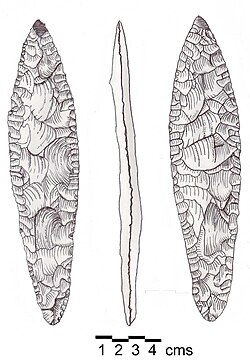
As human societies transitioned into the Chalcolithic period—a transitional era between the Stone Age and the Bronze Age—the technology was adapted for survival. The same flint-knapping techniques used for weapons were applied to create broad sickle blade elements, which were essential for harvesting crops.
The Role in Early Agriculture
Beyond harvesting, Canaanean blades played a critical role in the threshing of cereal grains. Threshing is the process of loosening the edible part of grain from the husks. The presence of these tools indicates the existence of early, sophisticated agricultural technologies in the Levant.
The Mechanics of Ancient Threshing
The application of these blades in agriculture required a specific assembly to be effective. To thresh grain, the blades were attached to a small wooden platform using bitumen, a naturally occurring sticky petroleum substance that acted as an adhesive.
Once the blades were secured, the platform was pulled across a threshing floor by an animal. To increase the efficiency of the cut, a human or another heavy weight would stand on the platform. The combination of the animal's forward momentum and the downward pressure exerted through the flint blades effectively cut the grain into small pieces.
| Period | Primary Function | Specific Tool Examples |
|---|---|---|
| Neolithic | Hunting and Warfare | Javelins, Arrowheads |
| Chalcolithic | Agriculture | Sickle blades, Threshing platforms |
Frequently Asked Questions
What exactly is a Canaanean blade?
A Canaanean blade is an archaeological term for a long, wide blade made of flint or stone, typically found in the regions of ancient Canaan (modern Israel and Lebanon).
When were these blades first used?
They were first manufactured and used during the Neolithic Stone Age, later continuing into the Chalcolithic period.
How were the blades attached to wooden tools?
The blades were secured to wooden platforms or handles using bitumen, which served as a strong, natural adhesive.
What does the use of these blades tell us about ancient society?
The transition of these tools from weapons to harvesting and threshing implements indicates the development and presence of early agricultural technologies.
Were they used for more than just farming?
Yes, before their agricultural application, they were primarily used as weapons, specifically as components for javelins and arrowheads.