Camille Chamoun Sports City Stadium
The Camille Chamoun Sports City Stadium (CCSC) is a premier multi-purpose venue located in the Bir Hassan area of Beirut, Lebanon. As the largest stadium in the country, it serves as a cornerstone of Lebanese athletics and is primarily utilized for high-profile football matches. With a seating capacity of 49,500, the facility is designed to host both national and international sporting events, blending athletic functionality with significant historical weight.
Key Facts
- Capacity: 49,500 seats.
- Location: Ziad Rahbani Avenue, Bir Hassan, Beirut.
- Primary Use: Football and athletics.
- Field Dimensions: 102 x 70 meters.
- Resilience: Engineered to withstand earthquakes up to 8.6 on the Richter scale.
- Ownership: Government of Lebanon.
A History of Resilience and Reconstruction
The stadium was originally established in 1957 under the presidency of Camille Chamoun and the Lebanese Ministry of Youth & Fine Arts. Its inaugural match was a friendly against Energia Ploiești, which Lebanon won 1–0 thanks to a goal by Joseph Abou Murad.
However, the stadium's history is marked by the volatility of the region. During the Israeli Invasion of 1982, the facility was completely demolished.
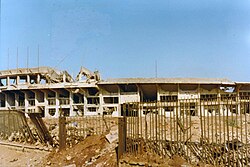
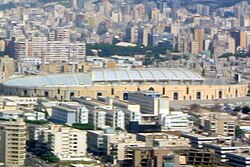
In preparation for the 2000 AFC Asian Cup, former Prime Minister Rafic Hariri initiated a massive reconstruction project. The rebuilding effort cost US$ 100 million (150 billion Lebanese Pounds), funded by the Lebanese government (US$ 75 million), Saudi Arabia (US$ 20 million), and Kuwait (US$ 5 million). The project was executed by the contracting company Kvarner, employing 25 British engineers, 115 Lebanese engineers, and 850 Lebanese and Arab workers. This phase also included the renovation of the adjacent Pierre Gemayel Hall.
Major Events and Milestones
Following its 1997 rebirth, the stadium became a symbol of national unity and peace. It has hosted several prestigious events, including:
- 1997 Pan Arab Games: An event emphasizing solidarity and the return of Lebanon to its heritage.
- 1999 Arab Athletics Championships: Serving as the primary venue.
- 2000 AFC Asian Cup: A major continental football tournament.
- 2009 Jeux de la Francophonie: Held from September 27 to October 3.
- 2017 Legends Match: A clash between Barcelona Legends and Real Madrid Legends, ending in a 3–2 victory for Barcelona.
Modern Challenges and Recent Developments
The stadium faced severe setbacks during the 2020 Beirut explosion, which caused significant damage and rendered the venue unavailable for the 2020–21 sporting season. In a temporary pivot to address national crises, the stadium was used as a storage facility for flour and wheat on October 26, 2020, after the city's primary wheat storage buildings collapsed.
Beyond sports, the venue has hosted significant national events, such as the funeral of Hassan Nasrallah on February 23, 2025, one of the largest funerals in Lebanese history.
In May 2025, Prime Minister Nawaf Salam visited the site to mark its partial reopening. This visit, occurring ahead of the Beirut derby between Nejmeh and Ansar, signaled the completion of the first phase of rehabilitation and the stadium's return to active use after years of neglect.
Architectural Structure and Facilities
Spanning 50,000 square meters, the stadium is a feat of modern engineering. A notable feature is the presidential gallery, which consists of 37 seats protected by bullet-proof glass.
The infrastructure beneath the stands is highly comprehensive, housing:
- Administration offices and a complex for the Lebanese Olympic Committee.
- Various sports federation offices and press centers.
- Emergency clinics for players and spectators.
- Dedicated parking for fire engines and ambulances.
| Feature | Detail |
|---|---|
| Capacity | 49,500 |
| Surface | Grass and Concrete |
| Field Size | 102 x 70 meters |
| Architect | Laceco Architects & Engineers |
| Reconstruction Cost | US$ 100 Million |
| Seismic Resistance | Up to 8.6 Richter scale |
Frequently Asked Questions
Who is the primary tenant of the stadium?
The Lebanon national football team has been the primary tenant from 1957 to 1982 and again from 1997 to the present.
How was the reconstruction of the stadium funded?
The US$ 100 million cost was covered by the Lebanese government (US$ 75 million), Saudi Arabia (US$ 20 million), and Kuwait (US$ 5 million).
What happened to the stadium after the 2020 Beirut explosion?
The stadium was severely damaged and temporarily used as a storage facility for wheat and flour to compensate for the collapse of Beirut's wheat storage buildings.
Is the stadium safe from natural disasters?
Yes, the structure is specifically engineered to absorb earthquakes measuring up to 8.6 on the Richter scale.
When did the stadium partially reopen for sports?
The stadium's partial reopening was marked by a visit from Prime Minister Nawaf Salam in May 2025, ahead of the Beirut derby.