Cameron Parish: History, Geography, and Resilience of Southwest Louisiana
Located in the southwest corner of Louisiana, Cameron Parish is a region of striking contrasts. While it holds the distinction of being the largest parish by area in the state, it maintains one of the smallest populations. Part of the Lake Charles metropolitan statistical area, this coastal region is defined by its deep ties to the Gulf of Mexico, a complex colonial history, and an enduring spirit of resilience in the face of nature's most powerful storms.
Key Facts
- Founded: 1870, named after Simon Cameron.
- Geography: Largest parish by area in Louisiana, with 34% of its territory consisting of water.
- Economy: Historically significant for offshore oil (Creole Field) and tourism centered on hunting and fishing.
- Population: 5,617 (2020 Census), with a projected estimate of 4,718 by 2025.
- Political Lean: Currently one of the most strongly Republican parishes in Louisiana.
A Legacy of Colonialism and Conflict
The history of Cameron Parish begins with the indigenous Atakapa and Choctaw peoples, who inhabited the land for thousands of years before French colonization began in the 17th and early 18th centuries. Following the Seven Years' War in 1763, the region became a sanctuary for French-speaking Acadian refugees. Families such as those of Joseph "Beausoleil" Broussard settled here after fleeing British expulsion in Acadia.
Control of the territory shifted between France and Spain before the United States acquired the region through the 1803 Louisiana Purchase. In the early 19th century, the area was characterized by a lawless frontier. A disputed zone known as "No Man's Land" existed between the Calcasieu and Sabine Rivers, serving as a haven for pirates, including the notorious Jean Lafitte, until the Adams-Onis Treaty of 1819 officially granted the land to the U.S.
During the American Civil War, the region saw conflict involving the Mermentau Jayhawkers—a band of deserters and outlaws who raided federal supply lines—and the Regulators, local vigilantes formed to protect families from these raids.
The Formation and Growth of the Parish
Cameron Parish was officially organized in 1870 during the Reconstruction era. It was created from portions of Calcasieu and Vermilion parishes by a Republican-dominated legislature to establish a new center of political strength. It was named in honor of Simon Cameron, the first Secretary of War under President Abraham Lincoln.
The 20th century brought a transformative economic shift in 1937 when the Pure Oil Company discovered the Creole Field. This was Louisiana's first offshore oil field, established on timber pilings just 1.2 miles from the shore, sparking a new era of industrial growth for the region.
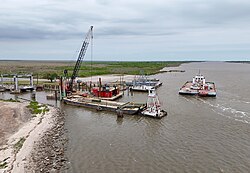
A History of Environmental Resilience
The geography of Cameron Parish makes it highly susceptible to tropical weather. The region's modern history is often categorized by the impact of four devastating hurricanes:
- Hurricane Audrey (1957): A defining event that caused over 390 deaths and divided local history into "before" and "after" the storm.
- Hurricane Rita (2005): Destroyed much of the parish, leaving few visual records of the area's prior state.
- Hurricane Ike (2008): Produced a massive 22-foot storm surge that flooded the coastline and decimated communities like Holly Beach, Hackberry, and Grand Chenier.
- Hurricane Laura and Delta (2020): Laura brought winds exceeding 150 mph, followed six weeks later by Hurricane Delta, a Category 2 storm.
These environmental disasters have had a profound impact on demographics. Between 2000 and 2010, the population dropped by nearly one-third due to the combined effects of Hurricanes Rita and Ike.
Geography and Demographics
Cameron Parish is a landscape dominated by marshes and coastal waters. It is the third-largest parish by land area and fourth-largest by total area in Louisiana. The region is bordered by Calcasieu, Jefferson Davis, and Vermilion parishes to the north and east, and Jefferson and Orange counties in Texas to the west.
The parish is home to several national protected areas, including the Cameron Prairie, East Cove, and Sabine National Wildlife Refuges, as well as part of the Lacassine National Wildlife Refuge. These areas support the local tourism industry, which focuses heavily on hunting and fishing.
| Category | Detail |
|---|---|
| Total Area | 1,937 sq mi |
| Land Area | 1,285 sq mi |
| Water Area | 652 sq mi (34%) |
| 2020 Population | 5,617 |
| Parish Seat | Cameron |
| Largest Community | Grand Lake |
Community and Education
There are no incorporated communities in the parish; instead, it consists of census-designated places like Cameron and Hackberry, and various unincorporated communities such as Creole and Grand Chenier. Education is managed by the Cameron Parish School Board, with Sowela Technical Community College providing higher education services. The Cameron Parish Public Library system operates six branches to serve the unincorporated areas.
Frequently Asked Questions
Why is Cameron Parish known for its small population despite its size?
While it is the largest parish by area in Louisiana, its population is the second-smallest in the state. This is due to its geography, which consists largely of marshes and coastal wetlands, and significant population declines following devastating hurricanes.
What is the significance of the Creole Field?
Discovered in 1937 by the Pure Oil Company, the Creole Field was the first offshore oil field discovered in Louisiana, marking a major milestone in the state's energy industry.
Who were the Acadians in Cameron Parish?
The Acadians were French-speaking refugees from Acadia (modern-day Canada) who settled in coastal Louisiana in the late 1700s after being expelled by the British. Their descendants continue to influence the culture and ancestry of the region.
How have hurricanes affected the population of the parish?
Hurricanes have caused significant population loss. Specifically, between 2000 and 2010, the population decreased by nearly one-third as a direct result of the destruction caused by Hurricanes Rita and Ike.
What is the political climate of Cameron Parish?
Historically Democratic, the parish has shifted sharply toward the Republican Party in the 21st century, driven by cultural issues and the local importance of the oil and gas industry.