Calvin Coolidge Memorial Bridge: History, Architecture, and Evolution
The Calvin Coolidge Memorial Bridge serves as a vital link in Hampshire County, connecting the college towns of Northampton and Amherst. More than just a transit point, the bridge is a striking example of early 20th-century engineering and Art Deco design, standing as a memorial to a former local resident who rose to the highest office in the United States.
Key Facts
- Design Style: Art Deco ornamentation with a five-span, single intersection Warren deck truss structure.
- Funding: Built under the Hayden Cartwright Act to provide jobs during the Great Depression.
- Memorial: Named for President Calvin Coolidge, a former mayor of Northampton.
- Historic Status: A contributing element of the Hadley Center Historic District.
- Recent Upgrades: A $32 million renovation in 2001 expanded the bridge to four lanes.
Architectural Design and Construction
The bridge was constructed as a replacement for a previous structure that was destroyed during the devastating flood of 1936. Its design was a collaborative effort between W & L Engineering Co., consultant Maurice A. Reidy, and architects Desmond & Lord, with the actual construction carried out by T. Stuart & Sons.
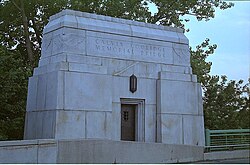
The bridge is characterized by its Warren deck truss—a design where the longitudinal members are arranged in triangles to efficiently support the load. The most visually striking features are the granite-faced abutment pylons, which measure 15 by 27 feet at the base. These pylons showcase classic Art Deco elements, including incised carved lettering and detailed carvings of eagles.
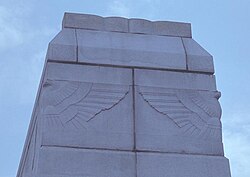
Further architectural details include bronze doors located on the northwest and southeast pylons, which provide access to small interior rooms. Additionally, bronze memorial plaques honoring President Calvin Coolidge are mounted on the northeast and southwest pylons.
Lighting and Railing Details
The bridge features a weathered green, welded steel Art Deco railing standing 3.5 feet high. This railing is positioned at the back of the north sidewalk and along the south parapet. Integrated into this railing are light standard posts that originally held low-pressure sodium lamp fixtures developed by General Electric in 1933.
These original lamps, based on European models, produced a monochromatic yellow-orange light. While innovative for the time, the color became unpopular with drivers, leading to their eventual replacement with modern cobra head luminaires that provide color-corrected lighting.
Modernization and Historic Preservation
By the turn of the millennium, the bridge required significant updates to handle modern traffic demands. In 2001, the Massachusetts Highway Department undertook a $32 million improvement project. This comprehensive overhaul included:
- Widening the roadway from three lanes to four (two lanes in each direction).
- Replacing the deteriorated bridge deck.
- Cleaning and restoring all granite facing.
- Refurbishing the historic Art Deco railings and light fixtures.
- Installing a new 5-foot sidewalk on the north side.
- Improving the approach roadways.
Regarding its historical significance, the Massachusetts Historical Commission determined in 2007 that while the bridge was not eligible for individual listing in the National Register of Historic Places, it was a contributing element to the Hadley Center Historic District, a status it has held since 1994.
Traffic and Geography
As the sole thoroughfare on Route 9 between Northampton and Amherst, the bridge has historically been a bottleneck for Hampshire County. To mitigate traffic congestion, a rotary was constructed on the Northampton side during the winter of 2018–19.
The bridge is accessed via Bridge St. when traveling eastbound from Northampton and Russell St. when traveling westbound from Hadley.
| Feature | Detail |
|---|---|
| Structure Type | Five-span Warren deck truss |
| Pylon Dimensions | 15 x 27 feet (at base) |
| Renovation Cost (2001) | $32 million |
| Current Lane Count | 4 lanes |
| Historic District | Hadley Center Historic District |
Frequently Asked Questions
Who was the bridge named after?
The bridge is a memorial to Calvin Coolidge (1872–1933), who served as the President of the United States and was previously the mayor of Northampton, a member of the State Senate, and the Governor of Massachusetts.
What architectural style is used on the bridge?
The bridge features Art Deco ornamentation, most notably on its granite-faced pylons, which include carved eagles and incised lettering.
Why was the bridge rebuilt in the 1930s?
The bridge was constructed to replace a previous structure that was destroyed during the flood of 1936.
What changes were made during the 2001 renovation?
The $32 million project widened the bridge to four lanes, replaced the deck, restored the granite facing and Art Deco railings, and added a 5-foot sidewalk on the north side.
How was the bridge funded?
Construction was funded under the Hayden Cartwright Act, a federal aid program created to provide employment opportunities during the Great Depression.