Callao: Peru's Historic Port and Constitutional Province
Perched on the edge of the Pacific Ocean, Callao is far more than just a gateway to Peru. As a seaside city and a unique constitutional province, it forms a vital part of the Lima metropolitan area. Known by the evocative nicknames "The Pearl of the Pacific" and "The First Harbour," Callao serves as the nation's primary maritime hub and the site of its busiest airport.
The city's identity is deeply tied to its autonomous status. Originally declared a Littoral Province of the Peru–Bolivian Confederation in 1836, it was later designated a Constitutional Province in 1857 by the government of Ramón Castilla. This distinct political status reflects Callao's historical importance as a center of trade, military defense, and law.
Key Facts
- Founded: March 6, 1537, by Diego Ruiz.
- Population: Approximately 1,226,200 (2025 estimate), ranking it 3rd in Peru.
- Status: A Constitutional Province with its own Regional Government.
- Key Infrastructure: Home to the Port of Callao and Jorge Chávez International Airport.
- Demonym: Residents are known as Chalacos.
- Geography: Total area of 147.85 km², including several offshore islands.
A Legacy of Maritime Power and Defense
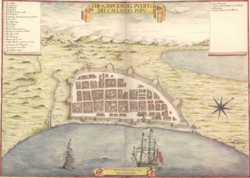
Callao's history began in 1535 when ships sold by Pedro de Alvarado to Francisco Pizarro and Diego de Almagro landed at the port. By 1537, Diego Ruiz established a tambo—an administrative supply structure—marking the early organized presence of the Spanish. As the primary port for the Viceroyalty of Peru, Callao became a strategic prize, making it a frequent target for pirates and privateers, including the English pirate Francis Drake in 1579 and the Dutchman Jacques l'Hermite in 1624.
To protect the city, the Spanish erected defensive walls between 1634 and 1647. These fortifications culminated in the construction of the Real Felipe Fortress, which began in 1747 and was completed in its first phase by 1773.
Natural Disasters and Resilience
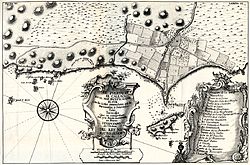
The city has faced immense challenges from nature. The most catastrophic event occurred on October 28, 1746, when a massive earthquake and subsequent tsunami decimated the population; of 5,000 residents, only 200 survived. In the aftermath, Viceroy José Manso de Velasco founded the city of Bellavista three kilometers inland to provide a safer alternative, though many residents chose to remain by the sea.
The Path to Independence
During the Peruvian War of Independence, Callao was a critical military objective. The Real Felipe Fortress changed hands multiple times, first captured by General José de San Martín in 1821. The Spanish presence finally ended in 1826 after a 13-month siege led by nationalist forces backed by Simón Bolívar.
Modern Development and Infrastructure
In the 19th century, Callao became a pioneer in South American infrastructure. Between 1850 and 1851, the Lima-Callao railway was established, followed by "El Urbanito," a smaller local transit system. The city also established Peru's first fire company, Unión Chalaca No. 1, in 1860.
Global Connectivity
Today, Callao is the heartbeat of Peruvian logistics. The Jorge Chávez International Airport is the country's main aviation hub. Recently expanded in 2025 with a new terminal, the airport now has the capacity to handle 40 million passengers annually, while the old terminal is being repurposed into a logistics center.
Geography and Subdivisions
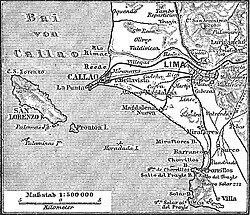
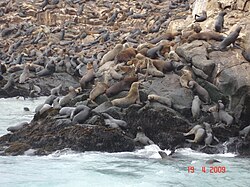
The province is divided into seven districts, with Ventanilla and downtown Callao being the most populous. Beyond the mainland, the region includes the islands of San Lorenzo, El Frontón, Cavinzas, and Palomino.
| District | Population | Area (km²) | Density (pers/km²) |
|---|---|---|---|
| Callao (downtown) | 415,888 | 45.65 | 9,147.60 |
| Bellavista | 75,163 | 4.56 | 16,483.11 |
| Carmen de la Legua Reynoso | 41,863 | 2.12 | 19,746.7 |
| La Perla | 61,698 | 2.75 | 22,435.64 |
| La Punta | 4,370 | 0.75 | 5,826.67 |
| Ventanilla | 277,895 | 73.52 | 3,779.86 |
| Mi Perú | 51,522 | 2.47 | 20,859.11 |
Social Challenges and Public Safety
Despite its economic importance, Callao faces significant security issues. It is recognized as one of the most dangerous areas in Peru, largely due to organized crime and its role as a major exit point for cocaine trafficking. This has led to periods of state emergency, such as the one declared between December 2015 and April 2016, to combat rising violence and homicide rates.
Frequently Asked Questions
What is the significance of Callao's "Constitutional Province" status?
This status grants Callao a level of autonomy equal to a department in Peru. It was first granted autonomy in 1836 and officially named a Constitutional Province in 1857, allowing it to be administered by its own regional government.
Who are the "Chalacos"?
Chalaco is the demonym used to describe people who are born or reside in the city and province of Callao.
What is the Real Felipe Fortress?
The Real Felipe Fortress is a historic military fortification built by the Spanish between 1747 and 1773 to defend the port from pirates and foreign invasions. It played a central role during the Peruvian War of Independence.
How has the Jorge Chávez International Airport changed recently?
The airport underwent a major expansion in 2025, including the construction of a new terminal that increased its capacity to 40 million passengers per year. The original terminal is being converted into a logistics center.
What happened during the 1746 earthquake?
A devastating earthquake and tsunami struck Callao on October 28, 1746, killing nearly the entire population; only 200 of the 5,000 residents survived the disaster.