C-295 Transport Aircraft: Global Operational History and Strategic Deployment
The C-295 is a versatile medium-range transport aircraft designed to bridge the gap between light utility planes and heavy strategic lifters. Since its inception, it has evolved from a specialized replacement for the Spanish Air Force into a global staple for tactical airlift, search and rescue (SAR), and maritime surveillance.
From its early adoption in Europe to massive industrial partnerships in Asia, the C-295 has proven its capability to operate from semi-prepared strips, making it an essential asset for nations requiring flexible logistics in challenging environments.
Key Facts
- Primary Role: Tactical and logistical transport, search and rescue, and maritime patrol.
- Largest Operator: Egypt, with a fleet of 21 aircraft as of April 2021.
- Major Competitor: The C-27J Spartan, which won several key contracts including the US JCA program.
- Industrial Milestone: India is establishing a Final Assembly Line (FAL) in Vadodara to manufacture 40 of its 56 ordered aircraft.
- Civil Use: Certified for civil operations, including humanitarian aid missions in Africa.
Early Adoption and European Expansion
The C-295's operational journey began with the Spanish Air Force's Future Medium Transport Aircraft II (FATAM II) program in 2000. Spain ordered nine aircraft to replace CN-235s that had been repurposed for maritime patrol and search-and-rescue, which had left a gap in the service's medium transport capacity.
Poland became the first export customer in 2001, initially ordering eight aircraft to replace Cold War-era Antonov An-26s. Based primarily at Kraków-Balice Air Base, the Polish fleet has supported NATO operations, including 2020 humanitarian efforts in Kosovo, and provides support for the Orlik Aerobatic Team.
Global Reach: From Egypt to Canada
During the 2010s, Egypt emerged as the largest operator of the type, acquiring 21 aircraft by 2021. To maintain this fleet, Egypt signed a five-year performance-based servicing agreement with Airbus for on-site support and on-wing maintenance.
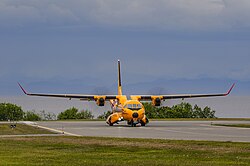
In North America, the Royal Canadian Air Force (RCAF) undertook a 12-year procurement process, eventually ordering 16 CC-295s to replace the aging CC-115 Buffalo and C-130H Hercules fleets. These aircraft are distributed across bases in Nova Scotia, Ontario, Manitoba, and British Columbia, with a dedicated training facility at CFB Comox.
While primarily military, the aircraft has seen civil application. The Stellwagen Group leased a C-295 to DAC Aviation International, which utilized the aircraft for humanitarian missions in Mozambique, delivering food, water, and anti-cholera kits.
Strategic Partnership in India
India represents one of the most significant industrial commitments to the C-295 platform. To replace the aging HS-748 Avro fleet, the Indian Air Force (IAF) entered a contract for 56 C-295Ws. This deal is structured as a hybrid of direct imports and domestic production.
Under the Tata-Airbus consortium, 16 aircraft were delivered directly from Spain, while 40 are being manufactured at a Final Assembly Line (FAL) in Vadodara, Gujarat. This facility aims for high levels of localization, with 96% of the assembly work shifting to India and local content rising to 75% for the final 24 aircraft.
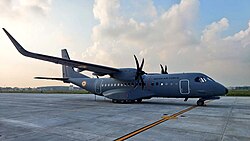
The IAF's fleet is designed to enhance tactical airlift in the Northern and North-Eastern sectors and the Andaman & Nicobar Islands. Furthermore, India is developing maritime variants: nine Medium-Range Maritime Reconnaissance Aircraft (MRMRA) for the Navy and six Multi-Mission Maritime Aircraft (MMMA) for the Coast Guard, featuring advanced weapon systems like the NASM-SR and Torpedo Advanced Light Shyena.
Competitive Landscape and Specialized Variants
The C-295 has faced stiff competition from the C-27J Spartan. The Spartan successfully beat the C-295 for the US Army/Air Force Joint Cargo Aircraft (JCA) program in 2007, as the US Army perceived the C-295's new operational mode for altitude and range as a higher risk. Similar losses occurred in Peru and Australia.
Despite this, the C-295 continues to expand into specialized roles. Spain recently approved the purchase of 16 C295W aircraft, split between maritime patrol and surveillance configurations. In 2025, the Irish Air Corps demonstrated the aircraft's utility in government operations by using a C-295 for the extradition of a high-profile suspect from the UAE.
| Country/Entity | Primary Role | Key Detail |
|---|---|---|
| Spain | Transport & Maritime | Launch customer; recently added 16 C295W units. |
| Egypt | Tactical Transport | Largest operator with 21 aircraft. |
| India | Tactical & Maritime | 56 aircraft total; domestic production in Vadodara. |
| Canada | Search and Rescue | 16 CC-295s replacing Buffalo and C-130H. |
| Poland | Transport | Replaced Antonov An-26; supports NATO missions. |
Frequently Asked Questions
Why did the C-295 lose the US JCA program to the C-27J Spartan?
The US Army reportedly viewed the C-295 as a greater risk because it employed a new operational mode to meet specific altitude and range requirements.
How is the C-295 being produced in India?
Through a partnership between Airbus and Tata Advanced Systems Limited, a Final Assembly Line was established in Vadodara. While the first 16 aircraft were imported from Spain, the remaining 40 are manufactured domestically with increasing levels of local content.
What is the role of the CC-295 in Canada?
The CC-295 serves as the primary search and rescue (SAR) aircraft for the Royal Canadian Air Force, replacing the older CC-115 Buffalo and C-130H Hercules models.
Can the C-295 be used for non-military purposes?
Yes, the C-295 is certified for civil use. It has been used by civil operators in Africa for humanitarian aid, including the delivery of food, water, and medical kits to Mozambique.
What specialized equipment is included in the Indian maritime variants?
The Indian Navy and Coast Guard variants are being developed with weapon systems including NASM-SR, NASM-MR, Torpedo Advanced Light Shyena, and air-launched sonobuoys.