Bullhead City History: From Ancient Roots to Modern Tourism
The story of Bullhead City is one of transformation, evolving from a fertile ancestral valley into a bustling river port and, eventually, a modern tourist destination. Situated along the Colorado River, this region has served as a vital crossroads for indigenous peoples, early explorers, and ambitious entrepreneurs for centuries.
Ancient Roots and Early Exploration
Long before the arrival of Europeans, the Mojave people inhabited the Colorado River Valley. The region's rich soil and abundant water allowed them to establish a prosperous farming community. Central to their culture is the legend of Spirit Mountain, the highest peak visible from the Bullhead City area, which is believed to be the birthplace of life.
European contact began in 1540 with Spanish explorer Melchor Díaz. He documented encounters with the native population who called themselves the Pipa Aha Macav, meaning "People by the River." This term was eventually shortened to "Mojave" (or "Mohave"). While the tribe maintains the Spanish spelling "Mojave," the local county uses the English "Mohave"; both are pronounced "Moh-hah-vee." Later, in 1774, Franciscan missionary Father Francisco Garces crossed the Colorado River in this same vicinity.
The Rise and Fall of Hardyville
In March 1864, a settlement known as Hardyville was established. It was named after William Harrison Hardy, a New York entrepreneur and politician who became the second-richest man in Arizona by 1864, with a personal worth exceeding $40,000. Hardy was a multifaceted figure: a Mohave County supervisor, a member of the Arizona Territorial Legislature, and the town's first postmaster, who is credited with inventing the riveted mail sack.
Hardyville served as a critical logistics hub. With the support of George Alonzo Johnson's steamboat company, Hardy established a ferry service and steamboat landing where the Mojave Road crossed the river. He also operated the Hardyville–Prescott Road, a toll road leading to the territorial capital of Prescott.
From 1864 to 1883, stern-wheeler steamboats traveled from Port Isabel, Mexico, stopping at Hardyville to deliver supplies to interior mining districts and transport ore for sale. Because of water levels, Hardyville was the low water limit of navigation; travel further upstream to locations like El Dorado Canyon was only possible during the late spring and early summer floods caused by snowmelt.
The Boom and the Ghost Town
Hardyville experienced a period of growth in the 1870s as mining became more profitable and hostilities with Native Americans ended. The town expanded to include a general store, saloon, blacksmith shop, billiard hall, and a public hall. It even served as the Mohave County seat starting in 1867.
However, a series of events led to its decline:
- Political Shift: The county seat moved to Cerbat in 1873.
- Railroad Competition: The arrival of the Southern Pacific Railroad in Yuma (1877) and the subsequent railhead at Maricopaville diverted wagon traffic.
- Commercial Rivalry: In 1881, Captain Isaac Polhamus established Polhamus Landing five miles upriver, stealing much of the river trade.
- Infrastructure Changes: The 1883 construction of the Atlantic and Pacific Railroad bridge near Needles shifted mining trade away from the river entirely.
By the late 1880s, falling silver prices silenced the Hardyville mill. The population departed, leaving the town a ghost town. Today, the most significant remnant is the Hardyville Pioneer Cemetery, a designated historic landmark.
The Birth of Modern Bullhead City
The area was resurrected decades later through the construction of Davis Dam between 1942 and 1953. The project was originally called Bullhead Dam, named after "Bull's Head Rock," a landmark used by steamboat captains for navigation. As the dam was completed and water levels rose, the rock formation was almost entirely submerged.
The construction headquarters became known as "Bullhead," and the community grew alongside the development of Lake Mohave and the rise of the resort town of Laughlin, Nevada, across the river. By 1970, Bullhead City consisted of six blocks along Highway 95 with approximately 1,000 residents, while the nearby community of Riviera housed about 3,000.
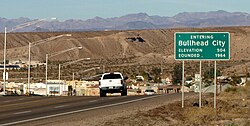
In 1984, the communities of Bullhead City, Riviera, and Holiday Shores voted to incorporate under the name "Bullhead City" to honor the area's historical significance.
Key Facts
- Indigenous Heritage: The Mojave people are the original inhabitants of the valley.
- Hardyville's Peak: Once the second-richest man in Arizona, William Harrison Hardy founded the town in 1864.
- Steamboat Era: Hardyville was the low water limit for river navigation until the early 1880s.
- Dam Construction: Bullhead City grew from the headquarters of the Davis Dam project (1942–1953).
- Modern Economy: Tourism is now the primary economic driver, focusing on water recreation and winter visitors.
| Era | Primary Focus | Key Landmark/Figure |
|---|---|---|
| Pre-European | Farming & Culture | Mojave People / Spirit Mountain |
| 1864–1883 | Mining & River Trade | Hardyville / William H. Hardy |
| 1942–1953 | Infrastructure | Davis Dam / Bull's Head Rock |
| 1984–Present | Tourism & Recreation | Lake Mohave / Laughlin proximity |
Frequently Asked Questions
Who were the first people to live in the Bullhead City area?
The Mojave people were the earliest inhabitants, utilizing the fertile soil and water of the Colorado River Valley to build a prosperous farming community.
What happened to the town of Hardyville?
Hardyville became a ghost town after the arrival of railroads in Yuma and Needles, the establishment of rival landings, and a decline in silver prices, which rendered its mill idle.
Why is the city called Bullhead City?
The name comes from "Bull's Head Rock," a navigation landmark on the river. The community that grew around the construction of the Bullhead Dam (later Davis Dam) adopted the nickname "Bullhead."
What is the significance of Spirit Mountain?
According to Mojave legend, Spirit Mountain is the highest peak visible from the area and is the place where life began.
What is the main economic driver of Bullhead City today?
Tourism is the primary economy, driven by summer water recreation on Lake Mohave and the Colorado River, as well as "snowbirds" who visit during the mild winters.