Bulgarians: History, Culture, and Global Distribution of a South Slavic People
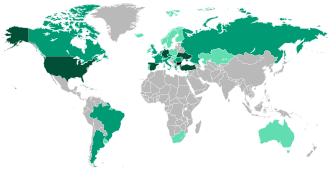
The Bulgarians are a South Slavic ethnic group with a rich historical legacy centered in the Balkan Peninsula. With a total global population of approximately 9 million, they maintain a strong cultural identity rooted in a unique blend of Slavic heritage and historical interactions with various Eurasian peoples. While the heart of the population resides in Bulgaria, significant diaspora communities exist across Europe, the Americas, and beyond.
Understanding the Bulgarian identity requires looking beyond modern borders to the complex process of ethnogenesis—the formation of an ethnic group—which involved the merging of various tribes and cultures over centuries.
Key Facts
- Total Population: Approximately 9 million worldwide.
- Primary Language: Bulgarian.
- Ethnic Classification: South Slavic.
- Major Population Center: Bulgaria (approx. 5.1 million).
- Cultural Legacy: Creators of the Cyrillic alphabet used by many Slavic nations.
Genetic Origins and Ethnogenesis
The formation of the Bulgarian people is a subject of extensive scientific and historical study. Genetic research indicates a significant contribution from Slavic-speaking donor groups. According to data from Hellenthal et al. (2014), Slavic ancestry is estimated to make up a substantial portion of the genetic makeup of various Eastern European groups, providing a biological foundation for the South Slavic identity.
![Historical contribution of donor source groups in European peoples according to Hellenthal et al., (2014). Polish is selected to represent Slavic-speaking donor groups from the Middle Ages that are estimated to make up 97% of the ancestry in Belarusians, 80% in Russians, 55% in Bulgarians, 54% in Hungarians, 48% in Romanians, 46% in Chuvash and 30% in Greeks.[121]](/images/2d/06/2d06c2ebe2030089c2000689ea489b5ebd540c59436179e27b5e7f7b4de5e0a9.png)
Historically, the group emerged from the interaction between the Bulgars (medieval Turkic tribes) and the local Slavic populations in the Balkans. This synthesis created a distinct ethnic identity that eventually adopted the Slavic language and culture, while retaining elements of the political and military organization of the early Bulgar state.
Global Distribution and Demographics
While the majority of Bulgarians live in the Republic of Bulgaria, the 20th and 21st centuries have seen significant migration. Large communities have established themselves in Western Europe and the Americas, driven by economic opportunities and political shifts.
| Country/Region | Estimated Population | Data Year |
|---|---|---|
| Bulgaria | 5,118,494 | 2021 |
| Germany | 436,860 | 2023 |
| Ukraine | 204,574–500,000 | 2001 |
| Spain | 300,000 | 2017 |
| United States | 300,000 | 2016 |
| United Kingdom | 86,000 | 2020–2021 |
| Argentina | 70,000–80,000 | 2020 |
| Moldova | 79,520 | 2004 |
Other notable populations are found in Brazil, Greece, Italy, Canada, and Russia, reflecting a wide global spread of the Bulgarian diaspora.
Cultural Heritage and Identity
Language and the Cyrillic Alphabet
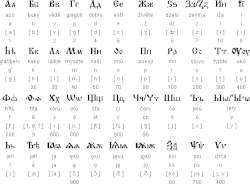
The Bulgarian language is a key pillar of the group's identity. Most significantly, the Cyrillic alphabet—the writing system used for the medieval Old Bulgarian language—was developed here, later spreading to become the standard script for many Orthodox Slavic nations.
Folk Traditions and Customs
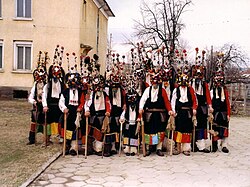
Bulgarian culture is characterized by vibrant folk traditions. These include the Kukeri, ritual performers who wear elaborate costumes to scare away evil spirits, and Lazaruvane, a traditional celebration performed by girls.
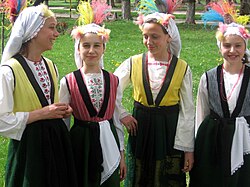
Traditional dress is also highly symbolic. Embroidery on national costumes often features Slavic cryptograms, such as the "Bur" pattern, which includes a cross inside a rhombus representing the sun and spirals indicating rain. These patterns are mirrored in other Slavic symbols, including the Flag of Belarus.
![Bulgarian folk dancers in a national costume with embroidery on the penultimate row of the aprons showing the most spread Slavic cryptogram Bur[187] with a cross inside the rhombus representing the sun and spirals indicating rain,[188] which is similarly represented as the Rising Sun[189] decorative pattern of the Flag of Belarus. Similar carpet patterns appear on the Flag of Turkmenistan ultimately derived from ancient Persia.](/images/38/9b/389b7be1488e588f0964345ff2b4920b971b38a825f2f53d57d6008351feeee0.jpg)
Cuisine and Daily Life
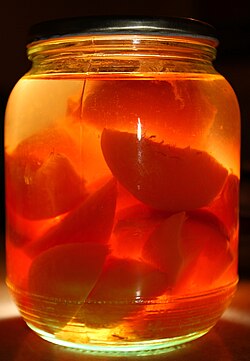
The culinary tradition is a reflection of the region's agriculture. A notable example is peach kompot, a non-alcoholic clear juice produced by cooking fruit, which remains a staple of traditional Bulgarian home preparation.
Historical Milestones
The history of the Bulgarians is marked by the rise and fall of powerful empires and the struggle for national sovereignty. From the First Bulgarian Empire to the period of the Bulgarian Exarchate (1870–1913), the group has consistently fought to maintain its religious and cultural autonomy.
![Map of the Bulgarian Exarchate (1870–1913). The Ottomans required a threshold of two thirds of positive votes of the Orthodox population to include a region into this jurisdiction.[166]](/images/2a/8a/2a8ae70f24203200050681750bc0c1ee712aee92e1551e9ea8ccc0e7dc2b1afe.jpg)
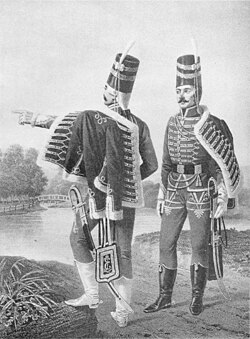
Military history also highlights the group's integration into broader European conflicts, such as the service of Bulgarian hussar regiments in Russia during the late 18th century.
Frequently Asked Questions
Who are the Bulgarians?
Bulgarians are a South Slavic ethnic group primarily residing in Bulgaria, with a global population of approximately 9 million. They are defined by their Bulgarian language, shared history, and cultural traditions.
What is the origin of the Cyrillic alphabet?
The Cyrillic alphabet originated from the medieval Old Bulgarian language and was developed to provide a written script for the Slavic people, eventually becoming the basis for many other Slavic languages.
What is the difference between Bulgars and Bulgarians?
The Bulgars were medieval Turkic tribes who migrated to the Balkans. The Bulgarians are the modern South Slavic ethnic group that formed through the merging of these Bulgars with the local Slavic populations.
Where do Bulgarians live outside of Bulgaria?
Significant Bulgarian populations are found in Germany, Ukraine, Spain, the United States, the United Kingdom, Argentina, and Moldova, among other countries.
What are some unique Bulgarian folk customs?
Unique customs include the Kukeri rituals to ward off evil and Lazaruvane celebrations, as well as the use of specific geometric embroidery patterns in folk dress that symbolize the sun and rain.