Buddha Perspectives: From Supreme Person to Transcendent Being
The identity of the Buddha is one of the most nuanced subjects in Eastern philosophy. Depending on the tradition, the Buddha is viewed variously as a human who achieved a supreme spiritual state, a transcendent cosmic force, or a wise teacher whose power lies in his shared humanity. These differing perspectives reflect the evolution of Buddhist thought across different schools and eras.
The Buddha as a Supreme Person
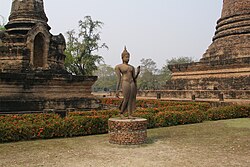
In the Theravāda tradition, the Buddha is generally regarded as a supreme person. He is not viewed as a god in the theistic sense, nor as a regular human or a deva (a celestial being). Instead, he belongs to a unique category known as a mahāpurisa, or "great person."
While the Pāli Canon acknowledges that the Buddha possessed a physical body subject to decay and death, it emphasizes his attainment of Nirvāṇa—the supreme spiritual goal. This liberation grants him siddhi (supranormal powers) and abhijñā (superknowledges). He is described as the "teacher of the gods and humans," superior to devas because he has overcome the attachment, ignorance, and sorrow that still affect celestial beings.
In the Doṇa Sutta, the Buddha explains his nature by comparing himself to a lotus flower: just as a lotus grows in water but blossoms above it, unsoiled, the Buddha grew up in the world but has now gone beyond it.
The Transcendent and Supramundane View
The Mahāsāṃghika school introduced a shift toward the lokottara, or supramundane, nature of the Buddha. In this view, the Buddha is not merely a human who attained enlightenment, but a transcendent being with limitless power, life, and knowledge.
Key tenets of the Mahāsāṃghika perspective include:
- Omniscience: The ability to know all dharmas (fundamental realities) in a single moment.
- Limitless Existence: A lifespan and power that are immeasurable.
- Dual Nature: The distinction between the Dharmakāya (the essential, real Buddha) and the nirmāṇakāya (the manifested transformation bodies used to liberate sentient beings).
According to this school, the historical Gautama Buddha was a transformation body, while the true Buddha is an omniscient entity. This tradition also posits the existence of many contemporaneous Buddhas across the ten directions of the universe.
![Buddha statue on the upper floor of Ajanta Cave No. 6. These caves are associated with the Mahāsāṃghika school.[24]](/images/13/4a/134a71421330b90f8d310c3aadc28bfb85f95be3f08dd722f3af82e20c67185e.jpg)
Buddhahood in Mahāyāna Buddhism
Mahāyāna Buddhism expanded upon the Mahāsāṃghika ideal, viewing the Buddha as an all-knowing (sarvajña) and omnipotent divinity. In Mahāyāna cosmology, innumerable Buddhas reside in various buddha kshetra (buddha fields). The Lotus Sūtra suggests that the Buddha achieved enlightenment countless kalpas (eons) ago and continues to teach through various manifestations.
Despite this transcendence, Mahāyāna teaches the doctrine of Buddha-nature, the belief that the essence of Buddhahood is immanent within all living beings. This creates a paradox where the Buddha is both a distant, spiritual king and an internal potential waiting to be awakened.
This transcendental view allows practitioners to direct prayers to Buddhas, seek visions, or aspire to be reborn in a Pure Land—a specialized environment where one can strive for enlightenment under optimal conditions.
The Buddha as a Wise Human
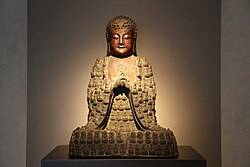
In contrast to the transcendental views, Buddhist modernism often emphasizes the Buddha's humanity to align the faith with rational and scientific frameworks. Modern thinkers argue that the Buddha's appeal lies precisely in the fact that he was not a god or a prophet, but a human being who "woke up" to full aliveness.
Figures such as Thích Nhất Hạnh have emphasized that the Buddha suffered as all humans do, making his achievement of enlightenment a testament to human potential rather than divine intervention.
Key Facts
- Theravāda: Views Buddha as a mahāpurisa (great person) who attained Nirvāṇa.
- Mahāsāṃghika: Introduced the lokottara (supramundane) nature and the concept of the Dharmakāya.
- Mahāyāna: Sees Buddha as an omnipotent being with immeasurable lifespan and immanent Buddha-nature in all beings.
- Modernism: Emphasizes the Buddha as a wise human being to promote a rational approach to Buddhism.
- Nirmāṇakāya: The concept of a Buddha manifesting in physical form to help sentient beings.
| Perspective | Nature of Buddha | Key Characteristic | Relationship to Humanity |
|---|---|---|---|
| Theravāda | Supreme Person | Attained Nirvāṇa | Human body, divine knowledge |
| Mahāsāṃghika | Supramundane | Limitless power/life | Historical form is a manifestation |
| Mahāyāna | Transcendent Divinity | Omniscience (Sarvajña) | Immanent Buddha-nature in all |
| Modernist | Wise Human | Rational awakening | Equal to all humans in suffering |
Frequently Asked Questions
Is the Buddha considered a god in Buddhism?
Generally, no. In Theravāda, he is a supreme person; in Mahāyāna, he is a transcendent being. While some Mahāyāna views are compared to theism, the Buddha is distinct from the creator gods found in theistic religions.
What is the difference between the Dharmakāya and Nirmāṇakāya?
The Dharmakāya is the essential, ultimate truth or the "body of Dharma," while the Nirmāṇakāya is the physical manifestation (such as the historical Gautama Buddha) used to teach and liberate beings.
What are the "thirty-two marks of a great man"?
These are physical characteristics attributed to a Buddha that signify his spiritual status and supranormal nature.
What is Buddha-nature?
Buddha-nature is the Mahāyāna belief that every sentient being possesses the inherent potential to become a Buddha.
How does the modern view of Buddha differ from ancient views?
Modernist views often strip away the supranormal powers (siddhis) and transcendental claims, presenting the Buddha as a human teacher whose wisdom is accessible through rational means.