British Armed Forces Colours: History and Tradition of Military Standards
In the military traditions of the Commonwealth of Nations, Regulation Colours serve as the official standards of the armed forces. In the British Armed Forces, these are not merely decorative flags but are deeply symbolic identifiers of a unit's identity, loyalty, and history.
Most British units carry two distinct flags: the Regulation King's Colour and the Regulation Regimental Colour, which are also commonly referred to as the standard or ensign. Historically, these colours functioned as identifying battle flags, providing a visible rally point for soldiers amidst the chaos of combat.
While original colours measured 6 feet 6 inches (198 cm) by 6 feet (183 cm), modern versions have been reduced to 3 feet 9 inches (114 cm) by 3 feet (91 cm). This change reflects the evolution of warfare, as regiments no longer carry these standards directly into the heat of battle.
The Evolution of British Army Colours
Before 1743, infantry regiments had significant autonomy over the design and number of standards they carried, with individual companies often sporting their own unique designs. This changed under King George II, who issued a royal warrant in 1743 to standardize the system.
Under these regulations, the first colour became the King's Colour, consisting of the Union Jack to symbolize royal allegiance. The second colour was based on the facings (the color of the uniform linings) of the regiment, featuring the Union flag in the upper canton. Specific rules applied to these designs:
- Red or White Facings: Replaced by the red cross of St George on a white background.
- Royal Designations: Regiments named after the royal family used royal blue colours.
- Irish Regiments: Used green facings.
Further warrants in 1747 and 1751 refined these rules. The 1747 warrant required regimental numbers to be displayed, though this was often ignored by units known by their colonel's name. The 1751 warrant strictly forbade colonels from placing their own personal arms, crests, or livery on regimental appointments, effectively phasing out company-specific colours in favor of sanctioned battalion designs.
![The Kings's colour of Barrell's Regiment of Foot that was carried at the Battle of Culloden in 1746. National Museum of Scotland, accession number M.1931.299.2[1]](/images/db/91/db912cea68f6b995d057c4b396d3b5579b203025d35b143ed48a9b7d8fb0639a.jpg)
Battle Honours and Modern Usage
Over time, colours evolved to display battle honours—official recognitions of a regiment's distinguished service in specific engagements. However, the practice of carrying these flags into active combat eventually ceased. The 58th (Rutlandshire) Regiment of Foot was the last British Army regiment to carry its colours into battle, occurring in January 1881 at the Battle of Laing's Nek during the First Boer War.
Unique Regimental Exceptions
While most units carry two colours, some maintain unique traditions:
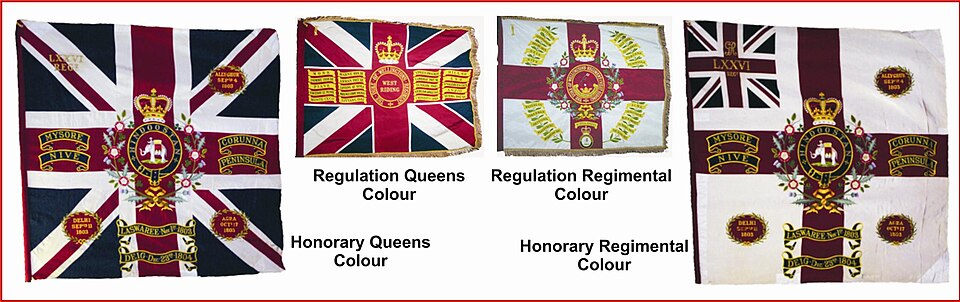
- The Royal Yorkshire Regiment: Carries four colours. In addition to the standard pair, they carry the 'King's Honorary Colour' and 'Regimental Honorary Colour' (original 6 ft 6 in size). These were awarded to the 76th Regiment of Foot by the East India Company for service at the Battle of Ally Ghur and Delhi (1802–1804).
- The Honourable Artillery Company: Maintains both a stand of colours and guns; the guns are accorded the same compliments as colours.
- The Royal Artillery: Regards its guns as its colours.
- The Rifles and Brigade of Gurkhas: Do not use colours due to their specific operational roles. The Gurkhas instead carry the Queen's Truncheon, awarded in 1857.
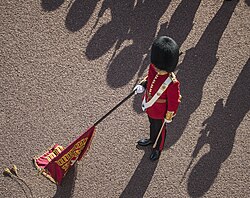
The Guards Division
The five Foot Guards infantry regiments follow a different pattern due to their role in defending the British Royal Family and royal facilities.
Guards Colour Designs
- Queen's/King's Colour: Crimson with regimental insignia, arms, and battle honours. Additional battalions include a Union Flag canton.
- Regimental Colours: The Union Flag featuring regimental insignia and battle honours.
Unlike standard infantry regiments, the Guards carry all their battle honours on both colours. Additionally, the Grenadier, Coldstream, and Scots Guards possess a Guards State Colour. This scarlet flag, featuring the Royal Cypher and regimental insignia without battle honours, is used exclusively when the monarch is present.
Key Facts
- Purpose: Originally used as rally points in battle; now primarily ceremonial.
- Standard Set: Most units carry one King's Colour and one Regimental Colour.
- Size Change: Reduced from 6'6" x 6' to 3'9" x 3' as they are no longer used in combat.
- Last Combat Use: The 58th (Rutlandshire) Regiment of Foot in 1881.
- Guards Exception: Guards regiments use crimson for the King's Colour and the Union Flag for the Regimental Colour.
- Non-Colour Units: The Rifles and Brigade of Gurkhas do not use colours.
Summary of British Military Colours
| Unit Type | King's/Queen's Colour | Regimental Colour | Special Notes |
|---|---|---|---|
| Standard Infantry | Union Jack | Facing colour with Union canton | Battle honours limited |
| Foot Guards | Crimson | Union Flag | All battle honours on both |
| Royal Yorkshire Reg. | Standard + Honorary | Standard + Honorary | Carries four colours total |
| Rifle/Gurkha Units | None | None | Gurkhas carry the Queen's Truncheon |
Frequently Asked Questions
What is the difference between the King's Colour and the Regimental Colour?
The King's Colour represents royal allegiance and typically features the Union Jack (or crimson for the Guards), while the Regimental Colour represents the specific identity of the unit, often using the colour of the regiment's uniform facings.
Why are modern colours smaller than historical ones?
Colours were reduced in size from 6 feet 6 inches to 3 feet 9 inches because they are no longer carried onto the battlefield, where larger flags were necessary for visibility as rally points.
Which regiments do not use colours?
The Rifles and the Brigade of Gurkhas do not use colours due to their specific military roles. The Brigade of Gurkhas carries the Queen's Truncheon instead.
What is a Guards State Colour?
The Guards State Colour is a scarlet flag used only by the Grenadier, Coldstream, and Scots Guards when the monarch is present. It features the Royal Cypher and regimental insignia but contains no battle honours.
What are battle honours?
Battle honours are official recognitions of a regiment's distinguished service in specific battles or campaigns, which are embroidered onto the colours to preserve the unit's history.