Brigadier-General Edward Allan Wood: A Life of Military Service
Brigadier-General Edward Allan Wood (1865–1930) was a distinguished officer of the British Army whose career spanned several of the most tumultuous conflicts of the late 19th and early 20th centuries. From his humble beginnings as a private soldier to commanding an infantry brigade during the Great War, Wood's trajectory is a testament to professional resilience and bravery under fire.
Key Facts
- Full Name: Edward Allan Wood, CMG, DSO and Three Bars.
- Service Branches: British Army, Bechuanaland Border Police, Matabeleland Mounted Police, and British South Africa Police.
- Major Conflicts: Jameson Raid, Second Boer War, and the First World War.
- Highest Rank: Brigadier-General.
- Notable Command: 55th Infantry Brigade (1917–1918).
- Final Resting Place: Highgate Cemetery, London.
Early Life and Colonial Service
Born in India on May 6, 1865, Edward Allan Wood was the ninth son of Oswald Wood, a civil servant and judge. Due to limited family resources, Wood did not enter the army through the traditional officer academies; instead, he enlisted as a private soldier in 1892. He began his service with the 2nd Dragoon Guards before transferring to the 17th Lancers.
During the 1890s, Wood transitioned into colonial policing, serving as an officer in the Bechuanaland Border Police (now the Botswana Police Service), the Matabeleland Mounted Police, and the British South Africa Police. His early career was marked by high-stakes operations, including the Jameson Raid (1895–96), during which he was captured in the Transvaal Republic. He also played a role in the 1896 rebellion with the Matabeleland Relief Force.
Wood's experience in Southern Africa continued during the Second Boer War (1899–1902), where he was notably present during the relief of Mafeking in 1900. He eventually resigned from the British South Africa Police in March 1906.
Leadership in the First World War
With the outbreak of the First World War in 1914, Wood returned to the British Army. He served as a company commander within the 6th Battalion of the King's Shropshire Light Infantry. His leadership capabilities led to a rapid ascent in rank, becoming a temporary lieutenant colonel in 1917.
His bravery and efficiency were recognized with the Distinguished Service Order (DSO). In a rare feat of military recognition, Wood was awarded the DSO and three subsequent Bars—additional awards of the same medal—between January 1917 and December 1919.
On November 9, 1917, Wood was promoted to Brigadier-General to lead the 55th Infantry Brigade, part of the 18th (Eastern) Division. He commanded the brigade until October 24, 1918, when he was forced to step down due to illness.
Later Career and Final Years
Following his demobilization in early 1919, Wood entered a new phase of service in October 1919 by joining the Auxiliary Division of the Royal Irish Constabulary during the Irish War of Independence. Initially serving as deputy commander under Frank Percy Crozier, Wood took full command of the division in February 1921 following Crozier's resignation.
Wood's personal life was marked by two marriages: first to Myra Cotterell in 1898, with whom he had a son, and later to Marguerite Dawson in 1916. Despite his military success, he faced financial hardship and was declared bankrupt in 1921.
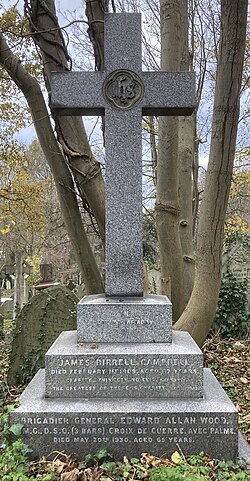
Brigadier-General Wood passed away on May 20, 1930, at the age of 65, due to cirrhosis of the liver. He was buried on the eastern side of Highgate Cemetery in London.
Service Summary
| Category | Details |
|---|---|
| Service Years | 1892–1906; 1914–1919 |
| Key Commands | 6th Battalion King's Shropshire Light Infantry; 55th Brigade |
| Major Awards | CMG, DSO (with 3 Bars), Croix de guerre |
| Primary Conflicts | Jameson Raid, Second Boer War, WWI, Irish War of Independence |
Frequently Asked Questions
What was Edward Allan Wood's highest military rank?
Edward Allan Wood achieved the rank of Brigadier-General, specifically commanding the 55th Infantry Brigade from 1917 to 1918.
Which prestigious awards did Brigadier-General Wood receive?
He was appointed a Companion of the Order of St Michael and St George (CMG) and a Companion of the Distinguished Service Order (DSO) with three Bars. He was also awarded the French Croix de guerre.
In which conflicts did Wood serve before World War I?
Before the First World War, Wood served in the Jameson Raid (where he was captured) and the Second Boer War, including the relief of Mafeking.
What role did he play during the Irish War of Independence?
Wood served in the Auxiliary Division of the Royal Irish Constabulary, first as deputy commander and later as the Commandant starting in February 1921.
Where is Brigadier-General Wood buried?
He is buried on the eastern side of Highgate Cemetery in London, England.