Brazil Current: Dynamics of the South Atlantic's Western Boundary
The Brazil Current is a powerful warm water current that plays a critical role in the climate and ecology of the South Atlantic. Flowing southward along the coast of Brazil, it transports heat from the tropics toward the mouth of the Río de la Plata, acting as a vital component of the global ocean circulation system.
As a western boundary current, it serves as the southern counterpart to the Gulf Stream. While it shares similar characteristics in terms of its position and function, the Brazil Current is notably shallower and weaker than its northern relative.
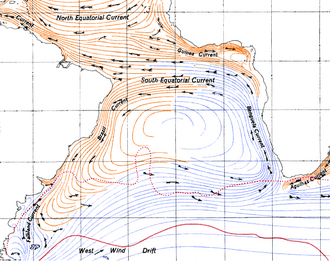
Key Facts
- Origin: Formed where the South Equatorial Current (SEC) splits near Cabo de São Roque.
- Direction: Flows south from the equator toward the west wind drift.
- Maximum Depth: Reaches depths of up to 700 meters.
- Peak Transport: Can reach 70 to 80 Sverdrups (Sv) by 36°S.
- Confluence: Meets the cold Falkland Current at the Brazil-Falkland Confluence.
Formation and the South Atlantic Subtropical Gyre
The Brazil Current is a primary element of the South Atlantic subtropical gyre, a large system of circulating ocean currents. This gyre is composed of four main boundaries:
- North: The South Equatorial Current (SEC), which flows west before splitting into the North Brazil Current and the Brazil Current.
- East: The Benguela Current System (BCS).
- South: The eastward-flowing South Atlantic Current (SAC).
- West: The southward-flowing Brazil Current.
The current officially begins between 10°S and 15°S. Its strength increases as it moves south, aided by an anticyclonic recirculation gyre (a clockwise rotating water mass) located around 30°S, which significantly boosts the volume of water transported.
Transport Volume and Flow Dynamics
Oceanographers measure the volume of water moved by currents in Sverdrups (Sv), where 1 Sv equals one million cubic meters of water per second. The Brazil Current shows a dramatic increase in transport as it progresses southward:
| Latitude | Estimated Transport (Sv) |
|---|---|
| 12°S | 2.5 |
| 15°S | 4 |
| 27°S | 11 |
| 31°S | 17 |
| 34°S | 22 |
| 36°S | 41 (up to 70-80 total) |
By the time the current reaches 36°S, the total transport can range from 70 to 80 Sv, with approximately half of this volume residing within the recirculation gyre.
The Brazil-Falkland Confluence
At approximately 36°S, the Brazil Current encounters the Falkland Current (also known as the Malvinas Current). This meeting point is known as the Brazil-Falkland Confluence. Here, the saltier, warm subtropical waters of the Brazil Current collide with the fresher, cold subantarctic waters of the Falkland Current, transforming the Argentine Sea into a temperate sea.
The separation of the Brazil Current from the coastline typically occurs around 38°S, where sea surface temperatures are estimated between 16°C and 18°C. However, this separation point is dynamic; it may shift further north between July and September compared to the January to March period. The behavior of the current is also influenced by the Falkland Current: if the Falkland Current's transport is low, wind stress curl dominates the path; if it is high, the current separates at the observed 38°S latitude.
Water Masses and Composition
The region is characterized by a complex mix of water masses, with salinity levels at the confluence ranging from 33.6 to 36 psu (practical salinity units) and temperatures between 7°C and 18°C. Six major water masses exist within this system:
- Upper Circumpolar Water (UCPW)
- Lower Circumpolar Water (LCPW)
- Central Water (CW)
- Antarctic Intermediate Water (AAIW)
- Antarctic Bottom Water (AABW)
- North Atlantic Deep Water (NADW)
Frequently Asked Questions
What is the Brazil Current?
The Brazil Current is a warm, southward-flowing western boundary current in the South Atlantic Ocean that transports tropical waters along the Brazilian coast toward the Argentine Sea.
How does the Brazil Current differ from the Gulf Stream?
While both are western boundary currents, the Brazil Current is considerably shallower and weaker than the Gulf Stream.
What happens at the Brazil-Falkland Confluence?
This is the region where the warm, salty subtropical waters of the Brazil Current meet the cold, fresher subantarctic waters of the Falkland Current, creating a temperate marine environment.
What factors influence where the Brazil Current leaves the coast?
The separation point is influenced by the season (shifting north between July and September) and the transport volume of the Falkland Current, as well as wind stress curl.
What is the maximum transport volume of the Brazil Current?
By 36°S, the total transport is estimated to be between 70 and 80 Sverdrups, though half of this is contained within a recirculation gyre.