Borough of Princeton, New Jersey
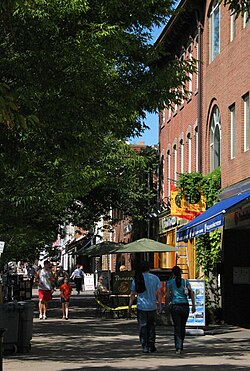
The Borough of Princeton was a distinct municipality in Mercer County, New Jersey, that served as a central hub of the region for two centuries. Established in the early 19th century, the borough was characterized by its dense population and its unique relationship with the surrounding Princeton Township. This administrative entity existed from 1813 until the end of 2012, when it merged with the township to create the unified municipality of Princeton, New Jersey.
The borough's history is one of gradual evolution. It was originally incorporated by the New Jersey Legislature on February 11, 1813, drawing land from West Windsor and Montgomery Townships. Over the decades, it shifted jurisdictions and expanded its borders, eventually becoming a fully independent municipality around 1894. For much of its later existence, the borough was completely surrounded by Princeton Township, creating a "doughnut" geographic arrangement.
Key Facts
- Lifespan: Incorporated February 11, 1813; disestablished January 1, 2013.
- Location: Mercer County, New Jersey.
- Final Population: 12,307 (2010 Census).
- Total Area: 1.843 square miles.
- Merger: Consolidated with Princeton Township on January 1, 2013.
- Government: Managed by a Borough Council and a Mayor.
Geography and Climate
Located at coordinates 40°21′02″N 74°39′34″W, the borough occupied a small but densely populated area of 1.843 square miles. Almost the entirety of this area was land, with only a negligible amount of water (0.00039 square miles). The elevation of the area averages around 190 feet.
The region experiences a temperate climate with distinct seasonal variations. Based on 1991–2020 normals, the area sees an average annual precipitation of 48.72 inches. Temperature extremes are significant, with record highs reaching 102.6°F in July and record lows dropping to -12.0°F in January.
Demographics and Population Trends
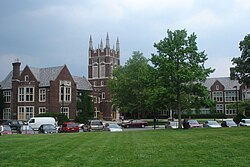
The population of the Borough of Princeton fluctuated over the years, heavily influenced by its role as an educational center. A notable characteristic of the borough was its unusually low median age and a high concentration of residents aged 18 to 24, a trend directly attributed to the presence of Princeton University.
By the 2010 Census, the population stood at 12,307, with a population density of 6,679.2 people per square mile. The racial composition in 2010 was 72.07% White, 13.51% Asian, 6.44% Black or African American, and 10.30% Hispanic or Latino of any race.
Economic Profile
The borough was an affluent community. According to the 2006-2010 American Community Survey, the median household income was $104,234, while the median family income reached $148,295. Per capita income was recorded at $45,566.
| Census Year | Population | Percentage Change |
|---|---|---|
| 1870 | 2,798 | — |
| 1900 | 3,899 | +13.9% (from 1890) |
| 1950 | 12,230 | +58.4% (from 1940) |
| 2000 | 14,203 | +18.2% (from 1990) |
| 2010 | 12,307 | -13.3% (from 2000) |
| 2011 (est.) | 12,131 | -1.4% |
Government and Politics
The borough operated under a council-manager form of government. The Borough Council served as the policy-making body, consisting of six members elected to three-year terms. The Mayor acted as the executive head, with Yina Moore serving as the final mayor before the merger, ending her term on December 31, 2012.
Politically, the borough leaned heavily Democratic. As of March 2011, 53.2% of registered voters were Democrats, while 9.4% were Republicans and 37.2% were unaffiliated. This political leaning was evident in the 2009 gubernatorial election, where Democrat Jon Corzine received 69.4% of the borough's vote.
The 2013 Consolidation
For over a century, the Borough and Township of Princeton operated as separate legal entities despite their shared identity. On November 8, 2011, voters in the borough approved a measure to consolidate the two municipalities. This process culminated on January 1, 2013, when both the Borough of Princeton and Princeton Township were dissolved to form the single municipality of Princeton, New Jersey.
Frequently Asked Questions
When did the Borough of Princeton cease to exist?
The Borough of Princeton was disestablished on January 1, 2013, when it merged with Princeton Township.
Why was the median age in the borough so low?
The low median age and high percentage of residents aged 18 to 24 were primarily due to the influence of Princeton University.
Who was the last mayor of the Borough of Princeton?
The last mayor was Yina Moore, whose term ended on December 31, 2012.
What was the total land area of the borough?
The borough had a total area of 1.843 square miles, nearly all of which was land.
How did the borough's population change between 2000 and 2010?
The population decreased by 13.3%, falling from 14,203 in 2000 to 12,307 in 2010.