Blue-capped Ifrit: The Toxic Songbird of New Guinea
Deep within the mist-shrouded montane rainforests of New Guinea lives one of the world's most unusual avian species: the blue-capped ifrit (Ifrita kowaldi). While it may appear to be a typical small songbird, this species possesses a chemical defense mechanism rarely seen in the bird world. By accumulating potent neurotoxins in its skin and feathers, the blue-capped ifrit transforms itself from prey into a hazardous encounter for any predator.
As the sole member of its own family, the Ifritidae, this bird is a biological marvel and an ancient relict of the Oligocene epoch. Its presence in the high-altitude forests of Papua New Guinea and Western New Guinea offers a fascinating glimpse into evolutionary adaptation and convergent evolution.
Key Facts
- Scientific Name: Ifrita kowaldi
- Family: Ifritidae (Monotypic)
- Primary Toxin: Batrachotoxin (BTX)
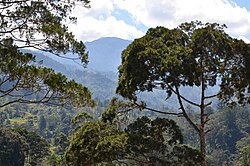
- Habitat: Montane rainforests of New Guinea (100 to 4,000 meters)
- Diet: Insectivorous, specifically consuming Choresine beetles
- Conservation Status: Least Concern (IUCN 3.1)
Physical Characteristics and Appearance
The blue-capped ifrit is a small passerine bird, measuring between 16 and 17 cm in length and weighing approximately 34 to 36 grams. It is characterized by a stout body, a broad chest, and short, rounded wings. Its legs are "booted," meaning feathers extend down toward its stout, clawed feet.
Visually, the bird features brown upperparts with finely dotted wing edges and light-yellow underparts. Its most striking feature is a bright blue cap outlined in black, accented by a small black spot on the crown and a long white stripe running beside the eye. The eye itself is encircled by a narrow white ring.
The species exhibits sexual dimorphism, meaning males and females differ in appearance. Males possess more vivid head and neck coloration, darker markings around the eyes, and white ear streaks. Females have paler eye markings and tawny yellow ear streaks, while juveniles resemble females but feature a light brown forehead.
Taxonomy and Evolutionary History
The blue-capped ifrit occupies a unique place in biological classification. It is the only species within the family Ifritidae, making it a monotypic family. It belongs to the order Passeriformes and the superfamily Corvoidea, which links it to other well-known birds such as crows, jays, and birds of paradise.
Historically, the ifrit was categorized into various families, including Monarchidae or Cinclosomatidae, before its unique status was recognized. Scientists consider the ifrit an ancient relict species that dates back to the Oligocene epoch on proto-Papuan islands, showing minimal evolutionary divergence over millions of years.
The Science of Toxicity
The most remarkable trait of the blue-capped ifrit is its accumulation of batrachotoxin (BTX), a potent neurotoxin found in its skin and feathers. This toxin is believed to be deadlier than cyanide and can cause irritation, sneezing, and allergic reactions in humans who handle the bird.

Source of the Toxin
The ifrit does not produce BTX internally; instead, it acquires the toxin through its diet. It is believed that the bird consumes Choresine beetles (family Melyridae), which may in turn obtain the toxin from soil mites or specific plants. This chemical defense protects the bird from parasites and predators.
Biological Mechanism and Resistance
Batrachotoxin works by forcing the sodium ion channels in nerve and muscle cells to remain open, leading to muscle paralysis and potential death. To survive its own toxicity, the blue-capped ifrit has evolved a mutation in the SCN4A gene, which encodes the NAV1.4 sodium channel. This mutation alters the channel's shape, preventing the toxin from binding—a phenomenon known as target-site insensitivity.
This is a prime example of convergent evolution, as poison dart frogs have evolved a nearly identical mutation to achieve the same resistance. Researchers also suspect the bird may produce a specialized protein to absorb excess poison and a transporter protein to move the BTX from the stomach to the skin and feathers.
Behavior, Diet, and Breeding
The blue-capped ifrit is an insectivorous bird, primarily foraging for worms and insects among moss, branches, and tree trunks, occasionally supplementing its diet with soft fruits. Socially, they are non-aggressive and typically found in small groups of up to six individuals.
Mating and nesting occur between August and November. The birds build nests from leaf fern and green moss, usually positioned 2 to 3 meters above the ground in the fork of a sapling. Each clutch typically contains a single white egg with black and purple spots. Both parents share the responsibilities of nesting and chick care, reflecting a k-selected species strategy where high investment is placed into a single offspring. Interestingly, the parents' toxic feathers may rub off on the nest and egg, providing chemical protection against predators.
Conservation and Distribution
Endemic to Western New Guinea and Papua New Guinea, the blue-capped ifrit inhabits a range of approximately 388,000 km². While they can be found from 100 to 4,000 meters, they are most common at altitudes above 1,500 meters.
Currently, the IUCN lists the species as Least Concern due to its large range and population. However, there are signs of decline; tree cover in their habitat has decreased by 1.7% over the last decade, contributing to a population decline of up to 19%. While not currently targeted for the illegal pet trade like the hooded pitohui, the lack of official protection under Indonesian law remains a potential risk.
| Feature | Details |
|---|---|
| Size/Weight | 16–17 cm; 34–36 g |
| Key Identifier | Bright blue crown with black outline |
| Toxin | Batrachotoxin (BTX) |
| Primary Diet | Insects (Choresine beetles) and worms |
| Distribution | New Guinea (Montane forests) |
| Clutch Size | Typically 1 egg |
Frequently Asked Questions
Is the blue-capped ifrit dangerous to humans?
While not typically lethal to humans, the batrachotoxin in their skin and feathers can cause sneezing, skin irritation, and allergic reactions upon contact.
How does the bird avoid being poisoned by its own toxin?
The bird has a genetic mutation in the SCN4A gene that changes the shape of its sodium channels, preventing the batrachotoxin from binding to them.
Where does the blue-capped ifrit get its poison?
The toxin is acquired through its diet, specifically by eating Choresine beetles from the Melyridae family.
Why is the blue-capped ifrit considered a "relict" species?
It is considered a relict because it is an ancient lineage dating back to the Oligocene epoch with very little evolutionary divergence over time.
What is the conservation status of the species?
It is listed as Least Concern by the IUCN, although its population is slowly declining due to habitat loss and tree cover reduction.