Bloomsbury Group: The Extended Circle and Associated Figures
The Bloomsbury Group is often remembered as a tight-knit collective of intellectuals, artists, and writers who redefined early 20th-century British culture. However, the boundaries of this circle were fluid. While a core group shared a specific creative mindset and set of values, many other influential figures orbited the group through professional collaborations, shared social spaces, and personal relationships without being formal members.
Key Facts
- Professional Ties: Many individuals were linked to the group via the Omega Workshops or the Hogarth Press but did not share the group's core identity.
- Social Overlap: Figures like Lady Ottoline Morrell hosted the group, creating a bridge to other intellectuals like Aldous Huxley.
- LGBT History: The group was central to early 20th-century LGBT networks, which later diversified into separate social circles.
- Family Ties: Some individuals, such as Thoby Stephen, were closely related to core members but died before the group fully coalesced.
Professional Collaborations and Business Ventures
The Omega Workshops
From 1913 to 1919, the Omega Workshops operated as a business focused on design and manufacturing. While core members like Roger Fry, Vanessa Bell, and Duncan Grant were central to its operation, the workshops employed various other designers and manufacturers who were not considered members of the Bloomsbury Group.
The Hogarth Press
Founded by Leonard and Virginia Woolf after they left the Bloomsbury area in 1917, the Hogarth Press became a vital publishing house. Many of its authors and staff members maintained professional relationships with the Woolfs without being part of the inner circle. Notable authors published by the press included T. S. Eliot, Katherine Mansfield, and Julia Strachey. Vita Sackville-West was recognized as the press's best-selling author. Additionally, personnel such as John Lehmann, who later founded his own publishing company, were associated with the press but not the group.
Social Circles and Shared Spaces
The Garsington Manor Circle
Lady Ottoline Morrell maintained a relationship with the Bloomsbury Group, though the identification was only partial. Her parties at Garsington Manor served as a meeting ground for the group and other figures, including L. P. Hartley, Eardley Knollys, Philip Morrell, and Aldous Huxley and his wife, Maria Nys.
The Ham Spray House and Tidmarsh Mill House
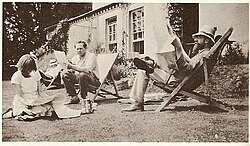
During World War I, Lytton Strachey and Dora Carrington moved to Tidmarsh Mill House in Berkshire. They later relocated to Ham Spray House in Wiltshire, where they lived in a ménage à trois (a domestic arrangement involving three people) with Ralph Partridge. Following the deaths of Strachey and Carrington, Frances Partridge married Ralph Partridge and continued to reside at Ham Spray House.
LGBT Networks and Evolution
The Bloomsbury Group played a significant role in the LGBT history of its era. Initially, LGBT activity was concentrated within a single group, exemplified by Duncan Grant's relationships with Maynard Keynes, James Strachey, Adrian Stephen, David Garnett, and Vanessa Bell. Over time, these networks differentiated based on location and life changes.
For instance, Maynard Keynes eventually married Lopokova and left these circles. Meanwhile, Duncan Grant and David Garnett, serving as conscientious objectors during World War I, established a home with Vanessa Bell and her sons, Julian and Quentin, at Charleston Farmhouse. David Garnett later co-founded a bookshop with Francis Birrell.
E. M. Forster, who also served as a conscientious objector in Egypt, returned to England with a circle of LGBT acquaintances that included Benjamin Britten, Christopher Isherwood, Siegfried Sassoon, J. R. Ackerley, W. J. H. Sprott, and Forrest Reid. Similarly, Virginia Woolf's move to Monk's House led her to Vita Sackville-West, inspiring the roman à clef (a novel about real life overlaid with a façade of fiction) Orlando: A Biography. Through Sackville-West, Woolf connected with Harold and Benedict Nicolson, Violet Trefusis, and Ethel Smyth.
Associated Figures and Critics
Several individuals were befriended by members of the group but did not fully share their creative mindset or views. This diverse list includes Bertrand Russell, G. E. Moore, Mulk Raj Anand, Arthur Waley, Hugh Walpole, and the Raverat couple, Jacques and Gwen. Others, such as the Garman sisters (Lorna and Kathleen), Bernard Meninsky, and Ann Bridge, also maintained ties to the circle.
Not everyone viewed the group favorably. Critics included Wyndham Lewis and the poet Roy Campbell. D. H. Lawrence, while close to core members, was critical of the group's homosexual tendencies.
Later Generations
The influence of the group extended to their offspring, though they were too young to be original members. These include Nigel Nicolson (son of Harold Nicolson and Vita Sackville-West and biographer of Virginia Woolf), Cressida Bell (daughter of Quentin Bell), and Burgo Partridge (son of Dora Carrington's widower), who married Henrietta Garnett.
| Category | Key Figures | Nature of Connection |
|---|---|---|
| Professional | T. S. Eliot, Katherine Mansfield, John Lehmann | Hogarth Press authors and staff |
| Social/Hosts | Lady Ottoline Morrell, Aldous Huxley | Garsington Manor circle |
| LGBT Networks | E. M. Forster, Benjamin Britten, Violet Trefusis | Shared identity and social circles |
| Critics | Wyndham Lewis, D. H. Lawrence | Intellectual and moral opposition |
| Family/Offspring | Nigel Nicolson, Cressida Bell | Children of core or associated members |
Frequently Asked Questions
Was Vita Sackville-West a member of the Bloomsbury Group?
While she was a close associate of Virginia Woolf and the best-selling author for the Hogarth Press, she is generally not seen as a formal member of the Bloomsbury Group.
What was the relationship between the Bloomsbury Group and the Omega Workshops?
The Omega Workshops was a business (1913–1919) involving core members like Roger Fry and Vanessa Bell, but it also employed many designers and manufacturers who were not part of the group.
Who were some of the primary critics of the group?
Wyndham Lewis and Roy Campbell were critics, and D. H. Lawrence specifically criticized the group's homosexual tendencies despite his closeness to some members.
How did the LGBT circles change after World War I?
The circles became more geographically and socially differentiated. Some members formed domestic partnerships in places like Charleston Farmhouse or Ham Spray House, while others, like E. M. Forster, developed their own distinct circles of acquaintances upon returning from abroad.
Who was Thoby Stephen?
Thoby Stephen was the brother of Virginia Woolf, Vanessa Bell, and Adrian Stephen, but he died before the Bloomsbury Group had fully formed.