Bloomsbury Group: Life and Relationships During and After WWI
The Bloomsbury Group, a renowned circle of intellectuals, artists, and writers, underwent significant transformations during and after the First World War. As the initial cohesion of the group shifted, members began to differentiate, forming smaller clusters based on their living locations and evolving personal lives. This era was marked by a transition from extravagant social gatherings to more secluded domestic arrangements and a strong commitment to pacifism.
Key Facts
- Many LGBT men within the Bloomsbury circle served as conscientious objectors (individuals who refuse to fight in a war for moral or religious reasons) during WWI.
- Virginia and Leonard Woolf founded the Hogarth Press, a publishing house that connected them with figures like Katherine Mansfield and John Lehmann.
- The group's living arrangements often defied traditional norms, including the ménage à trois (a domestic arrangement involving three people) at Ham Spray House.
- Virginia Woolf's novel Orlando: A Biography was a roman à clef (a novel about real-life events overlaid with a façade of fiction) based on Vita Sackville-West.
The Impact of World War I and Conscientious Objection
The First World War forced a geographical dispersion of the group. Many LGBT men in and around the Bloomsbury circle became conscientious objectors, which required them to leave London to perform manual labor on the land.
Duncan Grant and David Garnett were among those who worked the land during the war. This period led to their residence with Vanessa Bell at Charleston Farmhouse. Later, David Garnett expanded his professional interests by opening a bookshop with Francis Birrell.
Similarly, E. M. Forster spent his time as a conscientious objector in Egypt, remaining there for a period after the war ended. Upon his return to England, Forster maintained a wide circle of LGBT friends and acquaintances, including Siegfried Sassoon, Christopher Isherwood, Benjamin Britten, J. R. Ackerley, W. J. H. Sprott, and Forrest Reid.
Domestic Circles and Artistic Retreats
As the era of Lady Ottoline Morrell's extravagant parties faded, other hubs of intellectual activity emerged. During the war, Morrell provided housing at Garsington Manor for Aldous Huxley, a conscientious objector. It was here that Huxley married Maria Nys after the war and formed a friendship with fellow visitor D. H. Lawrence.
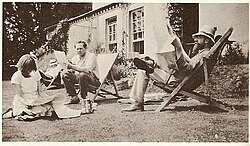
Lytton Strachey and Dora Carrington also sought refuge during the war, moving to Tidmarsh Mill House. They eventually relocated to Ham Spray House, where they lived in a ménage à trois with Ralph Partridge. Strachey's final lover was Roger Senhouse.
Virginia Woolf and the Hogarth Press
Virginia and Leonard Woolf established their own creative and professional sanctuary, first moving to Hogarth House in the London Borough of Richmond upon Thames. There, they founded the Hogarth Press. The couple later moved to Monk's House in East Sussex.
The Hogarth Press served as more than just a business; it was a link to other LGBT acquaintances, such as John Lehmann and Katherine Mansfield. Virginia Woolf also expanded her social circle to include the composer and suffragist Ethel Smyth.
The Inspiration for Orlando
While residing at Monk's House, Virginia Woolf met Vita Sackville-West. This relationship inspired Woolf to write Orlando: A Biography. Through Sackville-West, Woolf became acquainted with other LGBT individuals, including Violet Trefusis (Sackville-West's former lover), Harold Nicolson (Sackville-West's husband), and their son, Benedict Nicolson.
Summary of Key Figures and Locations
| Person(s) | Key Location | Notable Association/Role |
|---|---|---|
| Virginia & Leonard Woolf | Hogarth House / Monk's House | Founders of Hogarth Press |
| Duncan Grant, David Garnett, Vanessa Bell | Charleston Farmhouse | Conscientious objectors / Artists |
| Lytton Strachey, Dora Carrington, Ralph Partridge | Ham Spray House | Ménage à trois arrangement |
| Aldous Huxley | Garsington Manor | Conscientious objector / Guest of Lady Ottoline Morrell |
| E. M. Forster | Egypt | Conscientious objector |
Frequently Asked Questions
Who were the conscientious objectors in the Bloomsbury Group?
Many LGBT men in the circle, including Duncan Grant, David Garnett, Aldous Huxley, and E. M. Forster, were conscientious objectors who avoided military service during WWI, often by performing manual labor on the land.
What was the Hogarth Press?
The Hogarth Press was a publishing company owned and operated by Virginia Woolf and her husband, Leonard Woolf.
Who inspired the novel Orlando?
Virginia Woolf wrote Orlando: A Biography as a roman à clef based on her acquaintance, Vita Sackville-West.
Where did Lytton Strachey and Dora Carrington live?
They first moved to Tidmarsh Mill House during the First World War and later lived at Ham Spray House in a ménage à trois with Ralph Partridge.
How did the group change after the First World War?
The group became more fragmented, with members splitting into smaller circles based on where they lived. For example, Keynes married Lydia Lopokova and ceased having affairs with men, while others formed domestic clusters in places like Charleston and Ham Spray.