Bird Down: The Science and Utility of Nature's Finest Insulator
Beneath the sleek, weather-resistant exterior of a bird lies a hidden layer of specialized plumage known as down. These fine, fluffy feathers are nature's answer to thermal regulation, providing an efficient barrier against heat loss. While we often associate down with high-end bedding and winter jackets, it serves critical biological functions that allow birds to survive in diverse climates, from the Arctic tundra to tropical rainforests.
The evolutionary history of down extends far beyond modern birds. Evidence from feathers trapped in ancient amber suggests that some species of non-avian dinosaurs likely possessed down-like feathers, indicating that this insulating mechanism predates the rise of flight.
Key Facts
- Structure: Down feathers have a short or vestigial rachis (shaft) and barbules that lack hooks, preventing them from interlocking.
- Types: There are three primary categories: natal, body, and powder down.
- Insulation: Down traps air to prevent heat loss and provide buoyancy for waterbirds.
- Fill Power: This is the measure of down's insulating capacity, with eiderdown reaching the highest rating of 1200.
- Environmental Indicator: Because birds eliminate heavy metals through their feathers, down can be used to monitor environmental contamination.
The Biology and Types of Down
From a structural standpoint, the down feather is the most straightforward of all feather types. Unlike pennaceous feathers, which have interlocking barbules to create a flat surface, down feathers lack these hooks, resulting in a soft, loose structure.
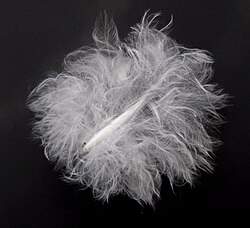
Natal Down
Natal down is the first layer of feathers most birds possess. Precocial nestlings (those born relatively mature and mobile) hatch already covered in down. In contrast, altricial nestlings (those born blind and helpless) develop their down layer days or weeks after hatching. The only exception is the megapode, which hatches with contour feathers already in place.
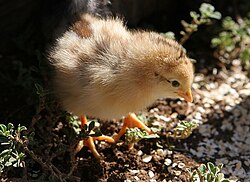
Body Down
Body down consists of small, fluffy feathers located beneath the outer contour feathers. This layer acts as a primary thermal blanket for the adult bird.
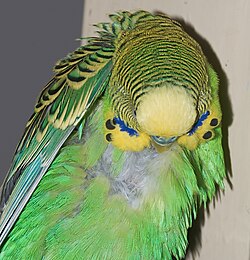
Powder Down
Powder down, or pulviplumes, is a specialized type found in specific groups such as parrots, herons, and tinamous. In some species, the barbules disintegrate into fine particles of keratin, creating a "feather dust." These feathers grow continuously and are not moulted. While useful for the bird, this dust is a known allergen for humans.
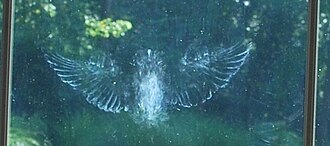
Biological Functions and Adaptations
The primary role of down is to trap air, which provides insulation and buoyancy. Birds in regions with significant temperature swings often increase their down density following the autumn moult. Interestingly, in some colonially nesting species, the stiffness of down may discourage nestling cannibalism by making the young harder to swallow.
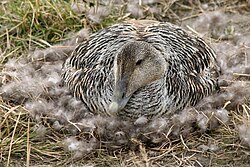
For female wildfowl, down serves a dual purpose in nesting. They pluck down from their own breasts to line their nests, which insulates the eggs and exposes the brood patch—a vascularized area of bare skin that transfers heat to the eggs. This down also provides camouflage for the eggs when the female is away.
However, these functions are easily compromised by pollutants. When oiled, down feathers clump together, destroying the bird's insulation and allowing water to penetrate to the skin.
Human Use and Industry
Humans have utilized down for centuries, from 17th-century Russian trade to modern luxury bedding. Today, the majority of the world's down supply comes from domestic geese, with China producing approximately 70% of the total.
Eiderdown Farming
In Iceland, Scandinavia, and Siberia, eider ducks are "farmed" sustainably. Farmers protect the nests and collect down intermittently without harming the birds. A single eiderdown duvet can require between 600 and 1,600 grams of fill and can command prices as high as US$5,116.
Fill Power and Quality
The quality of down is measured by fill power, which is the number of cubic inches displaced by one ounce of down. Higher fill power indicates better insulation for the same weight.
| Fill Power (in/oz) | Typical Use/Quality | Insulation Level |
|---|---|---|
| Below 550 | Basic gear | Reasonably good |
| 500–650 | Standard outdoor equipment | Warm and light for most conditions |
| 800–900 | Extreme cold/Ultralight gear | High efficiency |
| 1200 | Eiderdown | Highest known fill power |
Beyond insulation, down is used by fly fishers to create lures. Historically, the marabou stork was the primary source, though modern "marabou" feathers are sourced from domestic turkeys to protect the storks.

Ethics and Regulations
The industry faces scrutiny over "live-plucking," a cruel practice where feathers are removed from live birds. While illegal in the US, Canada, and Europe, it is reported to occur in China and some European countries. Companies like Patagonia and IKEA have adjusted their supply chains to eliminate live-plucked down.
Frequently Asked Questions
What is the difference between down and feathers?
While down is a type of feather, it differs from contour feathers by having a short or absent shaft and lacking the hooks (barbules) that allow feathers to zip together. This makes down fluffy and excellent for trapping heat rather than providing a streamlined surface for flight.
Why does down lose its warmth when wet?
Down insulates by trapping air in its loose structure. When wet, the feathers clump together, which collapses the air pockets and eliminates the thermal barrier, allowing heat to escape and water to reach the skin.
What is powder down?
Powder down (pulviplumes) is a specialized feather type found in birds like parrots and herons. It produces a fine keratin powder or "feather dust" that is scattered among other feathers; this dust can be an allergen for some humans.
How is fill power measured?
Fill power is measured by placing one ounce of down in a graduated cylinder and dropping a small weight on top. The volume of space the down occupies beneath the weight determines the fill power rating in cubic inches per ounce (in/oz).
Are people actually allergic to feathers?
True feather allergies are rare. Most respiratory issues associated with down pillows or comforters are actually caused by dust mites and molds that contaminate the feathers as they age.