Biodiesel: A Renewable Alternative to Petroleum Diesel
Biodiesel is a renewable biofuel designed as a sustainable alternative to conventional petroleum diesel. Derived from biological sources such as vegetable oils, animal fats, or recycled greases, it consists of long-chain fatty acid esters. Unlike unmodified vegetable oil, biodiesel is processed to ensure compatibility with modern engines, providing a cleaner-burning fuel source that leverages organic matter rather than fossil reserves.
The production of biodiesel typically involves a chemical process called transesterification, where fats are reacted with an alcohol to create esters. This process separates the glycerin from the oil, resulting in a fuel that can be used either in its pure form or blended with standard diesel.
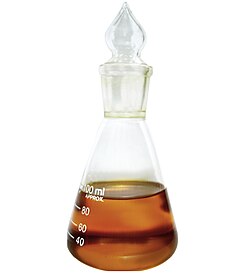
Key Facts
- Composition: Made from long-chain fatty acid esters derived from biological fats.
- Versatility: Can be used as 100% pure fuel (B100) or in various blends with petrodiesel.
- Feedstocks: Produced from a wide range of sources including palm oil, soybean oil, rapeseed, and waste vegetable oil (WVO).
- Environmental Impact: Offers a reduction in certain emissions, though carbon intensity varies based on feedstock and land use.
- Applications: Used in passenger cars, locomotives, generators, and for cleaning oil spills.
Biodiesel Blends and Standards
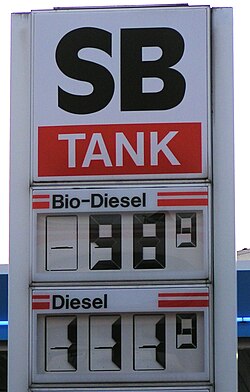
Biodiesel is frequently mixed with petroleum diesel to create blends that balance performance and environmental benefits. These blends are identified by a "B" followed by the percentage of biodiesel in the mixture.
- B100: 100% pure biodiesel.
- B20: 20% biodiesel, 80% petrodiesel.
- B10: 10% biodiesel, 90% petrodiesel.
- B7: 7% biodiesel, 93% petrodiesel.
- B5: 5% biodiesel, 95% petrodiesel.
- B2: 2% biodiesel, 98% petrodiesel.
These blends are achieved either through mixing in tanks at the manufacturing point or via "splash mixing" directly in the tanker truck during delivery.
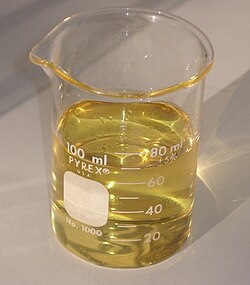
Production and Feedstocks
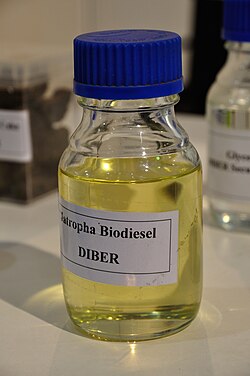
A diverse array of biological oils can be converted into biodiesel. The efficiency of production is often measured by the yield per hectare of the crop used. While some crops are highly productive, others are chosen for their ability to grow on marginal land or their availability as waste products.
Common Feedstock Sources
- Vegetable Oils: Palm, coconut, rapeseed, soy, sunflower, and hemp.
- Waste Products: Waste vegetable oil (WVO) and fats, oils, and greases (FOG) from sewage.
- Animal Fats: Tallow and fish oils.
- Experimental Sources: Algae, Jatropha, Pongamia, and even used coffee grounds.

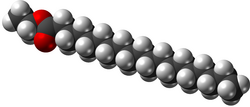
The chemical structure of these fuels, such as ethyl stearate produced from soybean or canola oil, allows them to function similarly to petroleum-based hydrocarbons.
Crop Yield Comparison
| Crop | Yield (L/ha) | Yield (US gal/acre) |
|---|---|---|
| Palm oil | 4752 | 508 |
| Coconut | 2151 | 230 |
| Cyperus esculentus | 1628 | 174 |
| Rapeseed | 954 | 102 |
| Soy (Indiana) | 554 - 922 | 59.2 - 98.6 |
| Chinese tallow | 907 | 97 |
| Peanut | 842 | 90 |
| Sunflower | 767 | 82 |
| Hemp | 242 | 26 |
Applications and Usage
Biodiesel is compatible with many existing diesel infrastructures, though manufacturer acceptance varies. It is widely used across several sectors:
Transportation
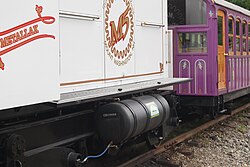
Beyond passenger vehicles, biodiesel is utilized in heavy transport. Older diesel engines, such as certain Mercedes models, are noted for their ability to run on biodiesel. It is also used in rail transport, including experimental trains in France and locomotives at the Mount Washington Cog Railway.



Industrial and Specialized Use
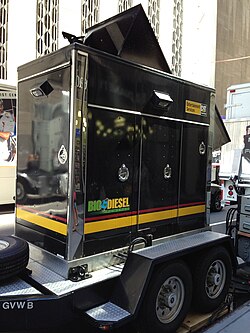
Biodiesel serves as a fuel for rental generators and as a heating oil. Due to its biodegradability, it is also employed in the cleanup of oil spills to reduce environmental toxicity.
Environmental and Mechanical Considerations
While biodiesel is renewable, its overall impact depends on the Carbon Intensity—the total greenhouse gas emissions produced throughout its lifecycle. This includes emissions from fertilizer use, feedstock transportation, and processing, balanced against the CO2 absorbed by the crops during growth.
![Calculation of Carbon Intensity of Soy biodiesel grown in the US and burnt in the UK, using figures calculated by the UK government for the purposes of the Renewable transport fuel obligation.[142]](/images/4c/0e/4c0ed4101e33720d2ef5b82c81b58892bc3455f75a6a8c78b1f118c11e6eb935.jpg)
![Graph of UK figures for the Carbon Intensity of Biodiesels and fossil fuels. This graph assumes that all biodiesel is used in its country of origin. It also assumes that the diesel is produced from pre-existing croplands rather than by changing land use[143]](/images/6c/be/6cbeae079be36f725f86a3b18b2149f2a24569f412bef9ab88add2cdb97477fe.jpg)
Environmental Concerns
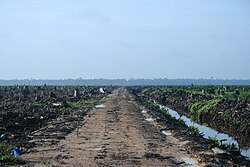
The expansion of biodiesel production has led to significant debates regarding "food vs. fuel," where land used for energy crops may displace food production. In some regions, such as Indonesia, this has contributed to deforestation to make room for oil palm plantations.
Mechanical Performance
- Emissions: Biodiesel generally reduces certain pollutants, though it can produce up to 4.7% more carbon dioxide at the tailpipe.
- Viscosity: Higher viscosity can lead to low-temperature gelling, affecting cold-start performance.
- Compatibility: Water contamination can cause corrosion in fuel pumps and lines.
Frequently Asked Questions
What is the difference between B20 and B100?
B100 is 100% pure biodiesel, whereas B20 is a blend consisting of 20% biodiesel and 80% petroleum diesel.
Can any vegetable oil be used as biodiesel?
While many oils can be used, they must undergo transesterification to become biodiesel. Unmodified vegetable oil is a different fuel type and may not be compatible with all diesel engines.
Does biodiesel increase CO2 emissions?
At the tailpipe, biodiesel can produce approximately 4.7% more CO2 than standard diesel. However, its overall carbon intensity is often lower because the crops absorb CO2 during their growth.
What are the main drawbacks of using biodiesel?
Key concerns include low-temperature gelling, potential for fuel system corrosion if contaminated by water, and the environmental impact of land-use changes, such as deforestation for palm oil.
Which crops are the most efficient for biodiesel production?
Based on yield per hectare, palm oil is the most productive, followed by coconut and Cyperus esculentus.