Bioceanic Corridor: Linking the Atlantic and Pacific Oceans
The Bioceanic Corridor (Portuguese: Corredor Bioceânico; Spanish: Corredor Bioceánico) is an ambitious infrastructure project designed to create a seamless transport link across South America. By connecting the Atlantic coast of Brazil to the Pacific coast of Chile, the corridor aims to revolutionize trade logistics between South America and the global markets of Asia and Oceania.
The primary objective of the project is to join the port of Santos in Brazil with the Chilean ports of Iquique and Antofagasta. This connection would allow goods to bypass longer traditional shipping routes, significantly reducing the time and cost of transporting exports.
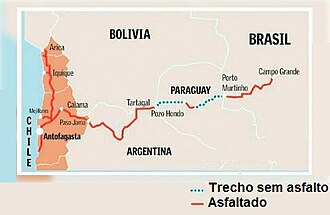
Key Facts
- Participating Countries: Brazil, Paraguay, Argentina, and Chile.
- Total Distance: Approximately 2,400 km between Campo Grande (Brazil) and Antofagasta (Chile).
- Primary Goal: Reduce travel time for exports to Asia and Oceania by up to two weeks.
- Key Infrastructure: Includes the paving of over 600 km of highways in Paraguay.
- Major Ports: Santos (Atlantic) and Iquique/Antofagasta (Pacific).
Project Origins and Planning
The vision for a transcontinental link gained significant momentum in 2013 when Bolivian President Evo Morales discussed the possibility of a railway linking the Atlantic and Pacific via Brazil and Peru with Chinese leader Xi Jinping. Following this, the Chinese government requested a feasibility study by 2014.
To execute these technical evaluations, the Bolivian government contracted FEVE, a Spanish narrow-gauge rail company. A collaborative effort involving Spanish, French, and Bolivian consultants produced the initial studies by June 2014. By August 2014, Bolivia actively sought financing from China to support the endeavor.
Strategic Framework
In December 2014, the Union of South American Nations prioritized the corridor as one of eight key regional integration projects. The planning phase focused on four critical baseline studies:
- Basic engineering design
- Market analysis
- Strategic planning
- Environmental impact assessment
Vladimir Sánchez, the then-Bolivian minister of public works, services, and housing, outlined a three-phase development plan: first, the construction of the railroad; second, its electrification; and third, the implementation of a double-track system.
Implementation and Progress
While early discussions focused heavily on rail, the corridor's development has evolved to include critical road infrastructure. In August 2017, an expedition traveled the route from Campo Grande to the Chilean ports of Iquique and Antofagasta, confirming the path through Brazil, Paraguay, Argentina, and Chile.
A significant portion of the project's success depends on Paraguay, which was tasked with paving more than 600 km of previously unpaved highways. A major milestone was achieved in February 2022, when Paraguay inaugurated 275 km of National Route 15. This segment connects Loma Plata in the center of the country to Carmelo Peralta on the Brazilian border.
Economic Impact and Trade Efficiency
The corridor is designed to optimize the export of Brazilian production, which currently relies heavily on the ports of Santos and Paranaguá. By utilizing Chilean ports, exporters in the midwest of Brazil can reach markets in China, Japan, India, and Australia more efficiently, potentially cutting shipping times by up to 14 days and lowering overall costs.
| Feature | Details |
|---|---|
| Route Length | 2,400 km |
| Atlantic Terminus | Port of Santos, Brazil |
| Pacific Terminus | Ports of Iquique and Antofagasta, Chile |
| Key Transit Countries | Brazil, Paraguay, Argentina, Chile |
| Estimated Time Saving | Up to 2 weeks for Asia/Oceania shipments |
Frequently Asked Questions
What is the main purpose of the Bioceanic Corridor?
The main purpose is to create a transport link between the Atlantic and Pacific oceans, allowing South American countries—specifically Brazil, Paraguay, Argentina, and Chile—to export goods to Asia and Oceania more quickly and cheaply.
Which countries are involved in the corridor?
The project involves Brazil, Paraguay, Argentina, and Chile, with early planning and feasibility studies also involving Bolivia and Peru.
How does the corridor benefit Brazilian exports?
It allows production from the midwest of Brazil to reach Chilean ports on the Pacific coast, reducing the travel time to Asian and Oceanian markets by up to two weeks compared to using Atlantic ports.
What progress has been made in Paraguay?
Paraguay has been responsible for paving over 600 km of highways. In February 2022, it inaugurated a 275 km stretch of National Route 15, connecting Carmelo Peralta to Loma Plata.
Who provided the technical feasibility studies?
The Bolivian government awarded the contract to the Spanish narrow-gauge rail company FEVE, with additional contributions from French and Bolivian consultants.