Bill Frisell: The Genre-Defying Architect of Modern Jazz Guitar
Few musicians have managed to blur the lines between high-art jazz and the raw, earthy sounds of American roots music as seamlessly as Bill Frisell. An American guitarist, composer, and arranger, Frisell has spent over four decades redefining the sonic possibilities of the electric guitar. From the avant-garde corridors of New York City to the wide-open landscapes of Americana, his career is a testament to musical curiosity and technical mastery.
Key Facts
- Full Name: William Richard Frisell
- Primary Instrument: Guitar
- Key Genres: Jazz, Jazz Fusion, Folk Jazz, Americana, and Classical
- Major Accolades: One Grammy Award win and six nominations
- Education: University of Northern Colorado and Berklee College of Music
- Career Span: Active from 1978 to the present
Early Life and Musical Foundations
Born in Baltimore, Maryland, on March 18, 1951, Bill Frisell spent much of his youth in the Denver, Colorado area. While he initially studied the clarinet under Richard Joiner of the Denver Symphony Orchestra, his interests shifted toward the guitar during his teenage years. He began his formal guitar studies with Dale Bruning, a partnership that would eventually lead to the release of the duo album Reunion in 2000.
Frisell's academic journey took him to the University of Northern Colorado (UNC), where he studied under guitarist Johnny Smith. Frisell has noted that his relationship with Smith often evolved into private lessons, as the rigorous focus on music theory, scales, and inversions was too demanding for many of his peers. He further refined his craft at the Berklee College of Music in Boston, studying with renowned musicians Jon Damian and Jim Hall.
The ECM Years and the New York Scene
Frisell's professional breakthrough occurred in the early 1980s through a recommendation from Pat Metheny. This led to a recording session with drummer Paul Motian for the album Psalm (1982) on ECM Records, a label known for its pristine production and atmospheric sound. Throughout the 1980s, Frisell served as ECM's in-house guitarist, contributing to various projects, including Jan Garbarek's Paths, Prints. He released his first leader album, In Line, in 1983.
During this era, Frisell became a central figure in the New York City "Downtown Scene," a hub for experimental and avant-garde music. He developed a significant working relationship with composer and saxophonist John Zorn, notably as a member of the band Naked City. He also maintained a long-term collaboration with Paul Motian, performing in his groups from the early 1980s until Motian's passing in 2011.
Expanding Horizons: Seattle and Americana
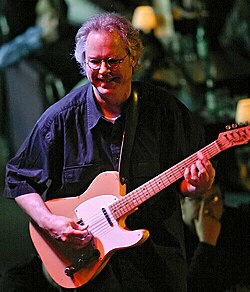
In 1988, Frisell relocated to Seattle, Washington, where his musical palette expanded to include more explicitly American sounds. In the early 1990s, he released two critically acclaimed albums: Have a Little Faith, which surveyed Americana through the works of Aaron Copland, Bob Dylan, and Madonna, and This Land, a collection of original compositions.
Frisell's versatility extended into film and television. He composed soundtracks for the silent films of Buster Keaton and provided music for the TV version of The Far Side. By 1997, his exploration of country and bluegrass culminated in the album Nashville on Nonesuch Records, featuring collaborations with Jerry Douglas and members of Union Station.
Later Career and Global Influence
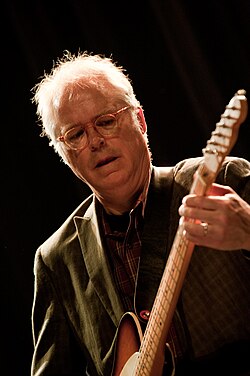
Entering the 21st century, Frisell continued to experiment with diverse ensembles and commissions. In 1999, he composed Blues Dream for the Walker Art Center and released The Sweetest Punch, a jazz reworking of songs by Elvis Costello and Burt Bacharach. Between 2003 and 2005, he served as the musical director for Century of Song at the Ruhrtriennale arts festival in Germany, arranging pieces for a wide array of artists including Suzanne Vega and Rickie Lee Jones.
His critical success peaked with the 2005 Grammy Award for Best Contemporary Jazz Album for Unspeakable. In recent years, he has continued to record for labels such as Savoy and Blue Note, and in 2017, he was awarded an honorary doctorate of music from the Berklee College of Music. He returned to reside in Brooklyn in 2017.
Career Summary
| Period/Year | Key Milestone/Project | Associated Label/Entity |
|---|---|---|
| 1980s | In-house guitarist and leader (In Line) | ECM Records |
| 1980s-90s | Downtown Scene / Naked City | Collaboration with John Zorn |
| 1992-1997 | Americana and Country exploration | Nonesuch Records |
| 2005 | Grammy Win for Unspeakable | Nonesuch Records |
| 2010-2011 | Beautiful Dreamers and Sign of Life | Savoy Jazz |
| 2017 | Honorary Doctorate of Music | Berklee College of Music |
Frequently Asked Questions
What musical genres does Bill Frisell play?
Bill Frisell is primarily known for jazz and jazz fusion, but his work extensively incorporates folk jazz, Americana, country, rock 'n' roll, and classical elements.
Which record labels has Bill Frisell worked with?
He has recorded for several prominent labels, including ECM, Nonesuch, Elektra, Savoy, and Blue Note.
Who are some of Bill Frisell's most important collaborators?
Key collaborators include drummer Paul Motian, composer John Zorn, and various artists such as Vinicius Cantuária and Jenny Scheinman.
Has Bill Frisell won any major awards?
Yes, he has received six Grammy nominations and won the Grammy Award for Best Contemporary Jazz Album in 2005 for his album Unspeakable.
Where did Bill Frisell study music?
He studied at the University of Northern Colorado, where he learned from Johnny Smith, and later attended the Berklee College of Music in Boston.