Berrypeckers and Longbills: The Unique Songbirds of New Guinea
Deep within the diverse forests of New Guinea resides a small, specialized family of songbirds known as the Melanocharitidae. Comprising the berrypeckers and longbills, this family consists of eleven species distributed across four genera. While they may appear modest with their generally dull plumage, these birds possess fascinating biological traits and a complex taxonomic history that has challenged ornithologists for decades.
Key Facts
- Endemic Range: Found exclusively in the forests of New Guinea.
- Species Count: 11 species divided among four genera.
- Size Extremes: Ranges from the pygmy longbill (7.3 cm) to the fan-tailed berrypecker (15 cm).
- Diet: Primarily berries and small fruits, supplemented by arthropods.
- Unique Trait: Some species exhibit reversed sexual dimorphism, where females are larger than males.
Taxonomy and Systematics
The identification of Melanocharitidae as a distinct family was only made possible through the work of Sibley and Ahlquist, who utilized DNA–DNA hybridization (a technique used to compare genetic similarity between species). Before this discovery, these birds were misclassified; berrypeckers were placed with flowerpeckers (Dicaeidae), and longbills were mistaken for honeyeaters due to their physical resemblance.
While early research linked them to sunbirds and flowerpeckers, a 2002 study suggested a closer relationship to satinbirds (Cnemophilidae). The family is currently organized into four genera: Melanocharis, Oedistoma, Rhamphocharis, and Toxorhamphus.
Taxonomic debate continues regarding the longbills. Although Oedistoma was established forty years before Toxorhamphus, the two are sometimes incorrectly lumped together. However, morphological differences in the tarsus (the lower leg) and molecular evidence support keeping them separate. Similarly, the spotted berrypecker is placed in Rhamphocharis due to distinct anatomical and behavioral traits, though some classifications group it with Melanocharis.
Physical Characteristics
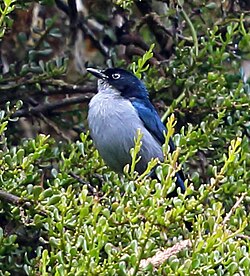
These songbirds are small to very small, characterized by drab plumage in shades of grey, brown, black, and white. The berrypeckers typically resemble stout, short-billed honeyeaters, while the longbills look like drab sunbirds or short-tailed honeyeaters.
One of the most remarkable aspects of this family is the reversed sexual dimorphism found in the fan-tailed and streaked berrypeckers. In most songbird species, males are larger; however, in these two species, the females are both longer and heavier. For instance, a male fan-tailed berrypecker weighs between 12 and 15 g, while the female weighs between 16 and 20 g.
Distribution and Habitat
The family is stratified by altitude across the New Guinean landscape. Berrypeckers are primarily montane (mountain-dwelling) species. The black berrypecker occupies the lowlands, the mid-mountain berrypecker inhabits mid-montane regions, and the fan-tailed berrypecker is found near the treeline.
Conversely, longbills are found in lowland forests, low montane forests, and on various small islands surrounding the mainland.
Behavior and Ecology
Melanocharitidae are highly active feeders that rarely pause while foraging. Their diet is dominated by berries and small fruits, though they also glean arthropods from foliage or occasionally snatch them while hovering. While most species forage in the lower and middle forest levels, the obscure berrypecker and the male black berrypecker are known to enter the canopy.
Socially, they are usually seen alone or in pairs. While they may join mixed-species feeding flocks, they remain loose members rather than core participants. Their vocalizations are described as rapid songs with high-pitched, faint calls.
Breeding and Nesting
Information on their breeding habits is limited, but known nests are cup-shaped and typically built on forked branches near the edge of a tree. These nests are constructed from plant fibers and fern scales, bound with spider or insect silk and decorated with lichens. They typically lay one or two eggs. In the case of the black berrypecker, the female builds the nest alone, though both parents share the responsibility of feeding the young.
Conservation Status
Currently, the berrypeckers and longbills are not considered threatened by human activity. No species is listed as threatened by the IUCN, although the obscure berrypecker is categorized as data deficient, as it is officially known from only two collected specimens.
| Genus | Common Name Group | Notable Species |
|---|---|---|
| Melanocharis | Berrypeckers | Fan-tailed, Black, Mid-mountain, Streaked, Obscure |
| Rhamphocharis | Berrypeckers | Thick-billed, Spotted |
| Toxorhamphus | Longbills | Yellow-bellied, Slaty-headed |
| Oedistoma | Longbills | Spectacled, Pygmy |
Frequently Asked Questions
Which is the smallest bird in New Guinea?
The pygmy longbill (Oedistoma pygmaeum) is the smallest bird in New Guinea, measuring only 7.3 cm (2.9 in) in length.
What is unique about the size of female berrypeckers?
In the fan-tailed and streaked berrypecker species, females exhibit reversed sexual dimorphism, meaning they are longer and heavier than the males.
What do berrypeckers and longbills eat?
Their diet consists primarily of berries and small fruits, supplemented by arthropods gleaned from foliage or caught while hovering.
How were these birds originally misclassified?
Before DNA analysis, berrypeckers were placed in the flowerpecker family (Dicaeidae), and longbills were considered to be honeyeaters due to their physical appearance.
Where can these birds be found?
The Melanocharitidae family is restricted entirely to the forests of New Guinea and its surrounding small islands.