Bernardino Rivadavia: The First President of Argentina
Bernardino Rivadavia stands as one of the most influential and controversial figures in the early formation of the Argentine state. Serving as the first President of Argentina—then known as the United Provinces of the Río de la Plata—Rivadavia sought to modernize the nation through European-style institutions, centralized governance, and ambitious urban development.
His legacy is a complex blend of intellectual progress and political friction, marked by the creation of the University of Buenos Aires and the struggle between the Unitarian Party (which favored a strong central government) and the Federalists (who advocated for provincial autonomy).
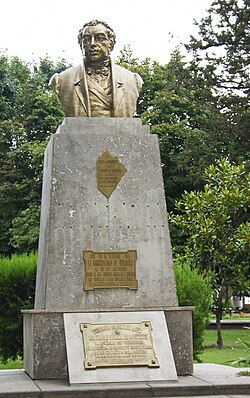
Key Facts
- First President: Served from February 8, 1826, to June 27, 1827.
- Educational Legacy: Founded the University of Buenos Aires and the continent's first natural science museum.
- Political Stance: A leading member of the Unitarian Party.
- Economic Impact: Negotiated a massive loan from Baring Brothers Bank that contributed to long-term foreign debt.
- Final Years: Died in exile in Cádiz, Spain, in 1845.
Early Life and Rise to Power
Born on May 20, 1780, in Buenos Aires to Spanish parents from Galicia, Bernardino Rivadavia was educated at the Real Colegio San Carlos. Though he did not complete his formal studies, he became a lawyer and entered the political fray during a period of intense volatility. He served as Third Lieutenant of the Galicia Volunteers during the British Invasions and played a pivotal role in the May Revolution of 1810, voting for the deposition of the Spanish viceroy.
Rivadavia quickly ascended the political ladder, serving as Minister of Government and Finance, as well as Minister-Secretary of War, under the First Triumvirate between 1811 and 1812. His early career was defined by a drive toward centralism and the organization of a professional army.
Modernizing Buenos Aires
Between 1821 and 1824, as Minister of Government for the Province of Buenos Aires, Rivadavia focused on transforming the city into a European-style capital. He implemented paved and lighted streets, constructed large avenues, and established several academic institutions, including the Theatre, Geology, and Medicine Academies.
However, this modernization came with a heavy financial price. Rivadavia authorized a one-million pound loan through the Baring Brothers Bank in London. Due to mismanagement and intermediaries, the government received only £552,700, while the debt remained. This foreign debt was eventually transferred to the national government in 1825 and was not fully repaid until 1904.
The Presidency and the Constitution of 1826
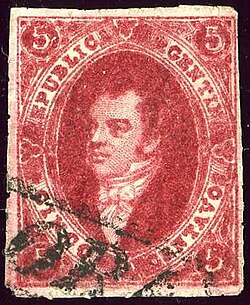
The outbreak of war with Brazil necessitated a centralized executive, leading to Rivadavia's election as President on February 8, 1826. His administration attempted to solidify the state through the Constitution of 1826, which officially renamed the nation the Argentine Republic and established a representative, republican, and unitary government.
This constitution was deeply unpopular in the interior provinces, where federalist leaders viewed it as an attempt by Buenos Aires to impose its will on the rest of the country. The resulting tension sparked civil unrest and open revolt in several provinces.
Economic Policies and Land Reform
Rivadavia introduced the system of emphyteusis—a legal arrangement where the state retains ownership of land but grants long-term leases to tenants. While intended to be progressive, this policy led to a massive concentration of land ownership. Approximately 138 owners, many of whom were Rivadavia's political collaborators, acquired over 18 million hectares of land, often paying little to no rent.
Conflict and Resignation
Rivadavia's presidency was plagued by the war with Brazil over the Cisplatine Province (modern-day Uruguay). The United Provinces struggled against Brazil's superior population and financial stability, further hampered by a blockade of the port of Buenos Aires.
The situation reached a breaking point with the Preliminary Peace Convention of 1827. Signed by plenipotentiary minister Manuel José García, the agreement was seen as too concessive to Brazil. Although Rivadavia opposed the convention, the political damage was irreversible. Facing pressure from both the Federalist Party and public opinion, Rivadavia resigned on June 27, 1827.
Exile, Death, and Repatriation
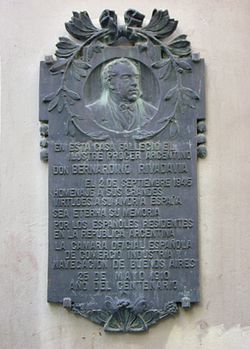
Following his resignation, Rivadavia eventually fled to Europe in 1829. He spent his final years in Spain, where he died in Cádiz on September 2, 1845, at the age of 65.
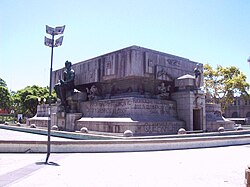
Despite his request in his will not to be buried in Buenos Aires, his remains were repatriated in 1857 with full honors. He was greeted by a crowd of roughly 60,000 people. Today, his remains lie in a mausoleum in Plaza Miserere, located next to the city's longest avenue, Avenida Rivadavia, which was named in his honor.
Summary of Bernardino Rivadavia's Career
| Period | Role/Event | Key Outcome |
|---|---|---|
| 1811–1812 | Minister (First Triumvirate) | Focused on central government and army organization. |
| 1821–1824 | Minister of Government (Buenos Aires) | Founded UBA and modernized city infrastructure. |
| 1826–1827 | 1st President of Argentina | Promulgated the Constitution of 1826; faced provincial revolt. |
| 1827 | Resignation | Triggered by the failed Peace Convention with Brazil. |
| 1857 | Repatriation | Remains returned to Buenos Aires; Avenida Rivadavia named. |
Frequently Asked Questions
Why was Bernardino Rivadavia's presidency so short?
His presidency lasted only about 16 months due to intense opposition from provincial federalists who rejected the centralized Constitution of 1826 and the fallout from the Preliminary Peace Convention of 1827 during the war with Brazil.
What was the impact of the Baring Brothers loan?
The loan was intended for public works to modernize Buenos Aires, but much of the money was diverted to British traders and never repaid. This created a significant foreign debt that the Argentine nation did not finish paying until 1904.
What is emphyteusis and how did it affect Argentina?
Emphyteusis was a land-leasing system where the state leased public lands to individuals. In practice, it allowed a small group of wealthy families and government collaborators to consolidate vast amounts of land, leading to extreme land concentration in Buenos Aires.
What were the main differences between the Unitarians and Federalists?
The Unitarians, led by figures like Rivadavia, wanted a strong central government based in Buenos Aires. The Federalists wanted a loose confederation of provinces where each region maintained its own autonomy and power.
Where can you find tributes to Rivadavia today?
The most prominent tributes include Avenida Rivadavia, the longest avenue in Buenos Aires, and his mausoleum located in Plaza Miserere.