Bay Laurel: The History, Botany, and Uses of Laurus nobilis
The Bay Laurel (Laurus nobilis) is an aromatic evergreen tree or large shrub renowned for its glossy green leaves and deep historical significance. Native to the Mediterranean region, this member of the Lauraceae family is widely recognized today as the source of the bay leaf used in global cuisines. Beyond the kitchen, the bay laurel has served as a potent symbol of victory, status, and divinity for millennia.
While many plants worldwide are referred to as "bay" or "laurel" due to similar scents or foliage, Laurus nobilis is the true laurel of classical tradition.
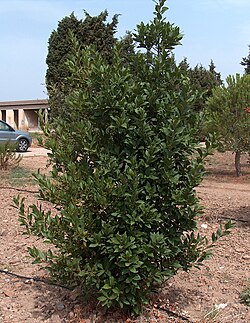
Key Facts
- Scientific Name: Laurus nobilis
- Conservation Status: Least Concern (IUCN 3.1)
- Native Region: Mediterranean Basin
- Primary Use: Culinary seasoning, ornamental gardening, and aromatherapy
- Key Chemical: 1,8-cineole (eucalyptol)
- Symbolism: Victory, immortality, and academic achievement
Botanical Description and Ecology
The bay laurel is a variable evergreen that can grow as a shrub or a small tree, typically reaching heights between 7 and 18 meters, though some specimens can reach up to 20 meters with stems measuring 1 meter in diameter. Its leaves are glabrous (smooth), measuring 6–12 cm in length and 2–4 cm in width, often featuring an entire, occasionally undulating margin.
This species is dioecious, meaning male and female flowers occur on separate plants. The flowers are pale yellow-green and approximately 1 cm in diameter. The resulting fruit is a small, shiny black drupe-like berry containing a single seed.
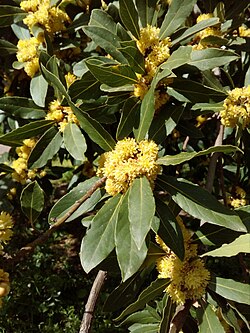
Ecologically, Laurus nobilis is a relict of the ancient laurel forests that once covered the Mediterranean Basin during more humid periods. As the region dried during the Pliocene era, these forests retreated. Today, remnants persist in the mountains of southern Turkey, northern Syria, southern Spain, north-central Portugal, northern Morocco, Madeira, and the Canary Islands.
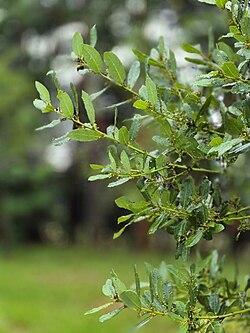
Human Uses and Applications
Culinary Uses
The bay laurel is a staple in Mediterranean cooking. Whole bay leaves are primarily used as flavoring agents during food preparation and are typically removed before serving, though they can serve as a garnish. These leaves have a long shelf life of approximately one year. While whole leaves are usually removed, ground bay leaves are safe for ingestion and are common in stocks, soups, and cocktails like the Bloody Mary. Additionally, dried berries and pressed leaf oil are used as spices, and the wood is sometimes burned for smoke flavoring.
Ornamental Gardening
Due to its dense foliage, Laurus nobilis is popular for topiary—the art of clipping shrubs into ornamental shapes such as balls, boxes, or twisted crowns. It is also used for low hedges. While slow-growing, certain varieties like the gold-form L. nobilis 'Aurea' and the willow-leaved L. nobilis f. angustifolia have received the Royal Horticultural Society's Award of Garden Merit.
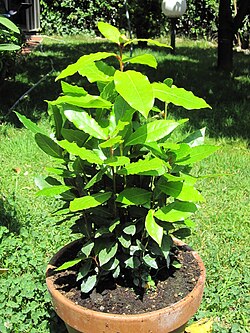
Gardeners should be aware of pests such as the jumping plant louse (Trioza alacris), which causes leaf edges to curl and thicken into necrosed galls, and the scale insect Coccus hesperidum.
Alternative Medicine
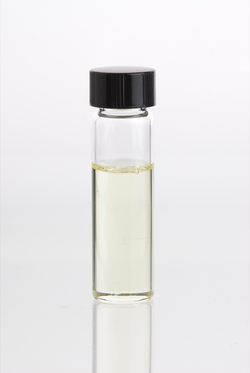
In herbal traditions, aqueous extracts of the plant have been used as salves for open wounds and as astringents. It is also employed in aromatherapy and massage therapy. Some folk remedies use boiled bay leaf poultices to treat rashes from stinging nettles or poison ivy. Historically, the Roman naturalist Pliny the Elder claimed laurel oil could treat conditions ranging from sciatica and rheumatism to headaches and ear infections.
Cultural Symbolism and History
Ancient Greece and Rome
In Greek mythology, the plant is named after the nymph Daphne, who was transformed into a laurel tree to escape the god Apollo. Consequently, the laurel became a symbol of Apollo. The laurel wreath was awarded at the Pythian Games and served as a mark of highest status. The Pythia, the oracle of Delphi, reportedly chewed laurel leaves to induce a trance for her prophecies.
The Romans adopted the laurel as a symbol of victory, prosperity, and immortality. It was closely linked to the Emperors; Augustus used laurels to signal his victory in the Civil Wars and his connection to Apollo. The tradition of the laurel wreath persists today in the terms "baccalaureate" and "poet laureate," and in the Italian tradition of crowning graduating students.

Global Influence
In East Asia, the Mediterranean laurel became associated with the Chinese "Moon gui" (月桂) through translations of European success symbols, linking it to the imperial examinations. In Finland, laurel leaves appear in the coat of arms of Kaskinen, possibly referencing the Bladh family or local flora.

Chemical Composition
The primary active component of laurel essential oil is 1,8-cineole, also known as eucalyptol. The leaves contain roughly 1.3% essential oils, consisting of eucalyptol (45%), terpinyl acetate (8–12%), and various terpenes and sesquiterpenes. The fruit contains up to 30% fatty oils and 1% essential oils, which serve as the characteristic ingredient in Aleppo soap.
| Feature | Detail |
|---|---|
| Growth Habit | Evergreen shrub or tree (up to 20m) |
| Flower Type | Dioecious, pale yellow-green |
| Fruit | Small, shiny black drupe-like berry |
| Main Chemical | 1,8-cineole (Eucalyptol) |
| Native Range | Mediterranean Basin |
Frequently Asked Questions
Can you eat whole bay leaves?
Whole bay leaves are typically used as flavoring agents during cooking and are removed before serving. However, ground bay leaves can be ingested safely and are often used in soups and stocks.
What is the difference between bay laurel and other "bay" plants?
Laurus nobilis is the true bay laurel of the Mediterranean. Many other plants are called "bay" due to similar aromas or leaves, but they belong to different families and may not have the same culinary or historical properties.
Why is the laurel wreath a symbol of victory?
The tradition began in Ancient Greece, where the laurel was sacred to Apollo. Wreaths were given as prizes at the Pythian Games and later adopted by Romans to symbolize triumph, immortality, and high status.
What is the main use of laurel fruit oil?
The oil extracted from the pressed fruit of Laurus nobilis is a key characteristic ingredient used in the production of Aleppo soap.
How do you grow bay laurel as an ornamental?
It is widely grown in Mediterranean or oceanic climates as a hedge or topiary. In colder regions, it is typically kept as a houseplant or in a greenhouse. Note that it is a slow-growing species.