Battle of Panium: The Fall of Ptolemaic Power in Coele-Syria
The Battle of Panium, fought in the summer of 200 BC, stands as a decisive turning point in the ancient struggle for hegemony in the Near East. Occurring near Paneas (modern-day Caesarea Philippi), this clash served as the climax of the Fifth Syrian War, pitting the ambitious Seleucid Empire against the Ptolemaic Kingdom of Egypt.
The conflict was not merely a territorial dispute but a struggle for the control of Coele-Syria. The result was a crushing Seleucid victory that fundamentally altered the geopolitical landscape, ending the Ptolemies' status as an independent great power and clearing the way for the Seleucids to face the rising threat of the Roman Republic.
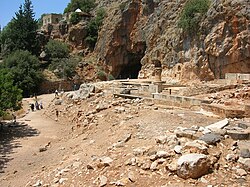
Key Facts
- Date: Summer 200 BC
- Location: Near Banias (Paneas), near Mount Hermon
- Outcome: Decisive Seleucid victory
- Primary Result: Seleucid conquest of Coele-Syria
- Key Commanders: Antiochus III the Great (Seleucid) vs. Scopas of Aetolia (Ptolemaic)
- Strategic Impact: The Ptolemaic Kingdom ceased to be a dominant independent power.
The Road to Panium
The seeds of the battle were sown in 202 BC when Ptolemy, the Ptolemaic governor of Coele-Syria, defected to Antiochus III the Great. Seizing this opportunity, Antiochus invaded and occupied much of the province, including Gaza, by the autumn of 201 BC. While the Ptolemaic commander Scopas of Aetolia managed to reclaim some territory during the winter, the momentum shifted back to the Seleucids in the summer of 200 BC when Antiochus gathered his forces at Damascus to confront the Egyptians at the stream of Panium.
Military Dispositions
The Ptolemaic Army
The Ptolemaic front line spanned four kilometers. Their primary strength lay in the left wing, where 25,000 to 32,000 phalangites (infantry armed with long pikes) from the Macedonian settler phalanx were deployed. These were considered the kingdom's elite troops. Overall command was held by the mercenary general Scopas of Aetolia, who contributed 6,000 infantry and 500 cavalry.
The Seleucid Army
Antiochus III commanded a numerically superior force of approximately 70,000 men. His army was a diverse machine of war, including cataphracts (heavily armored cavalry), the elite agema cavalry, Tarentines, hypaspists (elite guards), and war elephants. The cataphracts were led by the king's eldest son, Antiochus the Younger.
The Course of the Battle
The engagement began with a daring night maneuver by Antiochus the Younger, who seized Tel Hamra, a foothill of Mount Hermon. His cataphracts launched a sudden attack that quickly routed the Ptolemaic cavalry.
In the center, the Ptolemaic phalanx initially succeeded in pushing back the Seleucid lines. However, this momentum was halted when Seleucid war elephants charged through the gaps in their own phalanx to neutralize the Egyptian advance. Simultaneously, the cataphracts, having finished their pursuit of the cavalry, circled back to strike the rear of the Ptolemaic phalanx.
Trapped between war elephants, phalangites, and heavy cavalry, the immobile Ptolemaic phalanx was nearly annihilated. Seeing the collapse, Scopas fled the field with 10,000 of his troops.
Aftermath and Strategic Consequences
The defeat was catastrophic for the Ptolemies. While Scopas sought refuge in Sidon, other remnants of the army fled to Jerusalem, Samaria, Phoenicia, and Decapolis; all were forced to surrender by 198 BC. A formal peace treaty was signed in 195 BC, officially placing Coele-Syria under Seleucid control.
Beyond the territorial loss, the battle forced the Ptolemaic state to reduce the role of the Macedonian settler phalanx. For Antiochus III, the victory secured his southern border, allowing him to turn his full attention toward the looming conflict with the Roman Republic.
| Feature | Seleucid Empire | Ptolemaic Egypt |
|---|---|---|
| Commander | Antiochus III the Great | Scopas of Aetolia |
| Estimated Strength | ~70,000 men | 46,500–53,000 men |
| Key Units | Cataphracts, Elephants, Agema | Macedonian Settler Phalanx |
| Outcome | Complete Victory | Decisive Defeat |
| Estimated Losses | Unknown | 17,500–20,825 phalangites |
Frequently Asked Questions
What was the primary cause of the Battle of Panium?
The battle was the result of the Fifth Syrian War, specifically triggered by the defection of the Ptolemaic governor of Coele-Syria to Antiochus III, leading to a Seleucid invasion of the province.
How did the Seleucids defeat the Ptolemaic phalanx?
The Seleucids used a combined-arms approach: war elephants halted the phalanx's forward momentum, while heavy cataphract cavalry attacked the phalanx from the rear, trapping and annihilating the infantry.
What were the long-term consequences for the Ptolemaic Kingdom?
The Ptolemaic Kingdom lost control of Coele-Syria and ceased to be an independent great power in the region, significantly diminishing its influence in the ancient world.
Is there a biblical connection to this battle?
Some biblical commentators suggest that the Battle of Panium is the event described in Daniel 11:15, referring to the "king of the North" capturing a fortified city.
Who were the cataphracts mentioned in the battle?
Cataphracts were elite, heavily armored cavalry where both the rider and the horse were protected by armor, providing a powerful shock force on the battlefield.