Battle of Aleppo 1918: The Final Pursuit of the Sinai and Palestine Campaign
The Battle of Aleppo, fought on October 25, 1918, served as a pivotal closing chapter in the Middle Eastern theatre of World War I. Occurring during the final days of the Sinai and Palestine Campaign, the engagement saw the capture of the strategic city of Aleppo by Prince Feisal's Sherifial Forces. This victory capped a relentless pursuit of the retreating Ottoman forces following the Allied success at the Battle of Megiddo.
Aleppo, a city with a history stretching back to the Hittite era, held immense strategic value due to its location on the Anatolian frontier and its proximity to the Mouslimie Junction—a critical railway link between the Palestine and Mesopotamian systems. By 1918, the city housed approximately 150,000 residents and became the focal point for the remnants of the Ottoman Yildirim Army Group.
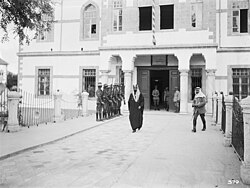
Key Facts
- Date: October 25, 1918.
- Outcome: Allied victory and the capture of Aleppo.
- Primary Belligerents: British Empire (including Australia) and Hejaz forces against the Ottoman and German Empires.
- Key Commanders: Edmund Allenby, Harry Chauvel, and Faisal bin Hussein (Allies); Mustafa Kemal Pasha and Otto Liman von Sanders (Central Powers).
- Decisive Action: Nighttime infiltration and street fighting by Sherifial Forces.
Strategic Background and the Pursuit
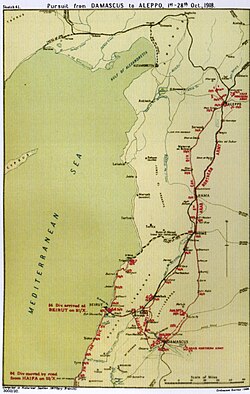
Following the decisive victory at the Battle of Megiddo, General Edmund Allenby, commander of the Egyptian Expeditionary Force (EEF), was encouraged by Sir Henry Wilson to push north toward Aleppo. The pursuit was a logistical challenge; Lieutenant General Harry Chauvel's Desert Mounted Corps (the primary mobile force of the EEF) was already 150 miles from its main supply base when it reached Damascus, with Aleppo lying another 200 miles further north.
As the Ottoman Yildirim Army Group retreated from the Judean Hills and Damascus, they suffered from panic and depletion. While the Australian Mounted Division and 5th Cavalry Division secured Damascus on October 1, the pursuit continued toward Aleppo using a combination of armoured cars and cavalry to maintain momentum despite sickness and supply shortages among the troops.
Forces and Defenses
The Allied Force
The pursuit force was a composite of diverse units, including:
- Sherifial Force: Two columns of 1,500 men each, commanded by Colonel Nuri Bey and Sherif Nasir.
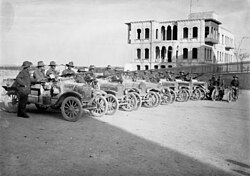
- Armoured Units: 24 armoured cars divided into three batteries and three light car patrols.
- Cavalry: The 15th Imperial Service Cavalry Brigade, supported by the 13th and 14th Cavalry Brigades of the 5th Cavalry Division.
The Ottoman Defense
Mustafa Kemal Pasha was tasked with the defense of Aleppo. He organized a garrison of 4,000 troops, with roughly 20,000 soldiers in the immediate vicinity. Kemal deployed four divisions south of the city in strong entrenched positions, including the reorganized 1st and 11th Divisions of the Ottoman XX Corps. Other divisions were stationed at Alexandretta and Tarsus to cover the northern retreat.
The Engagement: October 23–26
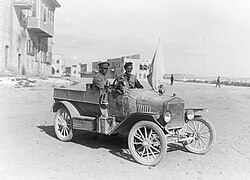
On October 23, Allied armoured cars conducted a reconnaissance toward the city. After engaging Ottoman cavalry at Khan Tuman, they encountered heavy entrenchments three miles south of Aleppo. Captain R. H. M. McIntyre of the 7th Light Car Patrol attempted to negotiate a surrender under a flag of truce, but Mustafa Kemal rejected the demand.
By October 25, the Sherifial Force under Nuri Bey launched an attack on the southern entrenchments but was driven back by heavy machine-gun and rifle fire. However, the tide turned during the night of October 25. While the 5th Cavalry Division planned a coordinated three-pronged attack for the following day, Nuri Bey's forces attacked from the east, and Sherif Nasir's troops bypassed the southern defenses to enter the city.
Violent hand-to-hand fighting erupted in the streets of Aleppo throughout the night. In the ensuing confusion, Mustafa Kemal withdrew his headquarters, losing contact with the troops in the southern trenches. By 10:00 AM on October 26, the Sherifial Forces had captured the city, suffering 60 fatalities.
Aftermath and Legacy
Following the city's fall, the Jodhpore and Mysore lancer regiments attempted to push toward Haritan on the Alexandretta road but were forced to retire due to strong Ottoman resistance. The remaining Ottoman forces, including the remnants of the Seventh Army, retreated further north and northwest.
The victory at Aleppo effectively ended the Ottoman presence in the region. Today, the memory of the conflict is preserved at the Aleppo War Cemetery near Sheikh Maqsoud, which commemorates British and Commonwealth casualties from both World Wars.
| Category | Allied Forces | Ottoman/German Forces |
|---|---|---|
| Key Leaders | Allenby, Chauvel, Prince Feisal | Mustafa Kemal, Liman von Sanders |
| Primary Units | Sherifial Force, 5th Cavalry Division, Armoured Cars | Yildirim Army Group (XX Corps) |
| Strategy | Rapid pursuit and urban infiltration | Entrenched rearguard defense |
| Result | Captured Aleppo | Retreated north of the city |
Frequently Asked Questions
Who were the Sherifial Forces?
The Sherifial Forces were Arab troops led by Prince Feisal (Faisal bin Hussein) and commanders like Nuri Bey and Sherif Nasir, fighting alongside the British Empire to establish Arab independence from Ottoman rule.
Why was Aleppo strategically important?
Aleppo was a vital frontier city and a key railway junction (Mouslimie Junction) connecting the Palestine and Mesopotamian railway systems, making it essential for logistics and troop movements.
What role did armoured cars play in the battle?
Armoured cars provided rapid reconnaissance and initial contact with Ottoman forces. While they struggled with the rough terrain southwest of the city, they were integral to the pursuit from Damascus.
How did the city actually fall?
Although the Ottomans held strong defenses south of the city, Sherifial Forces bypassed these entrenchments under cover of darkness, entering the city and engaging in street fighting that forced the Ottoman command to withdraw.
Who was Mustafa Kemal Pasha?
Mustafa Kemal Pasha was the Ottoman commander responsible for the defense of Aleppo. He later became the founder and first president of the Republic of Turkey.