Baltasar Hidalgo de Cisneros: The Final Spanish Viceroy of Río de la Plata
Baltasar Hidalgo de Cisneros was a high-ranking Spanish Navy officer and colonial administrator whose tenure as the 11th Viceroy of the Río de la Plata coincided with the collapse of Spanish authority in South America. A veteran of some of the most significant naval conflicts of the Napoleonic era, Cisneros transitioned from the battlefields of the Atlantic to the volatile political landscape of Buenos Aires, where he ultimately became a central figure in the May Revolution.
Key Facts
- Full Name: Baltasar Hidalgo de Cisneros y de la Torre.
- Role: 11th Viceroy of the Viceroyalty of the Río de la Plata (1809–1810).
- Naval Rank: Admiral of the Spanish Navy.
- Major Battles: Battle of Cape St Vincent and the Battle of Trafalgar.
- Legacy: Deposed during the May Revolution of 1810, leading to the establishment of the first local government junta.
Early Life and Naval Career
Born on January 6, 1756, in Cartagena, Spain, Baltasar was named after one of the Biblical Magi because his birth coincided with the feast of Epiphany. The son of a Royal Navy lieutenant, he began his military service in 1770. His early career took him to the coasts of Africa and Peru, including a campaign in Algiers.
By 1795, Cisneros was promoted to commander of the San Pablo during the Anglo-Spanish War. He participated in the Battle of Cape St Vincent, though the Spanish fleet suffered a defeat. His naval career reached a dramatic peak in 1805 when he captained the Nuestra Señora de la Santísima Trinidad, the largest Spanish ship of its time, during the Battle of Trafalgar.
During the battle, a falling mast struck Cisneros, causing a severe concussion that left him partially deaf for the remainder of his life. This injury earned him the nickname "El Sordo" (The Deaf). Despite the British victory and the sinking of his ship, Cisneros was awarded battle honors and eventually promoted to lieutenant general upon his return to Spain.
Appointment as Viceroy
Following his recovery, Cisneros served as vice-president of the governing council (Junta) of Cartagena. In 1809, the Junta of Seville appointed him to replace Santiago de Liniers as the Viceroy of the Río de la Plata. The Spanish authorities viewed Liniers as an afrancesado—a sympathizer of Napoleon Bonaparte—and ordered Cisneros to remove him and dissolve the local criollo (Spanish descendants born in the Americas) militias.
Cisneros arrived in Montevideo in June 1809. Contrary to the Junta's expectations of a violent struggle, Liniers stepped down without resistance. Recognizing that Liniers was not a rebel, Cisneros allowed him to remain in the Viceroyalty. He also worked to stabilize the region by adopting a conciliatory approach, granting veteran status to criollo militia commanders and pardoning several political prisoners.
Political Tension and Internal Conflict
Despite his attempts at diplomacy, Cisneros faced immense pressure from both the Spanish crown and local factions. He attempted to liberalize trade to appease landowners and the British, but faced pushback from local retailers. This economic tension was highlighted in the "Representation of the Landowners," a comprehensive economic report written by the criollo lawyer Mariano Moreno.
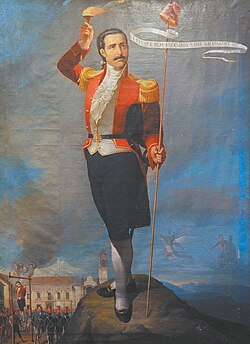
The administration was further strained by violent uprisings in the interior. In 1809, revolutions broke out in Chuquisaca and La Paz. While Cisneros and Spanish officials successfully crushed these rebellions—resulting in the beheading of leaders like Pedro Domingo Murillo—the brutality of the crackdown deepened the resentment of the criollos.
To combat the spread of "French ideologies" and subversive news, Cisneros established the Political Surveillance Court in November 1809. However, he resisted calls to banish prominent local figures such as Cornelio Saavedra and Manuel Belgrano, creating a fragile peace that lasted until the news of Spain's internal collapse reached the colonies.
The May Revolution and Downfall
In May 1810, news arrived in Buenos Aires that the Junta of Seville had fallen. With the Spanish king and the governing Junta removed from power, the legitimacy of Cisneros' rule vanished. This sparked the May Revolution.
Cisneros attempted to maintain control by calling upon local army commanders, but they refused to support him. He was forced to convene an open cabildo (a town hall meeting), where a coalition of the army and common citizens demanded his removal.
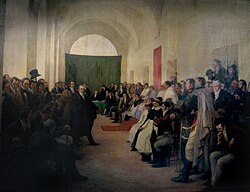
Although the Cabildo initially tried to keep Cisneros as the president of a new government junta, popular unrest became uncontrollable. Cisneros resigned and was eventually banished to the Canary Islands under the pretext that his life was in danger. He left behind his wife, Inés de Gaztambide, who remained in the region for a time before moving to Montevideo.
Final Years in Spain
Upon returning to Spain, Cisneros underwent a trial of residence to review his administration. The government found no fault in his rule and promoted him to general captain of Cádiz. After a period of imprisonment during a Spanish uprising, he was liberated following the return of King Ferdinand VII. He spent his final years as the general captain of his hometown, Cartagena, where he died on June 9, 1829, at the age of 73.
| Period | Role/Event | Key Outcome |
|---|---|---|
| 1770–1805 | Naval Officer | Served in Algiers and the Battle of Trafalgar; suffered permanent hearing loss. |
| 1809–1810 | Viceroy of Río de la Plata | Managed criollo tensions and suppressed revolutions in Chuquisaca and La Paz. |
| May 1810 | May Revolution | Deposed as Viceroy; replaced by the Primera Junta. |
| 1823–1829 | General Captain of Cartagena | Final administrative post before his death in 1829. |
Frequently Asked Questions
Why was Baltasar Hidalgo de Cisneros called "El Sordo"?
He was nicknamed "El Sordo" (The Deaf) because he suffered a severe concussion during the Battle of Trafalgar when a mast from his ship, the Nuestra Señora de la Santísima Trinidad, fell on his head, leaving him partially deaf for the rest of his life.
What was the primary cause of Cisneros' removal from power?
The fall of the Junta of Seville in Spain created a power vacuum. This led the people of Buenos Aires to believe that Cisneros no longer had legitimate authority to govern, triggering the May Revolution of 1810.
How did Cisneros handle the criollo militias?
Cisneros initially took a conciliatory approach by maintaining the criollo militias and granting their commanders veteran status, a privilege previously reserved for peninsular Spaniards born in Spain.
What happened to Cisneros after the May Revolution?
He was initially placed under the protection of the new Junta but was soon banished to the Canary Islands. He eventually returned to Spain, where he served as general captain of Cádiz and later Cartagena.
How did Cisneros respond to the revolutions in Chuquisaca and La Paz?
He reacted swiftly and with force, sending armies to defeat the rebels. While the rebellions were crushed and leaders like Pedro Domingo Murillo were executed, these actions increased resentment among the local criollo population.