Austrian Empire: The Rise and Rule of the Habsburgs (1804–1867)
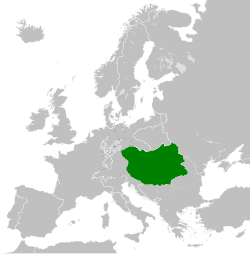
The Austrian Empire (Kaisertum Österreich) was a powerhouse of Central Europe, existing from 1804 until 1867. Established by the House of Habsburg, it served as a bridge between the ancient Holy Roman Empire and the later dual monarchy of Austria-Hungary. For over six decades, it navigated the turbulent waters of the Napoleonic Wars, the rise of nationalism, and the struggle between absolute monarchy and liberal reform.
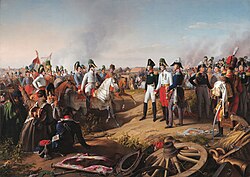
The empire was officially proclaimed on August 11, 1804, by Francis II. This move was a strategic response to Napoleon Bonaparte's declaration of the First French Empire. By creating the title of Emperor of Austria, Francis ensured that the Habsburg dynasty would maintain its imperial status regardless of what happened to the Holy Roman Empire, which eventually dissolved in 1806.
Key Facts
- Duration: 1804 to 1867.
- Capital: Vienna.
- Government: Absolute monarchy (1804–1861), transitioning to a constitutional monarchy (1861–1867).
- Peak Population: Approximately 37.5 million by 1843.
- Key Figures: Emperors Francis I, Ferdinand I, and Franz Joseph I; Minister-President Klemens von Metternich.
- Successor State: Austria-Hungary (established via the Compromise of 1867).
The Foundation and Napoleonic Struggles
The birth of the Austrian Empire was inextricably linked to the chaos of the Napoleonic era. Between 1797 and 1803, a series of conferences and the Imperial Recess (a decree that drastically reduced the number of ecclesiastical states and free imperial cities) signaled the collapse of the old Holy Roman Empire's constitution.
Francis II, becoming Francis I of Austria, unified all Habsburg possessions under one central government to safeguard his dynasty. The empire spent much of its early years fighting Napoleon, though it briefly allied with France during the invasion of Russia (1809–1813). Ultimately, Austria emerged victorious, cementing its status as a global power.
The Age of Metternich (1815–1848)
Following the Napoleonic Wars, the empire entered a period dominated by Klemens von Metternich, who served as Foreign Minister and later Chancellor of State. Metternich was a staunch conservative who viewed liberalism as a "legalized revolution" and believed absolute monarchy was the only stable form of government.
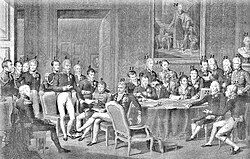
As the chief architect of the Congress of Vienna in 1815, Metternich established a "balance-of-power" diplomacy. This system, often called the Metternich System, aimed to maintain international equilibrium and suppress revolutionary movements through a series of congresses (such as those at Carlsbad and Troppau).
Under Metternich, the empire experienced significant stability and economic growth. The population grew to 37.5 million by 1843, and Vienna expanded into a major urban center of 400,000 residents. However, this stability came at the cost of suppressing national aspirations in Italy and Germany.
Territorial Composition and Demographics
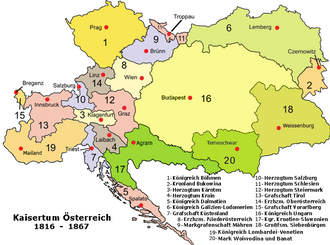
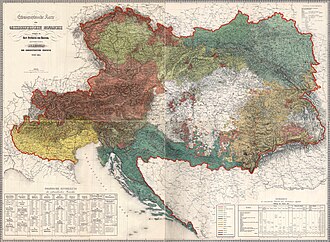
The Austrian Empire was a vast, multi-ethnic mosaic. It encompassed a diverse array of crown lands, ranging from the Archduchy of Austria and the Kingdom of Bohemia to the Kingdom of Hungary and the Kingdom of Lombardy–Venetia.
The empire's demographic makeup was highly complex, consisting of several major ethnic groups:
- Slavs: The largest group (approx. 16 million), including Czechs, Poles, Ruthenians, Croats, Slovaks, Serbs, and Slovenes.
- Germans: Approximately 6.5 million.
- Hungarians: Approximately 5.5 million.
- Italians: Approximately 4.6 million, primarily in the south.
- Romanians (Wallachians): Approximately 1.56 million.
Economic and Political Transition
While the empire saw growth during the Metternich era, the costs of the Napoleonic Wars had left a deep mark on the economy. Trade was significantly smaller than that of Great Britain or France, and the state relied heavily on land taxes.
The political landscape shifted violently during the Revolutions of 1848, which forced Metternich's resignation and emboldened liberal factions. The subsequent years saw a struggle to modernize the state, leading to the adoption of a constitution in 1860. However, military defeats—specifically the Austro-Prussian War of 1866—weakened the empire's grip on the German Confederation.
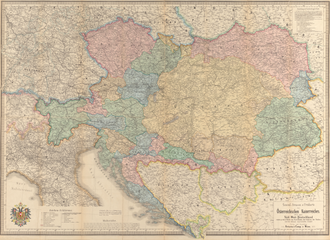
This decline culminated in the Compromise of 1867, which dissolved the unitary Austrian Empire and replaced it with the dual monarchy of Austria-Hungary.
Empire Summary Table
| Category | Details |
|---|---|
| Capital | Vienna |
| Total Area | 698,700 km² |
| Currency | Gulden, Thaler, Vereinsthaler |
| Key Emperors | Francis I, Ferdinand I, Franz Joseph I |
| Primary Governance | Absolute Monarchy $\rightarrow$ Constitutional Monarchy |
| Major Ethnic Groups | Slavs, Germans, Hungarians, Italians, Romanians |
Frequently Asked Questions
Why was the Austrian Empire created in 1804?
It was proclaimed by Francis II to unify all Habsburg possessions under one central government and to ensure the dynasty's imperial status in response to Napoleon Bonaparte declaring himself Emperor of the French.
Who was Klemens von Metternich?
Metternich was the Austrian Foreign Minister and Chancellor of State known for his conservative policies, his opposition to liberalism, and his role as the chief architect of the Congress of Vienna.
What was the "Metternich System"?
The Metternich System was a diplomatic approach based on the balance of power, using a series of international congresses to maintain political equilibrium in Europe and prevent revolutionary uprisings.
How diverse was the population of the empire?
The empire was highly multi-ethnic, with Slavs being the largest group (16 million), followed by Germans (6.5 million), Hungarians (5.5 million), and Italians (4.6 million).
What led to the end of the Austrian Empire in 1867?
Internal pressures from the 1848 Revolutions and external military losses, such as the Austro-Prussian War of 1866, led to the Compromise of 1867, which transformed the empire into the dual monarchy of Austria-Hungary.