Auks: The Specialized Diving Birds of the Northern Hemisphere
Auks, members of the family Alcidae, are highly specialized seabirds found throughout the Northern Hemisphere. This diverse group includes well-known species such as puffins, murres, guillemots, auklets, and murrelets. While they may appear similar to penguins at first glance, auks belong to the order Charadriiformes and represent a fascinating example of convergent evolution—where unrelated species evolve similar traits to adapt to similar environments.
With 25 extant or recently extinct species across 11 genera, auks have mastered the art of survival in cold, subarctic waters. Except for the extinct great auk, all members of this family are capable of flight, though they have traded aerial agility and land-based mobility for exceptional swimming and diving abilities.
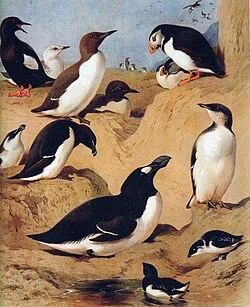
Key Facts
- Distribution: Found exclusively in the cooler waters of the Northern Hemisphere.
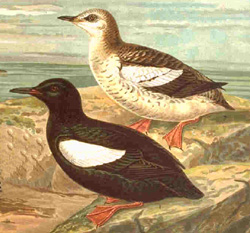
- Physical Traits: Monomorphic (males and females look alike) with black-and-white plumage.
- Locomotion: Wing-propelled pursuit divers that "fly" through the water.
- Diet: Primarily small schooling fish and krill.
- Social Structure: Mostly colonial breeders that form lifelong monogamous pairs.
- Evolution: Closest living relatives are the skuas, having diverged approximately 30 million years ago.
Physical Characteristics and Adaptations
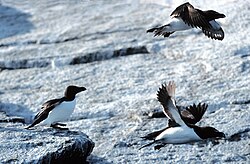
Auks exhibit a wide range of sizes, from the tiny least auklet (15 cm and 85 g) to the substantial thick-billed murre (45 cm and 1 kg). Their most striking adaptation is their wings, which serve as a compromise between the requirements for diving and the minimum needs for flight. Because their wings are short, auks must flap them rapidly to stay airborne.
This evolutionary trade-off varies by group. The Uria guillemots (including the razorbill) and murrelets are the most efficient underwater, while puffins and auklets maintain better capabilities for flying and walking on land.
Feeding and Ecology
Auks are pursuit divers, meaning they use their wings to propel themselves through the water to chase prey. Their primary competition in Northern waters comes from cormorants, though auks typically hunt further offshore to avoid direct competition.
Diving depths vary significantly by species:
- Uria guillemots: Can reach depths of up to 100 m (330 ft).
- Cepphus guillemots: Dive to approximately 40 m (130 ft).
- Auklets: Reach depths of about 30 m (98 ft).
Dietary preferences also differ; strong-swimming murres target fast schooling fish, whereas auklets focus on slower-moving krill.
Breeding and Social Behavior
As pelagic birds, auks spend the vast majority of their lives on the open ocean, returning to land only to breed. They are monogamous and typically form lifelong bonds, returning to the same nesting site year after year to lay a single egg.
Nesting habits vary by species:
- Cliff Nesters: Uria guillemots (murres) gather in massive colonies on cliff edges.
- Rocky Coast Nesters: Cepphus guillemots breed in smaller groups.
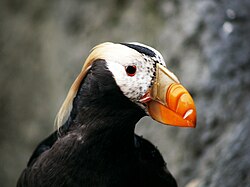
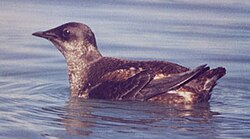
- Burrow Nesters: Puffins, auklets, and some murrelets dig burrows for their nests.
Evolutionary History and Distribution
Genetic analysis reveals that auks evolved from wading shorebirds into diving seabirds through intense natural selection. They are now classified under the suborder Lari, alongside gulls and skuas. The earliest unequivocal fossils date back to the late Eocene, roughly 35 million years ago.
Evidence suggests auks first evolved in the Pacific, later migrating to the Atlantic. Today, they are far more numerous in the Pacific (19–20 species) than in the Atlantic (6 species), likely due to historical extinctions in the Atlantic during the Pliocene.
Their distribution is limited by water temperature. In warmer waters, the speed of their prey (small fish) increases significantly, while the bird's swimming speed does not, making pursuit diving less efficient. This restricts most auks to cold northern waters, except in areas like California and Mexico where cold-water upwellings provide a viable habitat.
Summary of Auk Classifications
| Group (Tribe) | Key Species | Primary Nesting Habit | Specialization |
|---|---|---|---|
| Alcini | Murres, Razorbills | Cliff edges | High diving efficiency |
| Fraterculini | Puffins | Burrows | Better flight/walking |
| Aethiini | Auklets | Burrows | Krill specialists |
| Cepphini | True Guillemots | Rocky coasts | Coastal breeding |
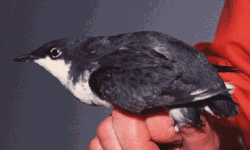
| Brachyramphini | Murrelets | Various/Burrows | Diverse diving styles |
Frequently Asked Questions
Are auks related to penguins?
No. While they look similar due to convergent evolution (adapting to similar marine environments), auks are not closely related to penguins. Auks are part of the order Charadriiformes, whereas penguins belong to a different lineage.
Why are there more auks in the Pacific than the Atlantic?
The fossil record indicates that auks were more diverse in the Atlantic during the Pliocene, but many of those species went extinct, leaving the Pacific as the primary stronghold for the family.
Can all auks fly?
Almost all extant auks can fly. The only notable exception was the great auk, which was flightless and became extinct around 1852.
What is the difference between a murre and a guillemot?
The difference is primarily regional terminology. In North America, these birds are typically called murres, while in Europe, they are referred to as guillemots.
How deep can auks dive?
Diving depth depends on the species. Uria guillemots are the deepest divers, reaching up to 100 meters, while auklets typically dive to around 30 meters.