Atlantic Salmon: Biology, Distribution, and Conservation Efforts
The Atlantic salmon (Salmo salar) is a remarkable anadromous fish—a species that hatches in freshwater, migrates to the ocean to grow, and returns to its natal rivers to spawn. As the largest species in the genus Salmo, it is celebrated for its strength and endurance, though it currently faces significant ecological challenges that have led to its classification as Near Threatened by the IUCN.
From the cold rivers of Europe to the northeastern coasts of North America, the Atlantic salmon plays a vital role in its ecosystem. However, its sensitivity to water temperature and habitat changes makes it a key indicator of environmental health.
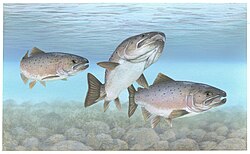
Key Facts
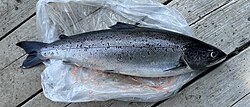
- Scientific Name: Salmo salar
- Conservation Status: Near Threatened (IUCN 3.1)
- Average Size: 71 to 76 cm in length and 3.6 to 5.4 kg after two years at sea.
- Record Size: The heaviest recorded specimen weighed 49.44 kg (109 lb), and the longest measured 160.65 cm.
- Habitat: Cold-water rivers in Europe and North America, with recent expansion to Svalbard.
- Life Cycle: Anadromous, moving between freshwater breeding grounds and saltwater feeding grounds.
Physical Characteristics and Growth
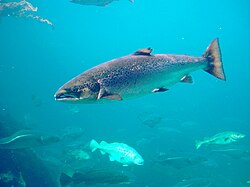
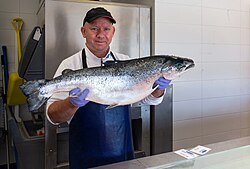
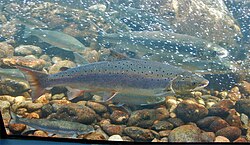
Atlantic salmon are characterized by their streamlined bodies and powerful swimming capabilities. While average adults typically range between 71 and 76 cm, those that spend four or more winters feeding in the ocean, or those that spawn multiple times, can grow significantly larger.
During the breeding season, males develop a distinct kype, which is a hooked lower jaw used during competition for mates.
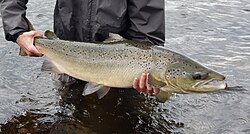
Distribution and Habitat
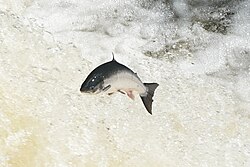
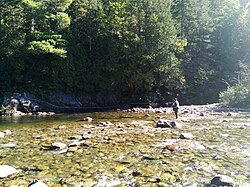
The natural breeding grounds of the Atlantic salmon are found in the rivers of Europe and the northeastern coast of North America. In Europe, their range extends from Spain in the south to the Pechora River in Russia to the northeast. Interestingly, climate warming has allowed the species to colonize Svalbard (78°N) between 2002 and 2006.
Because they are cold-water fish, Atlantic salmon are highly sensitive to temperature fluctuations. Their distribution is easily shifted by changes in climate and the quality of their freshwater habitats.
![Ocean migration of Atlantic salmon[9]](/images/f1/26/f126a25b4bed0a69ba6ae150d5ab52bcca2258356941351125f036717a9c962c.gif)
Life Cycle and Ecology
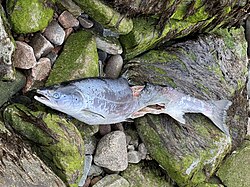
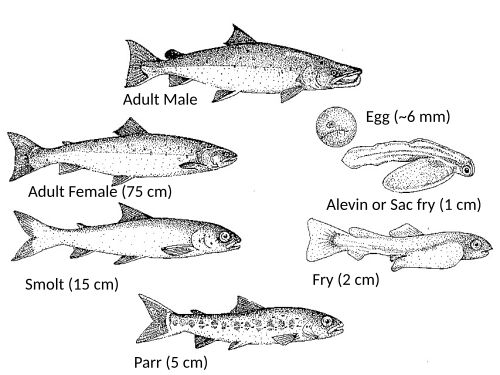
The life of an Atlantic salmon is a journey of transformation. It begins as an alevin—a newly hatched fish that survives by feeding on its own yolk sac before transitioning to active hunting in freshwater streams.
Once they reach a certain maturity, they enter the saltwater phase, migrating to the ocean to feed and grow rapidly. This marine phase is critical for achieving the size necessary for successful spawning. Eventually, they return to the freshwater rivers of their birth to reproduce.
The Challenge of Migration
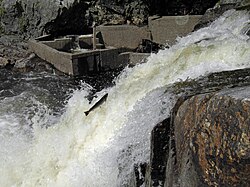
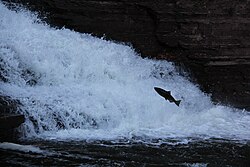
Returning to spawn requires immense energy. Salmon must often leap over waterfalls and navigate man-made obstacles. To assist this, many conservationists install fish ladders—structures that allow fish to bypass dams and other barriers to reach their upstream spawning grounds.
Human Interaction and Aquaculture
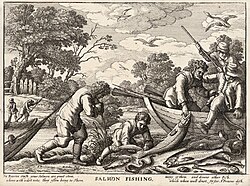
Atlantic salmon are a major global commodity, both for recreational sport and commercial food production. While wild populations have declined, aquaculture (fish farming) has surged. However, this industry is not without controversy.
Open-net pens can lead to accidental escapes. In 2017, approximately 300,000 Atlantic salmon escaped a farm in the San Juan Islands, Washington, raising concerns about invasive species impacting local ecosystems. In response, Washington state began a phase-out of salmon farming to be completed by 2025.
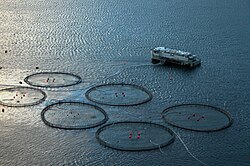
Environmental Impacts
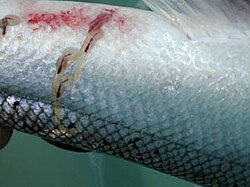
Aquaculture also introduces biological challenges, such as the spread of sea lice, which can affect both farmed and wild populations.
Conservation and Restoration
![Capture (blue) and aquaculture (green) production of Atlantic salmon (Salmo salar) in million tonnes from 1975 to 2022, as reported by the FAO[41]](/images/79/36/79366b86a37fbf88eb60327a63af3603ec71ca8146a3f32893c7bc0aed7e6586.webp)
Extensive efforts are underway to restore Atlantic salmon populations across North America. The Atlantic Salmon Restoration Program in Ontario, launched in 2006, has stocked Lake Ontario and its tributaries with over 6 million young salmon.
In New England, restoration focuses on removing obsolete dams and updating existing ones with fish ladders. The Atlantic Salmon Federation works to eradicate invasive species and remove barriers to fish passage. While some successes have been noted—such as the appearance of salmon nests in the Farmington River in 2015—experts remain cautious about the long-term sustainability of these returns.
Regional Legal Protections
- United States: Commercial and recreational fishing of wild, anadromous Atlantic salmon is prohibited. Several Maine river runs are listed as endangered under the Endangered Species Act (ESA).
- Canada: In Quebec, catch limits vary by river. Some are strictly catch-and-release, while others allow a limited number of grilse (salmon between 30 cm and 63 cm) to be kept.
- UK: Historically, the 1861 Salmon Fisheries Act in England and Wales established early frameworks for the legal protection and management of the species.
| Feature | Details |
|---|---|
| Average Adult Length | 71–76 cm |
| Average Adult Weight | 3.6–5.4 kg |
| IUCN Status | Near Threatened |
| Primary Habitats | North Atlantic Ocean, European and N. American Rivers |
| Key Threats | Climate change, habitat barriers, aquaculture escapes |
Frequently Asked Questions
What is an anadromous fish?
An anadromous fish is one that is born in freshwater, migrates to the ocean to spend most of its adult life feeding and growing, and then returns to freshwater to spawn.
How large can an Atlantic salmon grow?
While the average is around 71 to 76 cm, record-breaking specimens have reached lengths of 160.65 cm and weights of up to 49.44 kg.
Why are fish ladders important for salmon?
Fish ladders are engineered structures that allow salmon to bypass man-made barriers like dams, ensuring they can reach their upstream breeding grounds to spawn.
What is a grilse?
A grilse is a smaller Atlantic salmon, typically measuring between 30 cm and 63 cm, that returns to spawn after a shorter period at sea.
What are the risks associated with salmon aquaculture?
The primary risks include the escape of non-native farmed salmon into wild ecosystems, which can lead to hybridization, and the proliferation of parasites like sea lice.