Asian Argentines: History, Culture, and Community
Asian Argentines are Argentine citizens or residents of Asian ancestry, forming a diverse and influential part of the nation's social fabric. While the community is composed of various ethnic groups, the vast majority trace their roots to West Asia—primarily Lebanon, Syria, and Armenia—and the Far East, specifically China and Japan. Over the 20th century, several distinct waves of immigration shaped the presence of these communities, primarily settling in Buenos Aires, Córdoba, and the Argentine Northwest.
Key Facts
- Estimated Population: Approximately 3.8 million people of Asian descent.
- Largest Group: West Asians (primarily Lebanese and Syrian) make up about 3.5 million of the population.
- Language: Spanish is primary, alongside Arabic, Mandarin, Min, Japanese, Korean, Punjabi, Turkish, and Laotian.
- Key Hubs: Significant populations are concentrated in Buenos Aires, Córdoba, and the Northwest region.
- Religious Diversity: Includes Islam, Christianity, Buddhism, Hinduism, Shinto, Sikhism, Jainism, Zoroastrianism, Baháʼí, Judaism, and Taoism.
Historical Waves of Immigration
Early Arrivals and the War of Independence
The earliest Asian presence in Argentina consisted of Filipinos, who were fellow subjects under Spanish colonial rule. Some Filipinos participated in the Argentine War of Independence. Historical records indicate that Hypolite Bouchard, a privateer for the Argentine Army, commanded a multiethnic crew on the ship Santa Rosa that included Filipinos recruited from San Blas, Mexico, a port linked to the Manila-Acapulco galleon trade.
The 19th and Early 20th Century
During the 19th century, Argentina experienced a significant influx of immigrants from the Levant region of West Asia, particularly Lebanon and Syria. This migration was largely driven by the 1860 civil conflict in Damascus and Mount Lebanon, which were then provinces of the Ottoman Empire. In the early 20th century, East Asian immigration began, primarily consisting of small numbers of Japanese immigrants from the Okinawa Prefecture.
Mid-to-Late 20th Century Shifts
Political instability following the overthrow of Juan Perón in 1955 slowed Japanese immigration after 1960. However, new waves followed: Korean entrepreneurs began settling in Buenos Aires during the 1960s, and Chinese entrepreneurs arrived in larger numbers during the 1990s.
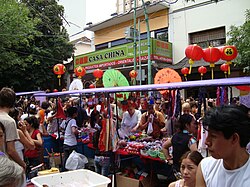
By the latter half of the century, Asian Argentines became active in national politics. An example was the Unión de Residentes Taiwaneses Justicialistas (Union of Justicialist Taiwanese Residents), a Peronist party office located in the heart of Buenos Aires' Chinatown.
Society and Demographics
The Asian Argentine community is characterized by its immense diversity in both origin and economic activity. The West Asian community is the largest, with Lebanese and Syrian descendants totaling roughly 3.5 million; the Lebanese alone are estimated at 1.5 million. Argentina also hosts the largest population of Arabic speakers in Latin America, estimated at 1 million people.
East Asian populations include approximately 120,000 people of Chinese descent (as of 2010), 65,000 of Japanese descent (as of 2021), and over 23,000 of Korean descent (as of 2022). Additionally, smaller clusters of ethnic Laotians, Thai, Cambodians, Vietnamese, and Hmong arrived in the 1970s following conflicts in Southeast Asia. The Lao community specifically settled in Misiones with government land grants and UN financial assistance, later establishing the Wat Rattanarangsiyaram temple in Posadas in 1997.

Population Summary Table
| Region/Group | Estimated Population | Primary Origins/Notes |
|---|---|---|
| West Asia | 3,500,000 | Lebanon, Syria, Armenia |
| East Asia | 208,000 | China, Japan, Korea |
| South Asia | 2,600 | India (Punjabi) |
| Southeast Asia | 2,000 | Laos, Thailand, Vietnam, Cambodia |
Challenges and Discrimination
The journey of integration has not been without conflict. In 1910, Senator Manuel Lainez proposed expelling Lebanese and Syrian immigrants, though the project was blocked by Joaquín V. González, who defended them as hardworking and "the most European in Asia."
In more recent times, some East Asian communities have faced scrutiny. Korean-Argentine textile businesses have been investigated for the illegal employment of Bolivian workers, leading some in the community to feel unfairly targeted. In June 2006, a dispute involving illegal firearms led to a month-long boycott of Chinese-owned stores by the truck drivers' union, resulting in temporary supply shortages.
Notable Figures
Asian Argentines have achieved prominence across politics, entertainment, and sports:
- Carlos Menem: Former President of Argentina (Syrian descent).
- Juliana Awada: Former First Lady of Argentina (Lebanese descent).
- Carlos Balá: Renowned actor (Lebanese descent).
- Mario Alberto Ishii: Politician (Japanese descent).
- Liu Song: Tennis player (Chinese descent).
- Chanty (Maria Chantal Videla): Actress and member of the K-pop group Lapillus (Filipino descent).
Frequently Asked Questions
Which Asian ethnic group is the largest in Argentina?
The largest group is of West Asian descent, specifically those from Lebanon and Syria, totaling approximately 3.5 million people.
Where do most Asian Argentines live?
The majority are located in Buenos Aires, Córdoba, and the Argentine Northwest region.
What is the significance of the Lao community in Misiones?
The Lao community settled in Misiones in the 1970s with the help of the Argentine government and the UN, and they established the Wat Rattanarangsiyaram temple in Posadas in 1997.
How many Arabic speakers are there in Argentina?
There are an estimated 1 million Arabic speakers, which is the highest number of Arabic speakers in Latin America.
When did the main waves of East Asian immigration occur?
Japanese immigration began in the early 20th century, followed by Korean entrepreneurs in the 1960s and Chinese entrepreneurs in the 1990s.