Ascidiacea: The Biology and Evolution of Sea Squirts
Ascidiacea, commonly known as sea squirts or ascidians, are a fascinating class of sac-like marine invertebrate filter feeders. Belonging to the subphylum Tunicata, these organisms are most recognizable by their tough outer shell, known as a tunic, which is composed of a polysaccharide called cellulose. While they may appear simple, they occupy a critical position in the animal kingdom as chordates, sharing a common ancestry with vertebrates.
Found in oceans worldwide, sea squirts typically thrive in shallow waters with salinities exceeding 2.5%. Unlike their pelagic relatives—the Thaliacea (salps and pyrosomes) and Appendicularia (larvaceans)—which swim freely as plankton, ascidians are sessile. This means that after an active larval stage, they attach themselves permanently to a substrate, such as rocks or shells, for the remainder of their lives.
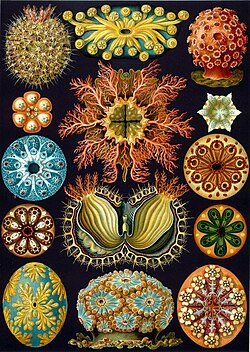
Key Facts
- Species Diversity: There are approximately 2,300 known species of ascidians.
- Unique Composition: Their tunic is made of cellulose, a material more common in plants than animals.
- Chordate Link: Larvae possess a notochord and a dorsal nerve tube, hallmarks of the phylum Chordata.
- Life Cycle: Most transition from a free-swimming "tadpole" larva to a stationary adult.
- Ecological Role: They act as efficient filter feeders in marine ecosystems.
Classification and Types
Ascidians are categorized into three primary structural types based on how they organize themselves in the environment:
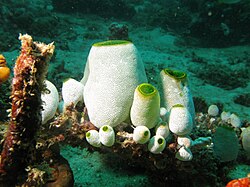
- Solitary Ascidians: Individual organisms that live independently.
- Social Ascidians: Individuals that form clumped communities by attaching their bases together.
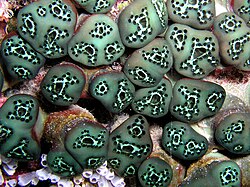
- Compound Ascidians: Large colonies consisting of many small, genetically identical individuals called zooids.
Anatomy and Physiology
Sea squirts are generally rounded or cylindrical, ranging from 0.5 to 10 cm in size. Their body is anchored to a solid surface via a pitted or ridged lower surface, sometimes featuring root-like extensions for a firmer grip. The tunic is not a dead shell but living tissue with its own blood supply, often reinforced with proteins and calcium salts.
In colonial species, the tunics of individual zooids may fuse into a single, massive structure, allowing the colony to function as a coordinated unit.
Life History and Development
Larval Stage and Metamorphosis
For solitary ascidians, reproduction begins with the release of eggs and sperm into the seawater for external fertilization. The resulting embryo develops into a free-swimming, tadpole-like larva within 12 hours to a few days. This larva is a biological marvel, possessing a notochord (a flexible rod made of exactly 40 cells) and a hollow dorsal nerve tube.
The metamorphosis from larva to juvenile is rapid, often taking less than 36 hours. During this process, the animal settles on a surface, and its mouth shifts to a posterior position.
Direct Development
Not all ascidians follow the tadpole path. Some, particularly within the Molgulidae family, exhibit direct development, where the embryo transforms directly into a juvenile without ever entering a free-swimming larval stage.
Colonial Life and Reproduction
Colonial ascidians utilize both sexual and asexual reproduction to ensure survival, with some colonies persisting for decades. Asexual reproduction often occurs via stolons—root-like projections that produce buds which eventually grow into new adult zooids.
Sexual reproduction in species like Botryllus schlosseri is complex. They are sequential hermaphrodites (protogynous), meaning they change sex over time. To prevent inbreeding depression—which leads to higher rates of developmental anomalies and lower growth—these organisms typically time their egg and sperm release to favor cross-fertilization over self-fertilization.
Evolutionary Significance and Research
Because they are simple chordates, sea squirts are invaluable model organisms for scientists. By studying species like Ciona intestinalis, researchers can gain insights into the evolution of vertebrates from ancestral non-chordate deuterostomes. Their small, easily manipulated genomes allow for the study of gene expression and DNA repair mechanisms, such as the use of the enzyme APEX1 to repair DNA damage during embryonic development.
The fossil record for Ascidiacea is sparse due to their soft bodies. However, reliable records date back to the Lower Cambrian (e.g., Shankouclava shankouense), with other enigmatic relatives appearing in the Ediacaran period.
Summary of Ascidian Characteristics
| Feature | Description |
|---|---|
| Phylum | Chordata |
| Tunic Composition | Cellulose, proteins, and calcium salts |
| Feeding Method | Filter feeding |
| Mobility | Sessile adults; free-swimming larvae |
| Reproduction | Sexual and Asexual (in colonial species) |
| Temporal Range | Cambrian Stage 3 to Present |
Culinary Uses
Beyond the laboratory, various species of ascidians are prized as delicacies in different cultures around the world, where they are served in various forms, including raw sashimi.

Frequently Asked Questions
Why are they called "sea squirts"?
They earn this name from their ability to rapidly expel water from their bodies through siphons when disturbed.
Are sea squirts related to humans?
Yes, in a broad evolutionary sense. Both belong to the phylum Chordata. The presence of a notochord in the sea squirt larva is a key characteristic shared with all vertebrates.
What is a zooid?
A zooid is an individual member of a compound ascidian colony. In these colonies, zooids are typically genetically identical and may share a circulatory system.
How do sea squirts eat?
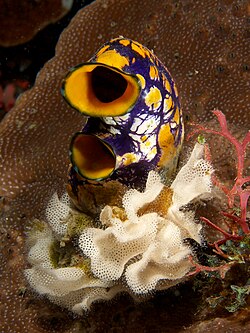
They are filter feeders, drawing water into their bodies through an oral siphon, filtering out organic particles and plankton, and expelling the water through an atrial siphon.
Can sea squirts move as adults?
No, adult ascidians are sessile, meaning they are permanently attached to a substrate. Only their larval stage is mobile.