Artillery: The Evolution of Long-Range Firepower

Artillery: The Evolution of Long-Range Firepower

Artillery consists of ranged weapons designed to launch munitions far beyond the distance and power of standard infantry firearms. From the massive stone-throwing engines of antiquity to the satellite-guided shells of the 21st century, artillery has consistently provided the largest share of an army's total firepower. While the term once referred to any soldier armed with manufactured weapons or armor, it now primarily describes shell-firing guns, howitzers, mortars, and rocket systems.

Historically, artillery development followed two primary paths: heavy, immobile siege engines designed to breach fortifications, and lighter, mobile field artillery used for active battlefield maneuvers. Today, this evolution continues with self-propelled vehicles that combine devastating power with high tactical mobility.

Key Facts
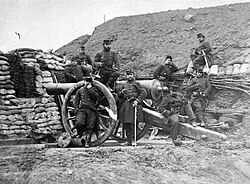
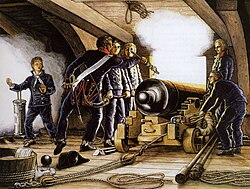
French soldiers in the Franco-Prussian War 1870–71
  • Core Components: A standard round consists of a fuze, projectile, propellant, and primer.
  • Indirect Fire: The ability to engage targets without a direct line of sight, a defining characteristic of modern artillery.
  • Precision: Modern systems use GPS and laser designation to hit specific point targets.
  • Versatility: Artillery ranges from small mortars to massive bombards like the Tsar Cannon (890 mm caliber).
  • Tactical Impact: Modern techniques like MRSI allow multiple shells to impact a target simultaneously.

The Early Era: From Mechanical Energy to Gunpowder
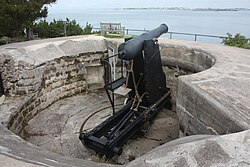
British 64 Pounder Rifled Muzzle-Loaded (RML) Gun on a Moncrieff disappearing mount, at Scaur Hill Fort, Bermuda. This is a part of a fixed battery, meant to protect against over-land attack and to serve as coastal artillery.

Before the advent of gunpowder, artillery relied on mechanical energy. The first known catapult was developed in Syracuse in 399 BC. These engines were massive and limited in power; for example, a 1st-century BC Roman catapult launching 6.55 kg stones produced 16 kilojoules of kinetic energy. In contrast, a mid-19th-century 12-pounder gun produced 240 kilojoules, and 20th-century battleship batteries exceeded 350 megajoules.

The introduction of gunpowder revolutionized warfare. By 1453, the Ottoman Empire utilized sixty-nine guns in fifteen batteries to conquer Constantinople, firing an estimated 19,320 times over forty days.
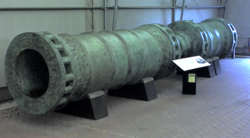
Dardanelles Gun. Very heavy 15th-C bronze muzzle-loading cannon of type used by Ottomans in siege of Constantinople (1453), showing ornate decoration. Taken by The Land Feb 07 at Fort Nelson, Hampshire.

Medieval and Early Modern Innovations

Early gunpowder weapons varied wildly in design. The 14th-century Ming Dynasty's Huolongjing described vase-shaped cannons and the "thousand ball thunder cannon." In Europe, the Austrian Pumhart von Steyr represents one of the earliest extant large-caliber guns.

A depiction of an early vase-shaped cannon (shown here as the "Long-range Awe-inspiring Cannon"(威遠砲)) complete with a crude sight and an ignition port dated from around 1350 AD. The illustration is from the 14th century Ming Dynasty book Huolongjing.[5]
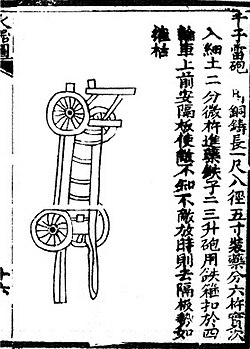
A bronze "thousand ball thunder cannon" from the Huolongjing.
The Austrian Pumhart von Steyr, the earliest extant large-calibre gun[13]

By the 16th century, artillery became more specialized. The Tsar Cannon, cast in 1586 in Moscow with a caliber of 890 mm, remains the largest bombard in the world. Meanwhile, Korean forces in the late 16th century integrated heavy artillery into ships, gaining a naval advantage over Japanese forces who utilized breech-loading swivel guns known as Kunikuzushi.
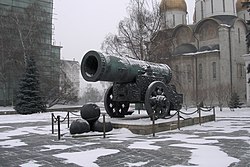
The Tsar Cannon (caliber 890 mm), cast in 1586 in Moscow. It is the largest bombard in the world.
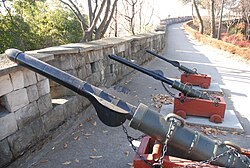
Three of the large Korean artillery, Chongtong in the Jinju National Museum. These cannons were made in the mid 16th century. The closest is a "Cheonja chongtong"(천자총통, 天字銃筒), the second is a "Jija chongtong"(지자총통, 地字銃筒), and the third is a "Hyeonja chongtong"(현자총통, 玄字銃筒).

The Transition to Modern Artillery

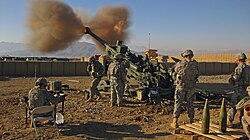
7-person gun crew firing a US M777 Light Towed Howitzer, War in Afghanistan, 2009

The 18th and 19th centuries saw a shift toward mobility and standardization. The Mysorean rockets of India, used effectively against the British in the late 1700s, served as the precursor to modern rocket artillery. These inspired William Congreve to develop the iron-cased Congreve rocket, which extended ranges up to 3,000 yards.
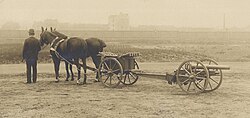
Horse-drawn artillery

A pivotal moment occurred in 1897 with the French Canon de 75 modèle 1897. This was the first truly modern artillery piece, featuring cased ammunition, a breech-loading system, and a hydro-pneumatic recoil mechanism. This mechanism allowed the gun to remain stationary after firing, enabling a rate of fire up to 15 rounds per minute—far exceeding the capabilities of contemporary rifles.
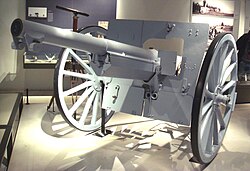
The French Canon de 75 modèle 1897, the first modern artillery piece

The Rise of Indirect and Predicted Fire

During World War I, the British developed "map-shooting" or predicted fire. This allowed artillery to strike accurately located targets without the need for ranging shots (adjusting fire based on initial misses). This transition to indirect fire—aiming without seeing the target—shifted artillery's primary role toward area suppression and barrages.
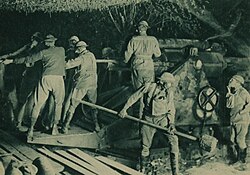
Australian gunners, wearing gas masks, operate a 9.2-inch (230 mm) howitzer during World War I

Modern Technology and Precision Guidance

Artillery illuminating ammunition used in a shooting exercise on Simplon Pass, Switzerland. The illuminated mountain is Mount Fletschhorn, 9 km from the photographer's position.

While traditional artillery provides area fire, the late 20th century introduced precision-guided munitions. Early systems like the US 155 mm Copperhead used laser designation. In the 21st century, the Global Positioning System (GPS) enabled shells like the M982 Excalibur to hit point targets with extreme accuracy.
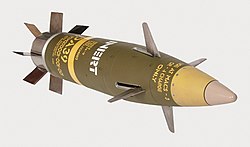
M982 Excalibur guided artillery shell

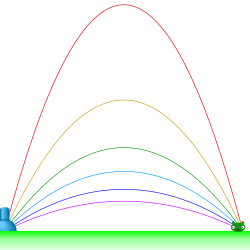
Modern systems also employ Multiple Round Simultaneous Impact (MRSI). By varying the elevation, speed, and timing of several shots, a single gun can ensure that multiple shells land on a target at the exact same moment, maximizing the window of vulnerability for the enemy.
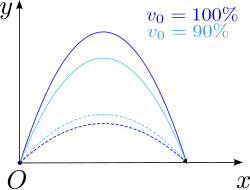
Illustration of different trajectories used in MRSI: For any muzzle velocity there is a steeper (> 45°, solid line) and a lower (<45°, dashed line) trajectory. On these different trajectories, the shells have different flight times.

Global Artillery Distribution (2010-2016)

The distribution of conventional barrel ordnance varies significantly by nation, reflecting different strategic doctrines.

Country 2010 Count 2016 Count
Russia 26,121 4,180+
North Korea 17,900+ 21,100+
China 17,700+ 13,178+
India 11,258+ 9,682+
South Korea 10,774+ 11,038+
United States 8,137 5,923

Frequently Asked Questions

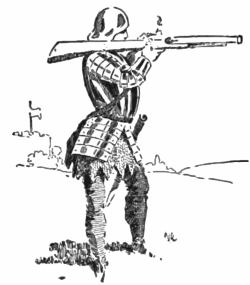
French gunner in the 15th century, a 1904 illustration
First Battle of Panipat[7]
Bullocks dragging siege-guns up hill during Akbar's Siege of Ranthambore[8]
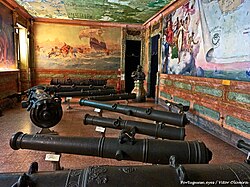
Portuguese artillery on display at the Military Museum of Lisbon, Portugal.
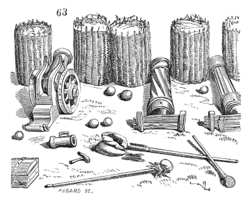
Artillery with gabion fortification
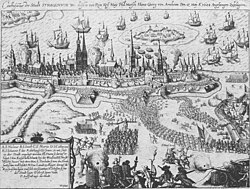
The Siege of Stralsund during the Thirty Years' War, 1628
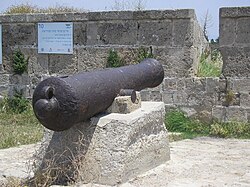
A 19th-century cannon, set in the wall of Acre to commemorate the city's resistance to the 1799 siege by Napoleon's troops.
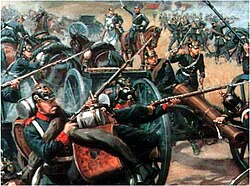
Prussian artillery at the Battle of Langensalza (1866)
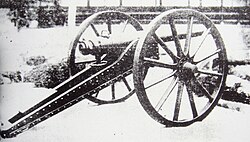
Armstrong gun deployed by Japan during the Boshin war (1868–69)
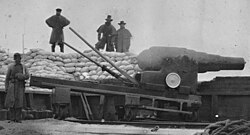
8-inch Armstrong gun during American Civil War, Fort Fisher, 1865
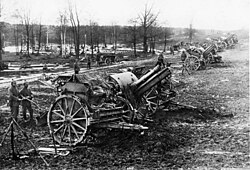
German 15cm field howitzers during World War I
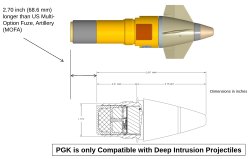
M1156 precision guidance kit can be added to unguided projectiles
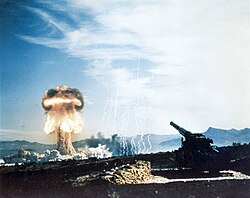
Artillery can be used to fire nuclear warheads, as seen in this 1953 nuclear test.
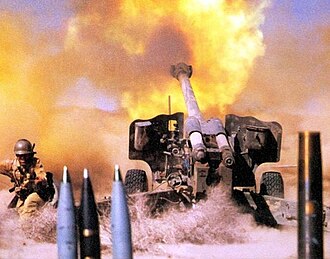
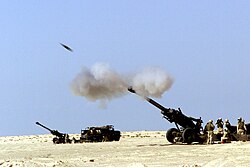
152 mm howitzer D-20 during the Iran–Iraq War
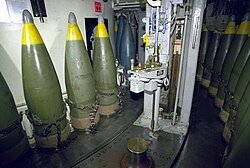
Battleship ammunition: 16" artillery shells aboard a United States Iowa-class battleship
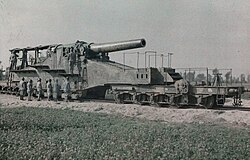
Cyclone of the 320th French Artillery, in Hoogstade, Belgium, September 5, 1917
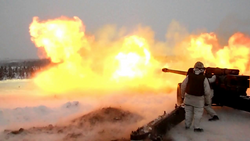
The Finnish Defence Forces using 130 mm Gun M-46 during a direct fire mission in a live fire exercise in 2010.
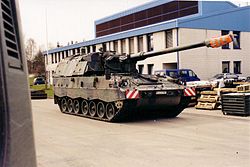
German Army PzH 2000 self-propelled artillery
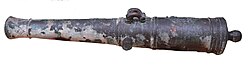
Naval cannon, early 19th century
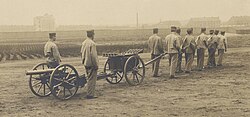
Man-pulled artillery
Firing of an 18-pound gun, Louis-Philippe Crepin (1772–1851)
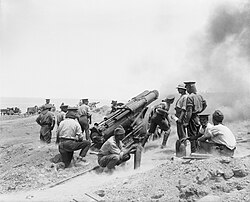
A British 60-pounder (5-inch (130 mm)) gun at full recoil, in action during the Battle of Gallipoli, 1915. Photo by Ernest Brooks.
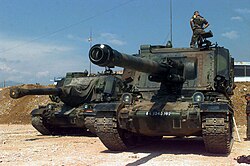
Two French Army Giat GCT 155mm (155 mm AUF1) Self-propelled Guns, 40th Regiment d' Artillerie, with IFOR markings are parked at Hekon base, near Mostar, Bosnia-Herzegovina, in support of Operation Joint Endeavor
A 155 mm artillery shell fired by a United States 11th Marine Regiment M-198 howitzer
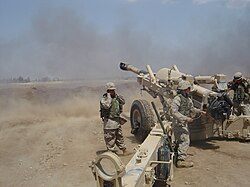
USMC M-198 firing outside of Fallujah, Iraq in 2004
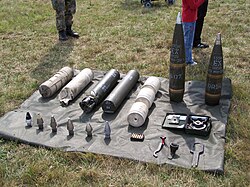
Modern artillery ammunition. Caliber 155 mm as used by the PzH 2000
Animation showing how six shots of different elevation, speed and timing can be used to hit a target at the same time (Click for SVG animated with SMIL)
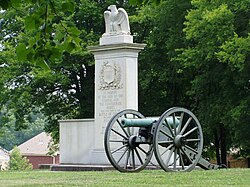
An artillery piece in the monument commemorating the 1864 Battle of Tupelo (American Civil War)

What is the difference between a gun and a howitzer?

While the terms are often used interchangeably, historically, guns had higher muzzle velocities and flatter trajectories, whereas howitzers fired projectiles in a higher, arched trajectory to hit targets behind cover.

What is indirect fire?

Indirect fire is a method of engaging a target that is not visible to the gun crew. It relies on coordinates provided by observers or radar and is the primary mode of operation for modern field artillery.

What are the four main components of an artillery round?

A complete round consists of the fuze (which triggers the explosion), the projectile (the payload), the propellant (the explosive charge that launches the shell), and the primer (which ignites the propellant).

How does MRSI work?

Multiple Round Simultaneous Impact (MRSI) works by firing several shells at different elevations and muzzle velocities. The shells with higher trajectories take longer to travel, allowing the gun to fire subsequent rounds so that all shells arrive at the target simultaneously.

What was the significance of the French 75?

The French 75 was the first artillery piece to use a hydro-pneumatic recoil system, meaning the gun did not jump backward when fired. This eliminated the need to re-aim after every shot, drastically increasing the rate of fire.

References

  1. Bellamy, Christopher (2004). "artillery". Oxford Companion to Military History. Oxford University Press. ISBN 978-0-19-860696-3.
  2. Rihll, Tracey Elizabeth (2007). The Catapult: A History. Westholme Publishing. ISBN 9781594160356.
  3. Šotnar, Jiří; Carbol, Michal; Blaha, Martin. "Modernization of artillery reconnaissance" (PDF). INASE. Applied Mathematics, Computational Science and Engineering. Archived from the original (PDF) on April 17, 2018. Retrieved March 17, 2015.
  4. "Arms and Men: The Trebuchet". Historynet. September 5, 2006. Retrieved February 28, 2022.
  5. Needham 1987, pp. 314–16