Argentina 1946 General Election: The Rise of Juan Perón
The general elections held on February 24, 1946, stand as a watershed moment in Argentine history. These elections were the final contests in which only men held the right to vote, and they determined not only the presidency but also the composition of the national legislature. The results signaled a profound shift in the country's political landscape, marking the ascent of Juan Perón and the birth of a movement that would redefine the nation.
The Path to Power: From Coup to Candidacy
The road to the 1946 election began with the end of conservative rule, which had long been sustained by electoral fraud. A coup d'état in June 1943 installed a new regime, though it initially struggled to gain public approval. A turning point occurred following the devastating San Juan earthquake of 1944. The regime sought to rebuild its image through nationwide fundraising efforts led by the Labor Minister, Juan Perón.
During this period, Perón collaborated with various figures, including radio star Eva Duarte, to mobilize support. His success in these efforts, combined with the rise of his ally Edelmiro Farrell within the military junta, led to Perón's appointment as vice-president. In this role, he built strong ties with struggling labor unions, most notably the CGT (General Confederation of Labour).
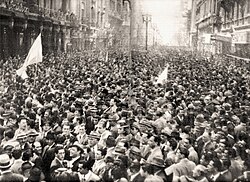
However, Perón's growing influence created friction with other junta members, leading to his arrest on October 9, 1945. This sparked a massive response from labor leaders like Ángel Borlenghi and Cipriano Reyes, as well as Eva Duarte. On October 17, 1945, a violent and massive demonstration at the Plaza de Mayo demanded his release. This event is widely regarded as the birth of the Peronist movement.
Following his release, the junta granted Perón presidential powers. He immediately began a program of mass nationalizations, targeting the Central Bank and various universities, before calling for general elections in February 1946.
The Electoral Battle: Perón vs. The Democratic Union
To oppose Perón, a diverse and fragile alliance known as the Democratic Union was formed. This coalition brought together conservatives, leftists, and members of the Radical Civic Union (UCR). The alliance nominated former Congressman José Tamborini for president and Enrique Mosca for vice-president.
The campaign was further complicated by international interference. U.S. Ambassador Spruille Braden released a white paper accusing Perón of having fascist ties. Rather than damaging him, this allowed Perón to frame the election as a choice between national sovereignty and foreign interference. His rallying cry, "Perón or Braden," effectively marginalized the Democratic Union and resonated with a wide segment of the electorate.
Election Results and Impact
Juan Perón won a decisive victory, securing both the popular and electoral votes. His victory was mirrored in the legislative elections, where his coalition gained a commanding majority in the Chamber of Deputies.
| Candidate | Party/Alliance | Popular Vote | Percentage | Electoral Vote |
|---|---|---|---|---|
| Juan Perón | Labour Party / JNCP | 1,485,468 | 53.71% | 304 |
| José Tamborini | Democratic Union | 1,262,630 | 45.65% | 72 |
Legislative and Provincial Outcomes
In the Chamber of Deputies, the National Board of Political Coordination (Perón's coalition) won 109 out of 158 seats, with 51.19% of the vote. The Radical Civic Union followed with 44 seats. Additionally, Perón's influence extended to the provinces, where his party or allies won 14 governorships, including key provinces like Buenos Aires, Santa Fe, and Tucumán.
Key Facts
- Date: February 24, 1946.
- Presidential Winner: Juan Perón (Labour Party) with 53.71% of the popular vote.
- Voter Turnout: Approximately 81.21% for the presidential race.
- Legislative Majority: Perón's coalition won 109 of 158 seats in the Chamber of Deputies.
- Historical Milestone: The last general election in Argentina where only men were allowed to vote.
- Key Turning Point: The October 17, 1945, mobilization at Plaza de Mayo.
Frequently Asked Questions
Who was the main opponent of Juan Perón in 1946?
The main opponent was José Tamborini, representing the Democratic Union, an alliance of conservatives, leftists, and the Radical Civic Union.
What was the "Perón or Braden" campaign?
It was a political strategy used by Perón to frame the election as a struggle for national sovereignty after U.S. Ambassador Spruille Braden published a report accusing Perón of fascist ties.
What role did the CGT play in Perón's rise?
The CGT (General Confederation of Labour) provided the critical labor support and organized the mass demonstrations, particularly on October 17, 1945, that forced the military junta to release Perón.
How many seats were contested in the Chamber of Deputies?
All 158 seats in the Chamber of Deputies were contested, with 80 seats required for a majority.
Was the 1946 election inclusive of all citizens?
No, these were the last general elections in Argentina in which only men were enfranchised.