Andrea Cau and the Evolution of Dinosaur Cladistics
In the field of vertebrate paleontology, the precise mapping of evolutionary relationships is essential to understanding how life transitioned from land-dwelling reptiles to modern birds. Andrea Cau, a prominent Italian vertebrate paleontologist, has dedicated his career to this pursuit, specializing in cladistics—the scientific method of classifying animals based on shared derived characteristics to determine their evolutionary lineage.
Cau's work is characterized by a rigorous re-evaluation of existing fossils and the naming of new taxa that fill critical gaps in the fossil record. His research often focuses on theropods, the group of bipedal carnivorous dinosaurs that includes both the fearsome Tyrannosaurs and the ancestors of birds.
Key Facts
- Specialization: Expert in vertebrate paleontology and dinosaur cladistics.
- Major Discovery: Named the unique dromaeosaurid Halszkaraptor escuilliei in 2017.
- Taxonomic Revision: Reclassified Balaur as a basal avialan (primitive bird) rather than a dromaeosaur.
- Contribution: Co-authored the naming of over 20 distinct prehistoric taxa between 2011 and 2026.
Major Contributions to Paleontology
One of Andrea Cau's most notable contributions is the description of Halszkaraptor escuilliei. This dromaeosaurid theropod challenged previous assumptions about the morphology and ecology of its family, suggesting a more specialized lifestyle than its relatives.
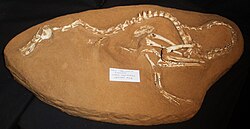
Beyond naming new species, Cau is recognized for his analytical approach to existing classifications. A prime example is his reanalysis of Balaur. By applying updated cladistic models, he shifted the animal's position from a dromaeosaur to a basal avialan, which refers to the most primitive members of the bird lineage.
Chronology of Named Taxa
Throughout his career, Cau has collaborated with international teams to identify and name a diverse array of species, ranging from early birds to ancient crocodilians and theropods.
| Year | Taxon | Key Authors |
|---|---|---|
| 2026 | Carinthiasuchus kandutschi | Dalla Vecchia & Cau |
| 2026 | Kunpengornis anhuimusei | Huang, Wang, Cau, et al. |
| 2025 | Shri rapax | Moutrille, Cau, et al. |
| 2025 | Shuilingornis angelai | Wang, Cau, et al. |
| 2023 | Migmanychion laiyang | Wang, Cau, et al. |
| 2022 | Musivavis amabilis | Wang, Cau, et al. |
| 2021 | Khinganornis hulunbuirensis | Wang, Cau, et al. |
| 2021 | Ceratosuchops inferodios | Barker, Hone, Naish, Cau, et al. |
| 2021 | Riparovenator milnerae | Barker, Hone, Naish, Cau, et al. |
| 2020 | Kompsornis longicaudus | Wang, Huang, Kundrát, Cau, et al. |
| 2020 | Huinculsaurus montesi | Baiano, Coria, & Cau |
| 2017 | Halszkaraptor escuilliei | Cau, Beyrand, Voeten, et al. |
| 2017 | Serikornis sungei | Lefèvre, Cau, et al. |
| 2013 | Aurornis xui | Godefroit, Cau, et al. |
| 2013 | Tataouinea hannibalis | Fanti, Cau, et al. |
| 2013 | Sauroniops pachytholus | Cau, Dalla Vecchia, & Fabbri |
| 2011 | Samrukia nessovi | Naish, Dyke, Cau, et al. |
| 2011 | Neptunidraco ammoniticus | Cau & Fanti |
Frequently Asked Questions
Who is Andrea Cau?
Andrea Cau is an Italian vertebrate paleontologist who specializes in dinosaur cladistics, the study of evolutionary relationships among prehistoric animals.
What is the significance of Halszkaraptor?
Named by Cau in 2017, Halszkaraptor escuilliei is a dromaeosaurid theropod that provides unique insights into the diversity and adaptation of the raptor family.
How did Cau change the classification of Balaur?
Through a detailed reanalysis, Cau determined that Balaur should be classified as a basal avialan (a primitive bird) rather than a dromaeosaur.
What is dinosaur cladistics?
Cladistics is a method of biological classification that groups organisms based on shared derived characteristics to create a phylogenetic tree, showing the most likely evolutionary path.
How many taxa has Andrea Cau contributed to naming?
Based on available records from 2011 to 2026, Andrea Cau has contributed to the naming of 18 different taxa, including various theropods and early birds.