Ancient Greek: History, Dialects, and Modern Legacy
Ancient Greek (Ἑλληνική, Hellēnikḗ) is the ancestral form of the Greek language used across the Eastern Mediterranean and the Greco-Roman world. Spanning roughly from 1500 BC to 300 BC, it served as the primary vehicle for some of the most influential philosophy, literature, and political thought in human history. As a member of the Indo-European language family, specifically the Hellenic branch, it evolved from Proto-Greek into a complex system of dialects and literary standards.
Key Facts
- Timeframe: Used from approximately 1500 BC to 300 BC.
- Family: Indo-European > Hellenic.
- Writing System: The Greek alphabet.
- Major Periods: Mycenaean, Dark Ages, Archaic (Homeric), and Classical.
- Global Reach: Spread throughout the Mediterranean during the Hellenistic period.
Chronological Evolution
The development of Ancient Greek is typically divided into four distinct eras, each marked by changes in writing, social structure, and linguistic style.
- Mycenaean Greek (c. 1400 – c. 1200 BC): The earliest attested form of the language.
- Dark Ages (c. 1200 – c. 800 BC): A transitional period following the collapse of Mycenaean civilization.
- Archaic or Homeric Period (c. 800 – c. 500 BC): The era of the great epics, characterized by the language found in the works of Homer.
- Classical Period (c. 500 – c. 300 BC): The peak of Athenian influence and the standardization of literary Greek.
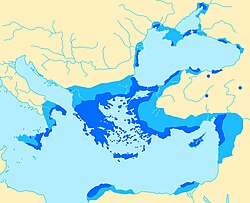
The Diversity of Dialects
Ancient Greek was not a monolithic language but a collection of regional dialects. These are generally categorized into several major groups:
West Group
- Northwest Greek: Including the Macedonian dialect.
- Doric: Widely spoken in the Peloponnese and Crete.
Aeolic Group
- Aegean/Asiatic Aeolic
- Thessalian
- Boeotian
Ionic-Attic Group
- Attic: The dialect of Athens, which became the basis for the later standard.
- Ionic: Spoken in Ionia (Asia Minor) and the Cyclades.
- Euboean: Including colonies in Italy.
Arcadocypriot Greek
- Arcadian
- Cypriot
Linguistic Structure and Phonology
The sound system of Ancient Greek is characterized by a specific set of consonants and vowels that distinguish it from its Proto-Indo-European roots. The consonant inventory includes labial, alveolar, velar, and glottal sounds, featuring a distinction between voiced, voiceless, and aspirated plosives.
| Type | Labial | Alveolar | Velar | Glottal |
|---|---|---|---|---|
| Nasal | μ (m) | ν (n) | γ (ŋ) | - |
| Voiced Plosive | β (b) | δ (d) | γ (ɡ) | - |
| Voiceless Plosive | π (p) | τ (t) | κ (k) | - |
| Aspirated Plosive | φ (pʰ) | θ (tʰ) | χ (kʰ) | - |
| Fricative | - | σ (s) | - | h |
The language also utilized a complex vowel system with distinctions between short and long versions of front and back vowels, as well as rounded and unrounded sounds.
Sample Texts and Writing
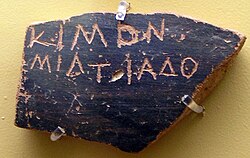
The Greek alphabet allowed for the recording of epic poetry and legal inscriptions. For example, the beginning of Homer's Iliad serves as a primary example of the Archaic period's linguistic style.

Ancient Greek in the Modern World
While no longer a spoken vernacular, Ancient Greek remains a vital part of global education and niche cultural production.
Educational Use
Ancient Greek is still taught in various capacities across Europe. In Italy, it is compulsory in the liceo classico, and in Greece, it is a mandatory subject in all gymnasiums and lyceums. In the United Kingdom, Germany, and the Netherlands, it is often an optional subject for students in humanities-oriented tracks or elite grammar schools.
Contemporary Applications
Modern authors occasionally use the language for artistic or academic purposes. Notable examples include translations of Harry Potter and the Philosopher's Stone and Asterix into Ancient Greek. Additionally, the publication Onomata Kechiasmena produces crosswords and puzzles in the language, and Akropolis World News provides weekly news summaries written in Ancient Greek.
Frequently Asked Questions
What is the difference between Mycenaean and Classical Greek?
Mycenaean Greek is the earliest recorded form of the language (c. 1400–1200 BC), whereas Classical Greek (c. 500–300 BC) represents the later, more standardized form used during the height of the Greek city-states.
Is Ancient Greek still taught today?
Yes, it is taught at major universities worldwide and remains a compulsory subject in certain secondary schools in Greece and Italy.
What are the main dialect groups of Ancient Greek?
The main groups are the West Group (Doric, Northwest Greek), the Aeolic Group (Thessalian, Boeotian), the Ionic-Attic Group (Attic, Ionic), and Arcadocypriot Greek.
Can you find modern books written in Ancient Greek?
While rare, some modern works have been translated into Ancient Greek, including Harry Potter and Asterix, and there is even a puzzle magazine called Onomata Kechiasmena.