Ancient Egyptian Civilization: History, Culture, and Legacy
The civilization of Ancient Egypt flourished along the Nile River from approximately 3150 BC to 30 BC. Known for its monumental architecture, complex religious systems, and enduring artistic traditions, it remains one of the most influential societies of the ancient world. From the unification of Upper and Lower Egypt to its eventual annexation by the Roman Empire, the Egyptian state evolved through a series of powerful kingdoms and transitional periods.
The foundation of this society was built upon the fertile banks of the Nile, which supported a sophisticated agricultural economy and allowed for the rise of a centralized government led by the pharaohs.
Key Facts
![Statues of two pharaohs of Egypt's Twenty-Fifth Dynasty and several other Kushite kings, Kerma Museum[52]](/images/8d/ba/8dba501e2fbaa3585128c8327d080468486dc9c56642c30bd28e104ac72049c7.jpg)
- Timeline: Spanned from c. 3150 BC to 30 BC.
- Political Structure: Ruled by pharaohs across various eras, including the Old, Middle, and New Kingdoms.
- Writing Systems: Utilized hieroglyphs, which were later deciphered using the Rosetta Stone.
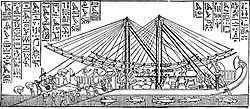
- Major Achievements: Construction of the Giza pyramids, advanced medical papyri, and sophisticated maritime technology.
- Religion: A complex polytheistic system focused on the afterlife and the divine nature of the king.
Chronological History of Ancient Egypt
The Predynastic and Early Dynastic Periods
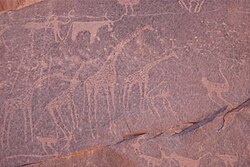
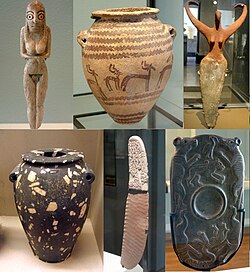
Before the rise of the pharaohs, prehistoric Egypt saw the development of early settlements and artistic expressions. The Early Dynastic Period (c. 3150–2686 BC) began with the unification of Upper and Lower Egypt, establishing the first centralized state.
![The Narmer Palette depicts the unification of the Two Lands.[24]](/images/76/37/7637efc6d587a11da00b5fbf2304b8d2998b09481e3c234e7178da043b29b952.jpg)
The Old, Middle, and New Kingdoms
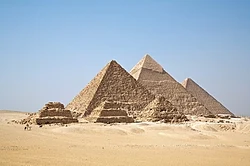
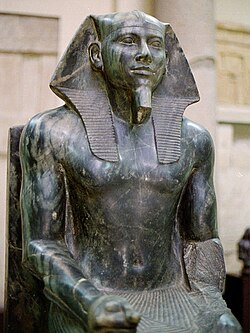
The Old Kingdom (2686–2181 BC) is often remembered as the "Age of the Pyramids," where the state's power was manifested in massive funerary complexes. Following the First Intermediate Period, the Middle Kingdom (2134–1690 BC) saw a resurgence of stability and cultural growth.
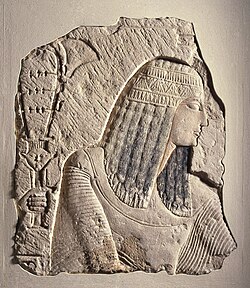
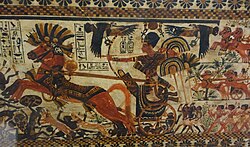
After the Second Intermediate Period and the influence of the Hyksos, the New Kingdom (1549–1069 BC) emerged as the peak of Egyptian imperial power, characterized by vast wealth and military expansion.
The Late Period and Foreign Rule
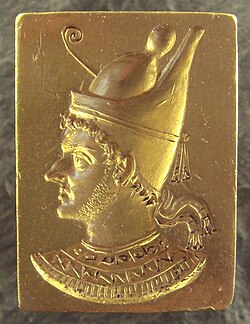
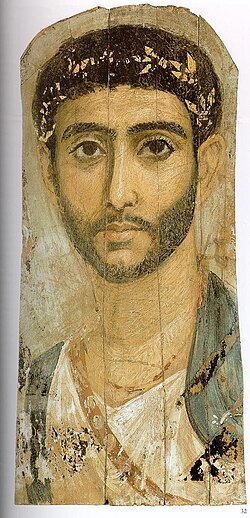
The Late Period (664–332 BC) saw Egypt navigate various foreign influences before the arrival of Alexander the Great. This led to the Ptolemaic Kingdom (332–30 BC), a Greco-Egyptian era that ended when the Roman Empire annexed Egypt in 30 BC.
Government, Economy, and Daily Life
Administration and Trade
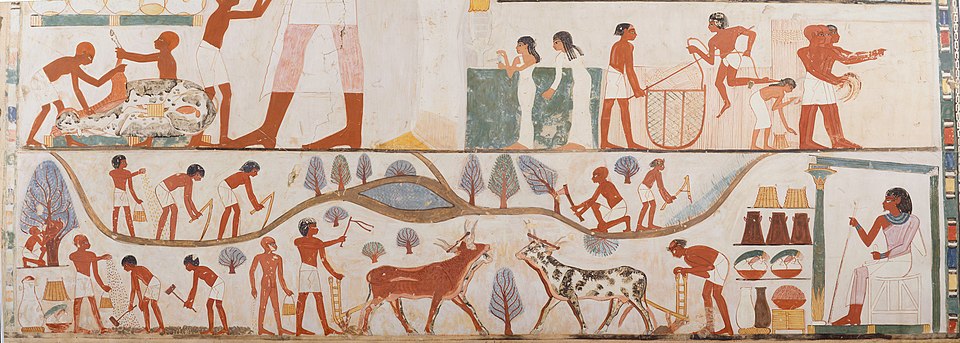
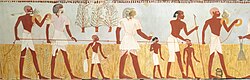
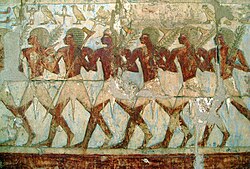
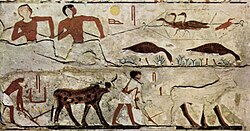
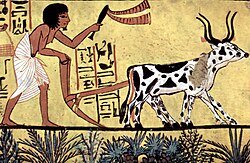
The Egyptian government was a highly organized bureaucracy. The economy relied heavily on agriculture, with the Nile's annual flooding providing the necessary silt for crops. Trade networks extended to the Land of Punt and other Near Eastern regions, importing luxury goods and raw materials.
![Egyptian gold stater of Nectanebo II: reverse with hieroglyphs nfr-nb minted in Egypt (around 360 BC).[106]](/images/5d/7f/5d7f481d9defc29d476afbbd3caa7a7b5ee751f90ac3b28e32633db551480167.jpg)
Social Structure and Occupations
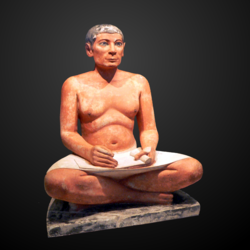
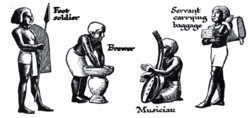
Society was hierarchical, ranging from the pharaoh and nobility to scribes, artisans, and farmers. Scribes held a privileged position due to their literacy in the complex Egyptian language.
Culture and Leisure
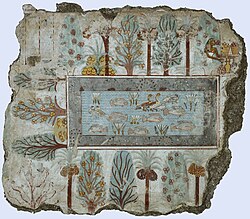
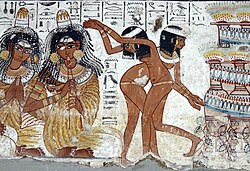
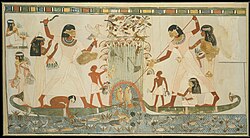
Daily life included a variety of leisure activities. Egyptians celebrated festivals with music and dance, and the nobility enjoyed hunting in the marshes and maintaining elaborate gardens.
Science, Technology, and Art
Writing and Literature
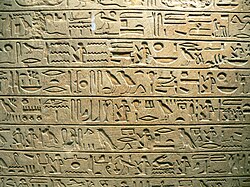
The Egyptians developed hieroglyphs, a formal writing system used for monumental inscriptions, and hieratic, a cursive script used for daily administration. The discovery of the Rosetta Stone was pivotal in allowing modern linguists to decode these scripts.
![The Rosetta Stone (c. 196 BC) enabled linguists to begin deciphering ancient Egyptian scripts.[128]](/images/ca/23/ca233ef4f87a0399eb672ecc0fa47c3765c9fa7e8f1fb1bd0d9234dd6e5924b6.jpg)
Medicine and Mathematics
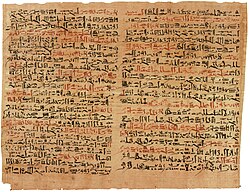
Ancient Egyptians were pioneers in medicine; the Edwin Smith papyrus provides evidence of their knowledge of anatomy and surgical treatments. In mathematics, they developed practical geometry to redraw land boundaries after Nile floods and to construct their massive monuments.
Art and Architecture
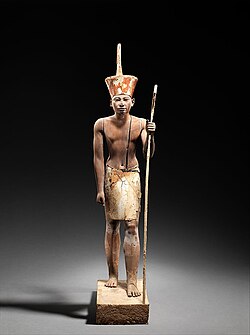
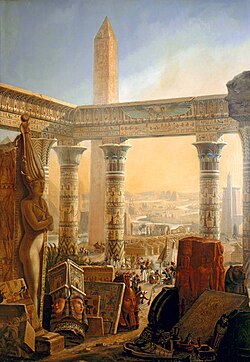
Egyptian art was characterized by strict conventions and a focus on the eternal. Architecture ranged from the colossal pyramids to intricate rock-cut tombs and temples.
Religious Beliefs and the Afterlife
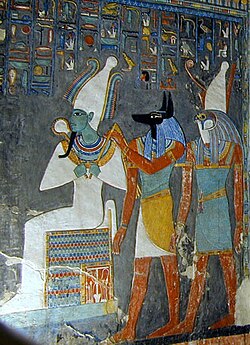
Religion permeated every aspect of life. The Egyptians worshipped a pantheon of gods, such as Osiris, Anubis, and Horus, who governed different aspects of existence and the transition to the afterlife.
Burial Customs and Mummification
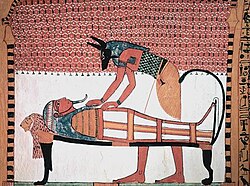
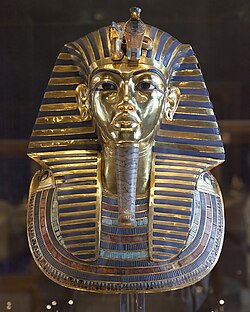
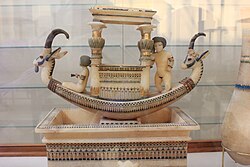
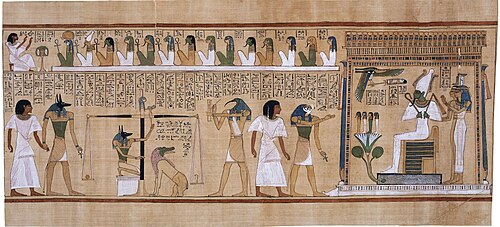
To ensure the soul's survival, the body was preserved through mummification. Tombs were equipped with funerary goods, including the Book of the Dead, which served as a guide for the deceased's journey.
Summary of Egyptian Historical Eras
| Era | Approximate Dates | Key Characteristics |
|---|---|---|
| Early Dynastic Period | 3150–2686 BC | Unification of Upper and Lower Egypt |
| Old Kingdom | 2686–2181 BC | Construction of the Great Pyramids |
| Middle Kingdom | 2134–1690 BC | Cultural resurgence and stability |
| New Kingdom | 1549–1069 BC | Imperial expansion and peak wealth |
| Late Period | 664–332 BC | Transition and foreign interactions |
| Ptolemaic Kingdom | 332–30 BC | Greco-Egyptian rule |
Frequently Asked Questions
![Facsimile of the Astronomical chart in Senemut's tomb, 18th dynasty[196]](/images/5e/c4/5ec4b688d7ea65d8c981acf5f61e5f919a97bea5790cb747ebe5b9e47a98647d.jpg)
![Ancestry model of Egyptian genome NUE001 from Nuwayrat (2855–2570 BC).[219]](/images/a2/3f/a23f433b0ca027457cf1c34dc57dfa87003e1af2499dfea93bdd0088dd4769fb.png)
![E1b1b is the most common paternal haplogroup across Africa, including Egypt, with modern genetic studies rooting the origin of the E haplogroup in East Africa.[223]](/images/79/3a/793a536b214f9e1a937f9d36c460cd908b383496c1b49a84c1bb94e49f419062.png)
What was the purpose of the pyramids?
The pyramids served as monumental tombs for the pharaohs, designed to protect the king's body and belongings while facilitating his ascent to the afterlife.
How was the Egyptian language deciphered?
The Rosetta Stone, which contained the same text in three different scripts (Hieroglyphic, Demotic, and Greek), enabled linguists to begin deciphering ancient Egyptian scripts.
Who were the Hyksos?
The Hyksos were a people of West Asiatic origin who ruled parts of Egypt during the Second Intermediate Period before being expelled by the New Kingdom pharaohs.
What was the role of the Book of the Dead?
The Book of the Dead was a collection of funerary texts and spells intended to guide the deceased through the dangers of the underworld to reach the afterlife.
What was the significance of mummification?
Mummification was essential because Egyptians believed the soul required a preserved physical body to return to in order to achieve eternal life.