Anaspida: The Shieldless Jawless Fish of the Paleozoic
In the ancient oceans of the Paleozoic era, a unique group of vertebrates navigated the waters without the heavy armor typical of their contemporaries. Known as Anaspida (meaning "shieldless ones"), these extinct jawless fish lived from the early Silurian period to the late Devonian period, roughly between 444 and 358.9 million years ago.
Unlike many other early vertebrates, anaspids were small marine fish that lacked a heavy bony shield and paired fins. However, they possessed a distinct hypocercal tail—a tail where the lower lobe is longer or larger than the upper lobe—which helped define their movement and ecological niche.
Key Facts
- Temporal Range: 444 to 358.9 million years ago (Early Silurian to Late Devonian).
- Defining Feature: Absence of a heavy bony shield, replaced by small, weakly mineralized scales.
- Key Anatomy: A characteristic tri-radiate spine located behind the gill openings.
- Classification: Part of the Agnatha (jawless fish) and considered potential stem-cyclostomes.
- Habitat: Marine environments.
Anatomy and Physical Characteristics
The most striking difference between anaspids and other ostracoderms (primitive armored jawless fish), such as the Heterostraci and Osteostraci, is the lack of a massive bony head shield. Instead, the anaspid body was covered in an array of small, weakly mineralized scales.
In the birkeniids, these scales were composed of aspidine, an acellular bony tissue, arranged in tile-like rows. Along the back, a series of larger, massive scutes provided structural support. Their sensory and respiratory systems were equally distinct: they had prominent eyes positioned laterally without a scleral ring, and their gills opened through a series of 6 to 15 pairs of holes along the sides of the body.
The primary synapomorphy—a shared derived characteristic—that identifies anaspids is a large, tri-radiate spine located immediately posterior to the branchial (gill) openings.
![Anaspids are characterized by a large, tri-radiate spine (red) posteriorly to the series of branchial openings. It is assumed that the most primitive anaspids, such as Pharyngolepis (top), possessed a long, ribbon-shaped, ventrolateral fin-fold (green). More advanced forms, such as Rhyncholepis (bottom), possessed a shorter paired fin-fold (green) and enlarged, spine-shaped, median dorsal scutes. – Philippe Janvier[1]](/images/ea/7c/ea7ce2dbf1fc2abba0bd171b0296757eb9a677c639013c7a7fdf7b587c52e041.png)
Taxonomy and Evolutionary Relationships
The classification of Anaspida has evolved as new fossils have been discovered. Currently, the class is divided into two primary orders: the basal, monogeneric Lasaniida (containing only the genus Lasanius) and the more diverse Birkeniida.
Birkeniida is further subdivided into several families, including the Birkeniidae, Pterygolepididae, Rhyncholepididae, and Pharyngolepididae. Some taxa, such as the Septentrioniidae, are known exclusively from scale fossils rather than complete skeletons. Recent additions to the record include the genera Kerreralepis and Cowielepis.
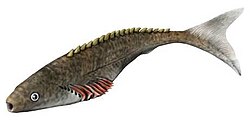
Historically, anaspids were viewed as the direct ancestors of modern lampreys. While recent phylogenetic analyses have challenged this direct lineage, many researchers now suggest they are stem-cyclostomes, meaning they are more closely related to hagfish and lampreys than to any jawed fish.
Summary of Anaspid Classification
| Category | Details |
|---|---|
| Temporal Range | 444–358.9 Ma (Silurian to Devonian) |
| Phylum/Infraphylum | Chordata / Agnatha |
| Primary Orders | Lasaniida, Birkeniida (including Endeiolepidiformes) |
| Type Species | Birkenia elegans |
| Key Tissue | Aspidine (acellular bony tissue) |
Frequently Asked Questions
Why are they called "Anaspida"?
The name Anaspida translates to "shieldless ones," referring to their lack of the heavy bony armor plates that characterized most other ostracoderms of their time.
Are anaspids related to modern lampreys?
While they were once considered direct ancestors, modern analysis suggests they are stem-cyclostomes, meaning they share a common evolutionary branch with lampreys and hagfish rather than being a direct linear ancestor.
What is a tri-radiate spine?
A tri-radiate spine is a three-pronged bony structure located behind the gill openings. It serves as the primary diagnostic feature used by paleontologists to identify anaspid fossils.
What was the composition of their scales?
Their scales were made of aspidine, which is a specific type of acellular bony tissue, often arranged in tile-like patterns across the body.
How did their tails differ from other fish?
Anaspids possessed a hypocercal tail, where the lower lobe is more developed than the upper lobe, which is a distinct morphological trait compared to many other early fish groups.