Amniotes: The Evolutionary Leap to Terrestrial Life
The transition from water to land was one of the most significant milestones in vertebrate history. While early tetrapods began the journey, the emergence of amniotes—a clade of tetrapods characterized by a specialized egg—allowed vertebrates to break their ancestral ties to the water. This biological innovation enabled them to colonize the interiors of continents, leading to the vast diversity of reptiles, birds, and mammals we see today.
Key Facts
- Defining Feature: The development of the amnion, a membrane that protects the embryo and prevents desiccation.
- Timeline: Recent evidence suggests origins as early as the Devonian period, with footprints dating to 358.9–354 million years ago.
- Primary Divergence: Amniotes split early into two main lineages: Sauropsida (reptiles and birds) and Synapsida (mammals and their extinct ancestors).
- Earliest Body Fossils: Hylonomus (sauropsid) and Asaphestera (synapsid) from the Late Carboniferous (approx. 318 Ma).
The Origins of Amniotes
For decades, scientists believed amniotes first appeared during the mid-to-late Carboniferous period. However, groundbreaking discoveries in 2025 have shifted this timeline. Clawed footprints found in the Snowy Plains Formation of Australia, dating between 358.9 and 354 million years ago, indicate that crown-group amniotes existed much earlier than previously thought, likely originating during the Devonian period.
These animals evolved from amphibian reptiliomorphs (primitive tetrapods that resembled lizards). This transition occurred during a period known as Romer's gap, a window in the fossil record where adult tetrapods became fully terrestrial, while their fish-like relatives went extinct during the late Devonian mass extinction approximately 360 million years ago.
Adaptations for Terrestrial Living
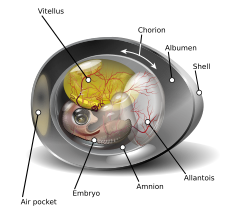
The primary challenge for early land-dwellers was reproduction. Unlike amphibians, which generally require moist environments to lay their gelatinous eggs, amniotes evolved a complex egg structure. This allowed them to lay eggs in diverse environments, such as depressions under fallen logs in Carboniferous forests, without the risk of the embryo drying out.
The amnion is a specialized membrane that encloses the embryo in a fluid-filled cavity, effectively providing a private "pond" for development. While some modern amniotes still require moisture to prevent desiccation, the evolution of the soft shell and internal membranes marked a definitive break from amphibian biology.
Classification and Divergence
Shortly after their emergence, amniotes diverged into two distinct evolutionary paths. The Synapsids include modern mammals and their extinct ancestors, such as the pelycosaurs and therapsids. The Sauropsids encompass all reptiles, including dinosaurs, crocodilians, turtles, and birds.
Traditional vs. Monophyletic Classification
Historically, amniotes were divided into three classes: Reptilia, Aves, and Mammalia. Modern science, however, prefers monophyletic taxa—groups that include an ancestor and all its descendants. Under this framework, birds are recognized as a specialized lineage within the sauropsid clade, specifically descending from the archosaurs.
| Clade | Key Groups | Modern Examples |
|---|---|---|
| Synapsida | Pelycosaurs, Therapsids, Mammals | Humans, Dogs, Platypuses |
| Sauropsida | Parareptiles, Diapsids, Archosaurs | Lizards, Crocodiles, Eagles |
Frequently Asked Questions
What is the main difference between an amphibian and an amniote?
The primary difference is the amniotic egg. Amniotes possess an amnion and other membranes that protect the embryo and allow for reproduction on dry land, whereas amphibians typically must lay their eggs in water or very moist environments.
When did amniotes first appear?
While body fossils date back to about 318 million years ago, footprint evidence from the Snowy Plains Formation suggests they likely originated during the Devonian, with a minimum divergence date of 358.9–354 million years ago.
Are birds considered reptiles?
In modern phylogenetic classification, birds are part of the Sauropsida clade and are the direct descendants of theropod dinosaurs, making them biologically a specialized group of reptiles.
What are synapsids?
Synapsids are the lineage of amniotes that includes mammals and their extinct ancestors. They are distinguished from sauropsids by the structure of the skull and their evolutionary path toward mammalian physiology.
What was Romer's gap?
Romer's gap is a period in the fossil record following the late Devonian mass extinction where there is a notable scarcity of tetrapod fossils. It is during this interval that the transition to fully terrestrial adult tetrapods is believed to have occurred.