Amharic: The Official Language of Ethiopia
Amharic (አማርኛ, Amarəñña) is a vibrant and historically rich language native to Ethiopia. As the most widely spoken mother tongue in the country, it serves as the primary official working language of the Ethiopian federal government and several federal regions. Beyond its national importance, Amharic holds a significant global position as the second most spoken Semitic language in the world, following Arabic.
The language is primarily associated with the Amhara ethnicity, though its role as a lingua franca—a common language used between people who do not share a native tongue—has extended its reach across diverse ethnic groups within Ethiopia.
Key Facts
- Total Speakers: Approximately 60 million (as of 2019–2020).
- Native Speakers: Over 33.7 million (2020).
- Language Family: Afro-Asiatic, specifically the South Semitic branch of the Ethiopic group.
- Writing System: Geʽez script, an alphasyllabary (abugida).
- Official Status: Official working language of the Ethiopian federal government.
Linguistic Classification and Dialects
Amharic belongs to the Afro-Asiatic language family. Its lineage traces through the Semitic, West Semitic, and South Semitic branches, eventually landing in the Ethiopic group. Within this group, it is closely linked to Argobba.
While Amharic is standardized for official use, several regional dialects exist, reflecting the geographical diversity of Ethiopia. These include the dialects of:
- Gondar
- Gojjam
- Wollo
- Shewa
- Addis Ababa
The Geʽez Writing System
Amharic utilizes the Geʽez script, also known as the Amharic abugida. An abugida is a type of writing system where each character represents a consonant-vowel sequence. Vowels are indicated by modifying the base consonant shape.
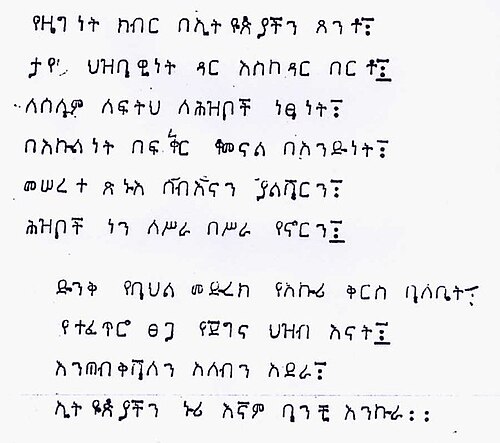
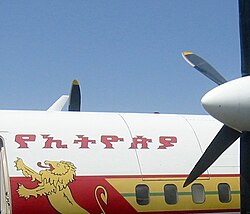
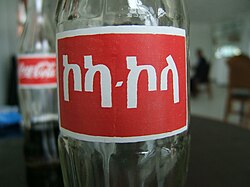
The script is not only used for traditional and official documents but is also integrated into modern commercial life and technology. From Coca-Cola labels to aircraft livery, the script is a visible symbol of Ethiopian identity.
Phonology and Vowels
The sound system of Amharic is complex, featuring a variety of plosives, fricatives, and ejective sounds (consonants produced with a sudden release of air). The vowel system is carefully structured to distinguish meaning through subtle shifts in sound.
![The vowels of Amharic on a vowel chart.[56] Vowels in parentheses are allophones of /ɨ/ and /ə/.](/images/5b/a2/5ba28e1d2031953b38178999903d6bf4c614df54c17c76424d60f243aee27dc1.webp)
Grammar and Structure
Amharic grammar is characterized by a subject-predicate structure. A unique feature of the language is its use of gemination (the doubling of consonant sounds) and a sophisticated system of pronouns and suffixes.
Nouns and Possession
Nouns in Amharic can be marked for definiteness using suffixes. For example, bet means "house," while bet-u means "the house." The language also employs an accusative suffix to mark the direct object of a sentence.
Verb Conjugation
Verbs are the core of Amharic sentences and are conjugated based on the subject. The language distinguishes between different types of verb stems (Triradicals, Biradicals, and Quadriradicals) and uses various forms such as the Perfect, Simple Imperfect, and Compound Imperfect to denote time and aspect.
Language Summary Table
| Feature | Details |
|---|---|
| ISO 639-1 Code | am |
| Primary Region | Ethiopia |
| Script Type | Abugida (Geʽez) |
| L1 Speakers | ~35 Million |
| L2 Speakers | ~25 Million |
| Family | Semitic $\rightarrow$ Ethiopic |
Digital Integration
In the modern era, Amharic has transitioned successfully into the digital space. It is supported by major Linux distributions like Ubuntu and Fedora. The script is included in the Unicode standard (Ethiopic block U+1200 – U+137F). Microsoft has also provided support for the language, releasing Windows Vista in Amharic in 2010 and providing the Nyala font for Windows users.
Frequently Asked Questions
Is Amharic the only official language of Ethiopia?
While Amharic is the primary official working language of the federal government, Ethiopia has recently added four more federal working languages to foster national unity.
What is an abugida?
An abugida is a writing system where each character represents a consonant with an inherent vowel. Other vowels are indicated by adding small marks or modifying the character's shape.
How many people speak Amharic?
As of 2019–2020, the total number of speakers is estimated at over 58.8 million, including both native (L1) and second-language (L2) speakers.
Is Amharic related to Arabic?
Yes, both Amharic and Arabic are Semitic languages, though they belong to different branches. Amharic is part of the South Semitic/Ethiopic branch.
Can I use Amharic on a computer?
Yes, Amharic is supported by most modern operating systems, including Windows and Linux, and is standardized via Unicode.