American Flamingo
The American flamingo (Phoenicopterus ruber) is a striking large wading bird renowned for its vibrant reddish-pink plumage. First formally described by Carl Linnaeus in 1758, this species is a marvel of biological adaptation, thriving in equatorial regions and specialized saline environments. From the Caribbean islands to the Galápagos, these birds have developed unique physiological mechanisms to survive in challenging climates.
Key Facts
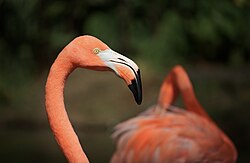
- Scientific Name: Phoenicopterus ruber
- Conservation Status: Least Concern (IUCN 3.1)
- Average Height: 120 to 145 cm (47 to 57 in)
- Life Expectancy: Up to 40 years, among the longest for birds
- Distinctive Feature: Reddish-pink plumage with black flight feathers
- Nesting: Lays a single chalky-white egg on a mud mound
Taxonomy and Classification
The American flamingo belongs to the family Phoenicopteridae. The genus name Phoenicopterus is derived from the Latin word for flamingo, while the specific epithet ruber means "red." While the greater flamingo (Phoenicopterus roseus) of the Old World was once considered a subspecies, molecular phylogenetic studies have since confirmed they are distinct taxa and each other's closest relatives.
Currently, two recognized subspecies exist:
- P. r. ruber: Found from the Caribbean to northeast Brazil.
- P. r. glyphorhynchus: Endemic to the Galápagos Islands.

Distribution and the Florida Population
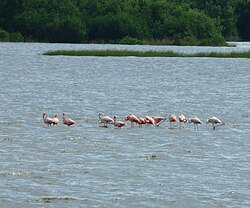
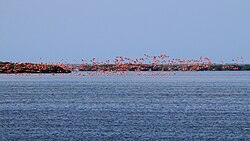
The American flamingo is widely distributed across the Americas and the Caribbean. However, its history in Florida is a complex tale of collapse and recovery. During the 19th century, naturalists like John James Audubon recorded massive flocks of up to 1,000 individuals in South Florida and the Florida Keys. By 1900, these populations collapsed, likely due to heavy hunting by Native Americans and early settlers.
For decades, sightings in Florida were rare or attributed to escapees from captive populations, such as those at Hialeah Park. This led the Florida Fish and Wildlife Conservation Commission to list the species as nonnative until 2018. However, recent evidence—including a 2012 record of a bird banded in the Yucatán Peninsula—suggests a return of wild populations. In 2014, a significant flock of over 147 birds was spotted at Lake Okeechobee, marking a notable resurgence.
Physical Characteristics
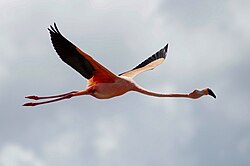
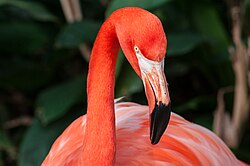
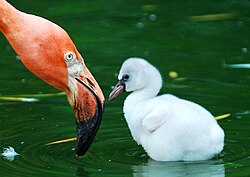
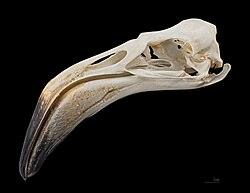
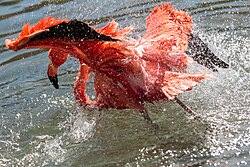
Adult American flamingos are the largest flamingo species in the Americas. Males are generally larger, averaging 2.8 kg (6.2 lb), while females average 2.2 kg (4.9 lb). Their plumage is predominantly pink, though the wing coverts are red and the primary and secondary flight feathers are black. They possess a pink and white bill with a prominent black tip and entirely pink legs.
Their reproductive cycle begins between 3 and 6 years of age, though most do not breed until age 6. Both parents share the responsibility of brooding the young, which hatch after an incubation period of 28 to 32 days.
Biological Adaptations
Thermoregulation
As homeothermic endotherms (animals that maintain a constant internal body temperature), American flamingos have evolved several ways to manage heat in equatorial climates. They typically operate within a temperature niche of 17.8–35.2 °C (64.0–95.4 °F).
- Hyperthermia: To prevent water loss during extreme heat, they may allow their body temperature to rise to 40–42 °C (104–108 °F), allowing heat to dissipate into the cooler ambient air.
- Evaporative Cooling: They use cutaneous (skin) evaporation and respiratory evaporation (panting) to cool down.
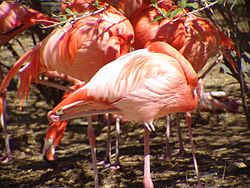
- Heat Conservation: During cold periods, they tuck their heads beneath their wings or shiver to generate muscular heat.
Osmoregulation and Blood
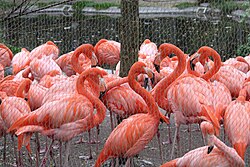
Living in saline environments requires specialized osmoregulation—the process of maintaining salt and water balance. This involves specialized cells and transport mechanisms to handle high salt intake. Interestingly, research at the Copenhagen Zoo indicated that captive flamingos may have more red blood cells than their wild counterparts.
Summary of Species Profile
| Feature | Detail |
|---|---|
| Height | 120–145 cm |
| Weight | Male: 2.8 kg | Female: 2.2 kg |
| Plumage | Pink/Red with Black flight feathers |
| Incubation | 28–32 days |
| Conservation | Least Concern |
| Key Habitats | Caribbean, Galápagos, South America |
Frequently Asked Questions
Why do American flamingos stand on one leg?
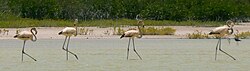
Standing on one leg is a thermoregulatory behavior used to retain body heat by reducing the amount of surface area exposed to the environment.
Are the flamingos in Florida native or invasive?
While previously listed as nonnative due to captive escapees, evidence of banded wild birds and historical nesting sites suggests they are native to the region and are returning to the wild.
How long do American flamingos live?
They have a remarkably long life expectancy for birds, often living up to 40 years.
What is the difference between the American and Greater flamingo?
The American flamingo is generally smaller than the Greater flamingo and possesses a deeper, more vibrant reddish-pink plumage compared to the paler pink of the Greater flamingo.
How do they handle extreme heat?
They employ hyperthermia to let body heat escape to the environment and use panting (respiratory evaporative heat loss) to cool down efficiently.