American Acclimatization Society: The Legacy of Biological Pollution
In 1871, a group of enthusiasts in New York City set out with a mission that seemed both noble and aesthetic: to introduce foreign plants and animals into North America. Known as the American Acclimatization Society, this organization aimed to bring "useful or interesting" varieties from the European animal and vegetable kingdoms to the New World. While their intentions were rooted in cultural nostalgia and economic utility, their legacy has become a profound lesson in the unintended consequences of human interference with local ecosystems.
The Roots of Acclimatization
The movement was not an isolated phenomenon. It was inspired by the 1854 founding of the Société zoologique d'acclimatation in Paris by naturalist Isidore Geoffroy Saint-Hilaire. In his writings, Saint-Hilaire advocated for the introduction and selective breeding of foreign animals to provide new food sources and manage pests. This concept of acclimatization—the process of adapting a species to a new environment—spread globally, particularly to European colonies.
For many 19th-century settlers, the motivation was deeply personal. Wildlife scientist John Marzluff notes that these enthusiasts often sought to recreate the landscapes of their homelands, introducing birds that reminded them of Europe to their new American environs.
Early Efforts in New York City
Before the formal establishment of the Society, wealthy New Yorkers were already experimenting with foreign species. In 1864, Central Park commissioners introduced Java sparrows, house sparrows, chaffinches, and blackbirds. While most of these species did not thrive, the European sparrows multiplied with astonishing speed, becoming a permanent fixture of the New York landscape.
Once the American Acclimatization Society was formed, these efforts intensified. At an 1877 meeting held at the Great New York Aquarium, members discussed various releases, including English skylarks, which had largely migrated from Central Park to Brooklyn. The group also noted the introduction of Japanese finches, pheasants, and European starlings. Their ultimate goal was to populate the region with birds that were both beautiful to observe and beneficial to farmers.
Key Figures and Controversies
The Society was led by notable figures, including chairman Eugene Schieffelin, a New York pharmacist, and Alfred Edwards, a wealthy silk merchant who built bird boxes across Manhattan to support the breeding of house sparrows.
Schieffelin remains a controversial figure in natural history. Some accounts suggest he aimed to introduce every bird species mentioned in the works of William Shakespeare, though historians have found no contemporary evidence to support this literary connection. While the poet William Cullen Bryant expressed admiration for Schieffelin's work in his poem The Olde-World Sparrow, modern biologists often view Schieffelin's ecological impact through a much more critical lens.
The Starling Explosion and Ecological Impact
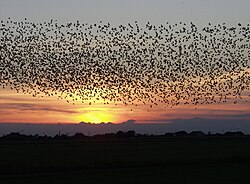
The most significant and lasting impact of the Society's work was the introduction of the European starling. Following additional releases by the Society in 1890 and 1891, the population exploded. By the early 21st century, more than 200 million starlings had spread across the United States, Canada, and Mexico.
This massive population shift has had severe consequences:
- Competition for resources: Starlings aggressively compete for nesting cavities, which has been linked to the decline of certain native species, such as sapsuckers.
- Agricultural damage: The species causes significant harm to farming operations.
- Invasive status: Due to these factors, the European starling is included on the IUCN List of the world's 100 worst invasive species.
The scale of this ecological shift led the San Francisco Chronicle to describe the Society's work as "the canonic cautionary tale of biological pollution moving forward."
Key Facts
- Founded: 1871 in New York City.
- Primary Goal: To introduce useful or interesting foreign flora and fauna to North America.
- Most Impactful Species: The European starling.
- Starling Population: Over 200 million in North America by the early 21st century.
- Scientific Status: The European starling is recognized by the IUCN as one of the world's 100 worst invasive species.
Summary of Introduced Species and Outcomes
| Species | Primary Outcome | Ecological Status |
|---|---|---|
| House Sparrow | Multiplied rapidly in urban areas | Common/Established |
| English Skylark | Migrated from Central Park to Brooklyn | Established |
| European Starling | Massive population spread across North America | Highly Invasive |
| Java Sparrow | Limited success in Central Park | Introduced |
Frequently Asked Questions
What was the main goal of the American Acclimatization Society?
The Society aimed to introduce foreign plant and animal varieties into North America that were considered either economically useful to farmers or culturally interesting and beautiful.
Why were birds introduced to North America in the 19th century?
Motivations were largely cultural; many European settlers wanted to surround themselves with the birds and nature of their homelands. There was also a scientific belief in the utility of certain species for agriculture or pest control.
How did the European starling affect native wildlife?
Starlings are highly aggressive competitors for nesting cavities. While research suggests they may not be the primary cause for the decline of all native birds (like the eastern bluebird), they have significantly impacted species like sapsuckers.
Is the European starling considered an invasive species?
Yes. Due to its ability to damage agriculture and compete with native species, the European starling is listed by the IUCN as one of the 100 worst invasive species in the world.
Did Eugene Schieffelin really try to introduce Shakespearean birds?
While some accounts claim he wanted to introduce every bird mentioned in Shakespeare's plays, multiple historians have disputed this, noting a lack of contemporary evidence to prove such a connection.