Aluminium: Properties, Production, and Global Applications
Aluminium (known as aluminum in the United States and Canada) is a silvery-gray metallic element that has become indispensable to modern industry. As the most abundant metal in the Earth's crust, it is prized for its low density, high conductivity, and resistance to corrosion. From the cans in our kitchens to the frames of high-performance aircraft, this versatile element balances strength and lightness in a way few other materials can.
In the periodic table, aluminium is located in group 13 (the boron group) and period 3, with the atomic number 13. Its chemical symbol is Al, and it possesses a standard atomic weight of approximately 26.982.

Key Facts
- Atomic Number: 13
- Appearance: Silvery-gray metallic solid
- Primary Ore: Bauxite
- Key Properties: Low density (2.699 g/cm³), high thermal conductivity, and paramagnetic magnetic ordering.
- Global Production: Led by China, with a total global output of approximately 72 million tons in recent reporting periods.
- Common Oxidation State: +3
Physical and Chemical Properties
Aluminium is a p-block element with an electron configuration of [Ne] 3s² 3p¹. At standard temperature and pressure, it is a solid with a face-centered cubic (fcc) crystal structure. It has a melting point of 660.32 °C and a boiling point of 2470 °C.
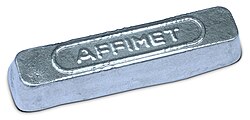
One of the most significant characteristics of aluminium is its electronegativity (1.61 on the Pauling scale) and its ability to form a protective oxide layer, which prevents further corrosion. Its physical robustness is defined by a Young's modulus of 70 GPa and a Mohs hardness of 2.75.
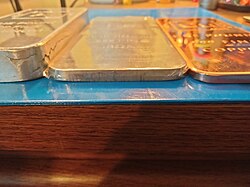
On a microscopic level, the arrangement of aluminium atoms provides the foundation for its metallic properties. High-resolution imaging allows scientists to view these atoms along specific zone axes to understand the material's structural integrity.
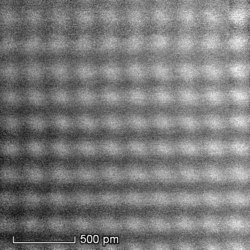
Chemical Behavior
Aluminium primarily exhibits a +3 oxidation state. It is known for its hydrolysis—the process where it reacts with water—which varies significantly depending on the pH level of the environment.
![Aluminium hydrolysis as a function of pH. Coordinated water molecules are omitted.[51]](/images/38/10/38108c5e763d4973f429db6008e8e6ae5907ba4d3f0958575c57c434af0273cb.png)
Beyond simple metallic forms, aluminium creates complex organoaluminium compounds. An example is trimethylaluminium, a compound featuring a five-coordinate carbon atom, which is used in various chemical syntheses.
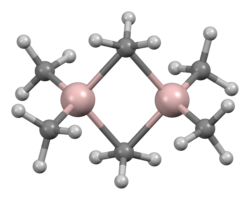
Natural Occurrence and History
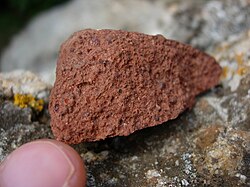
Aluminium is primordial and does not occur as a free metal in nature due to its high reactivity. Instead, it is found in various ores, the most prominent being bauxite. Bauxite is characterized by a red-brown color, a result of the iron oxide minerals present within the ore.
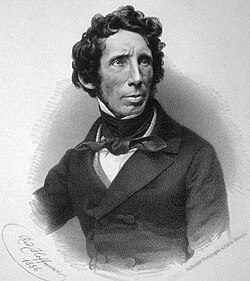
The history of aluminium is a journey from a precious rarity to a common commodity. While Antoine Lavoisier predicted its existence in 1782, it was Hans Christian Ørsted who discovered it in 1824. The chemist Friedrich Wöhler later provided the first thorough description of the metallic element.
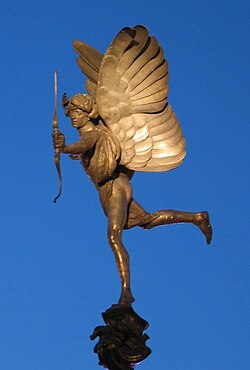
In the late 19th century, aluminium was so expensive that it was used for luxury items and prestigious monuments. For instance, the statue of Anteros in London's Piccadilly Circus, cast in 1893, was one of the first major works made from the metal.
Production and Refinement
The transition of aluminium from ore to metal involves two primary industrial stages: the Bayer process and the Hall–Héroult process.
- Bayer Process: This stage extracts pure aluminium oxide (alumina) from bauxite ore using sodium hydroxide.
- Hall–Héroult Process: This electrolytic process reduces the alumina into pure metallic aluminium.
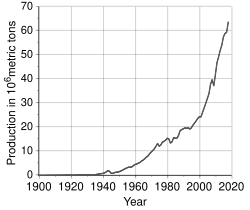
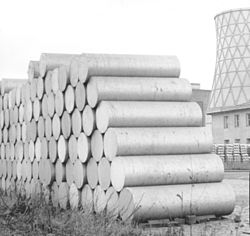
Production has scaled massively since the early 20th century, evolving from a niche material to the second most produced metal globally, surpassed only by iron.
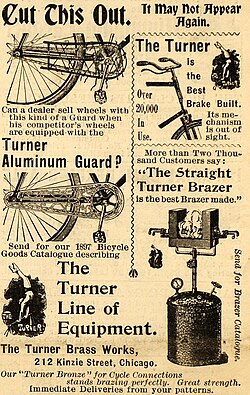
Historically, the spelling of the element has varied. While "aluminium" is the international standard, "aluminum" became the dominant spelling in North America, as seen in early 20th-century advertisements.
Global Production Statistics
Modern production is heavily concentrated in a few key nations. China is the dominant producer, followed by India, Russia, and Canada.
| Country | Output (Thousand Tons) |
|---|---|
| China | 43,000 |
| India | 4,200 |
| Russia | 3,800 |
| Canada | 3,300 |
| United Arab Emirates | 2,700 |
| Bahrain | 1,600 |
| Australia | 1,500 |
| Norway | 1,300 |
| Brazil | 1,100 |
| Malaysia | 870 |
| Iceland | 780 |
| United States | 670 |
| Other countries | 6,800 |
| Total | 72,000 |
Applications and Sustainability
Aluminium's unique properties make it ideal for a vast array of applications. In the automotive and aerospace industries, it is used for bodies and components to reduce weight and increase fuel efficiency.

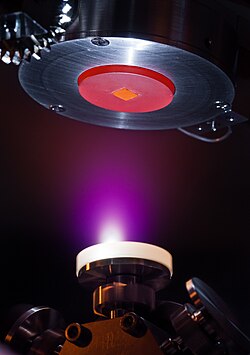
In consumer goods, aluminium is most visible in the form of beverage cans and foil. Additionally, alumina (aluminium oxide) is used in specialized laser deposition for substrates.

Recycling and Environment
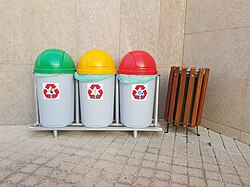
Recycling aluminium is significantly more energy-efficient than producing it from raw bauxite. Because it can be recycled indefinitely without losing its properties, it is a cornerstone of sustainable waste management.
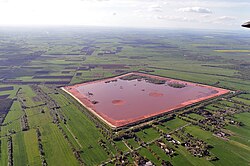
However, the primary production process creates environmental challenges. The industry generates approximately 70 million tons of bauxite tailings (waste) annually, which must be managed in specialized storage facilities.
Biological Impact and Toxicity
Aluminium interacts with the human body through various exposure routes, including skin absorption. Once inside, it can exist in several forms, such as free solvated trivalent cations or various soluble complexes.
![Schematic of aluminium absorption by human skin.[188]](/images/13/de/13de4a0213636020b3ca5a568a0698b73b2b91e52fbe1fe6d677ab3f21af7a96.jpg)
These forms are transported across cell membranes via five major routes: paracellular, transcellular, active transport, channels, and receptor-mediated endocytosis.
![There are five major aluminium forms absorbed by human body: the free solvated trivalent cation (Al3+(aq)); low-molecular-weight, neutral, soluble complexes (LMW-Al0(aq)); high-molecular-weight, neutral, soluble complexes (HMW-Al0(aq)); low-molecular-weight, charged, soluble complexes (LMW-Al(L)n+/−(aq)); nano and micro-particulates (Al(L)n(s)). They are transported across cell membranes or cell epi-/endothelia through five major routes: (1) paracellular; (2) transcellular; (3) active transport; (4) channels; (5) adsorptive or receptor-mediated endocytosis.[188]](/images/08/45/084589b15c0cd82c32fe6a20cf0f433b8b2fba13d4be290ac63c7409f0cf8bac.jpg)
Frequently Asked Questions
What is the difference between aluminium and aluminum?
There is no chemical difference; they are two different spellings of the same element. "Aluminium" is used globally, while "aluminum" is the standard spelling in the United States and Canada.
How is aluminium extracted from the earth?
It is extracted from bauxite ore through a two-step process: the Bayer process, which refines bauxite into alumina, and the Hall–Héroult process, which uses electricity to smelt alumina into pure aluminium metal.
Why is aluminium so widely used in transportation?
Aluminium is highly valued in the automotive and aerospace sectors because it provides a high strength-to-weight ratio, which reduces the overall mass of the vehicle and improves fuel efficiency.
Is aluminium recyclable?
Yes, aluminium is highly recyclable. It can be melted down and reused repeatedly without losing its structural properties, which requires far less energy than producing new aluminium from ore.
What are bauxite tailings?
Bauxite tailings are the waste materials left over after the Bayer process has extracted alumina from bauxite ore. The industry produces about 70 million tons of this waste every year.